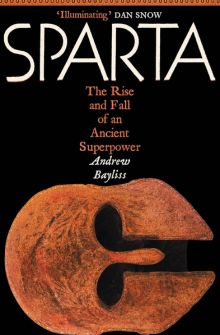
In this compelling narrative study of the rise and fall of Sparta, Birmingham University professor, Andrew Bayliss, seeks to strip away the myth of the Spartans, peer behind the lens of unreliable ancient historians, and get to the heart of what this extraordinary ancient ‘superpower’ was all about.
Part of the challenge is that the enduring appeal of the Spartans offers modern societies a kind of ideological Rorschach test – depending on your politics, culture, or worldview. Admirers of Sparta are attracted by their discipline, equality, courage, and simplicity. Enlightenment writers admired its ‘virtue’, totalitarian regimes admired its militarism, and Victorian elites admired its educational rigour. Modern pop culture (such as the swords-and-sandals epic 300) simplified Sparta into Xbox-ready hero-warriors.
But no contemporary academic worth his or her Research Council stipend would get away without decrying the Spartan’s ghastly treatment of the helots (slaves), who would be subject to an annual ‘running man’ style game, the krypteia, in which they were hunted down and slaughtered with knives by young Spartans to keep them in their place. Likewise, the practice of abandoning weak or disabled children to die on Mount Taygetus, which was so admired by Adolf Hitler as evidence of their racial superiority.
And of course, no editor is going to let a narrative historian get away without commenting on the role of women in society. Spartan women were allowed to inherit property, and Bayliss tells us “It is hard to overstate just how significant such female land ownership was” because women were not allowed to own property in Britain until the Married Women’s Property Act of 1870.
This dichotomy of good or bad Spartans, however, distracts from the opportunity to take a deeper look into a fascinating distinctive culture which earned its place in history by protecting the ancient Greeks from being overrun by Xerxes and his armies during the Persian Wars. Without Sparta holding the line at the battles of Thermopylae and Salamis, the course of Western civilisation may have taken a very different turn. In fact, so convinced of our debt to Sparta was William Golding that he wrote: “a little of Leonidas lies in the fact that I can go where I like and write what I like. He contributed to set us free.”
Bayliss provides us with wonderful insights into the snarky, pedantic side of Spartan culture. They would become notorious for sending solitary ambassadors to deliver blunt messages to foreign kings, “who naturally saw the lack of pomp and ceremony as a sign of disrespect.” The Spartans possessed a natural dislike for long-winded speeches, the origin of our word laconic. When the people of Samos petitioned them for military help, pointing out their supplies were running low and saying “this sack needs filling with grain”, the Spartans could not help pointing out that the word ‘sack’ was superfluous.
Self-serving interpretations of the Delphic Oracle’s pronouncements must have driven their enemies to distraction. When the Spartan King Cleomenes made a seven-day truce with the nearby Argives and then attacked them on the third night, the Spartan response was that the word ‘night’ had not been included in their agreement.
Bayliss introduces nuance and balance into the story of the Spartans. Far from representing and unbending commitment to the ascetic Spartan lifestyle, some kings such as Pausanias, the victor of the Battle of Plataea, drifted into sybaritic hedonism in Byzantium, “the first of many Spartans to be swayed by the delights of the outside world.” (Sybaris it should noted was another Greek city famous for its indulgent lifestyle.)
The historical sources such as Herodotus, Thucydides, and Xenophon are particularly unreliable. Spartans discouraged outsiders, published little, and preserved their institutions orally. Almost everything we think we know about Sparta comes from non-Spartans. Spartans themselves wrote almost nothing that survives, and the evidence is almost entirely Athenian or later Greek. So, we see Sparta through the eyes of rivals, enemies, admirers, or moralists never through Spartan voices.
Bayliss’s account of the great rivalry between Sparta and Athens, the Peloponnesian Wars, reveals not simply a clash of armies, but a duel between two competing models of power, one rigid, hierarchical, and security-obsessed; the other restless, innovative, and politically fluid. The Athens vs. Sparta struggle speaks directly to our own era of strategic competition, where today’s superpowers likewise embody contrasting visions of order, prosperity, and human ambition.
And so we come full circle. In seeking to “peel away the layers of myth” we end up back where we began. Sparta, for all of its clichés of tough, militaristic, self-denying austerity, undoubtedly serves as a model for a kind of ordered, self-reliant society which appeals to many in today’s confusing age of uncertainty.
Bayliss is a sure guide to a unique society, and Sparta will be read and enjoyed by students, classicists, political advisers, and Spartiates for years to come.
Andrew Bayliss is Associate Professor in Greek History at the University of Birmingham and the author of Sparta: The Rise and Fall of an Ancient Superpower.
Justin Doherty is a classicist, former army officer and advisor to governments on crises and complex situations.