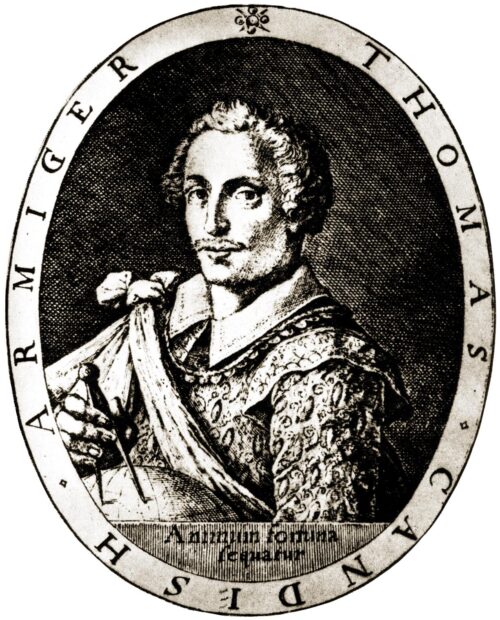
Born in 1560 into a family of wealthy and well-connected gentry, Thomas Cavendish would stake both his fortune and his life on voyages of plunder and discovery. The youngest, most audacious adventurer of his age, he captained a ship on the first English expedition to colonise Virginia in 1585; led a fleet around the world on a voyage of exploration and exploitation a year later, in the course of which he captured the most valuable prize ever taken by a single privateer; he inherited, won, and wasted fortunes; and, in 1591, at the age of 30, he launched a final, fatal expedition intended (in addition to practising robbery under license in the Atlantic, Pacific and Indian Oceans) to establish direct trade with China, which was frustrated by treachery and mutiny.
Cavendish was the most existential of Elizabethan heroes, aloof, calculating and motivated by opportunity and expediency rather than introspection, piety or prejudice. His principles – such as they were – derived from a medieval concept of honour that sanctioned both violence and theft, and glorified revenge. He was, nonetheless, a hero both in his lifetime and for a century after his death. His triumphs were celebrated in ballads, and his fall was mourned by poets. His contemporaries considered his death to have been a model of fortitude in the face of adversity and named their sons after him. The Dutch followed in his footsteps, using his charts and pilots to establish themselves in Asia, and Cavendish’s dream of sea- borne commerce between England and China proved to be prophetic.
So why do we know so little about Thomas Cavendish when his contemporaries such as Sir Francis Drake and Sir Walter Raleigh live on – in literature, in monuments and even street names? I blame it on the Victorians. When they invented a narrative of their own Anglo-Saxon and Protestant domination of the globe, they sought muscular Christians to populate their creation myths, and found them in the sea-knights of Queen Elizabeth I. Mid-19th-century historians transformed Sir Francis Drake from a psychotic zealot who would do anything for gold into a prudent and devout officer of his monarch; Sir Walter Raleigh, meanwhile, a privateer all his life and nearly as rapacious as Drake, became a pioneer of the British Empire. However, individuals who were celebrated in their own lifetimes but could not be remoulded to match Victorian ideals, were swept under the carpet.
In the case of Cavendish, they wanted to get rid of him. Cavendish had accused John Davis, an Arctic explorer who had joined his last expedition, of treachery. Davis had made a counter-accusation, only one of the two could be right, and the Victorians and their successors decided to back Davis. They chose Davis because they shared his obsession with the northwest passage, a speculative sea route over North America. How could such a prophet be wrong? Cavendish, meanwhile, was not only a liar, but indecisive to the extent of being weak-minded, and had committed suicide rather than face up to the consequences of his actions.
But Davis was the liar: there was a third witness, Anthony Knivet, bastard son of a courtier and knight, who’d sailed under Cavendish on the last voyage. Although Knivet had no love for his leader, who, he believed, had left him ashore in Patagonia to die of cold and starvation, he was convinced that it was Davis who had betrayed Cavendish. Knivet was dismissed as a fantasist by the Victorians, who pointed out that he’d spent ten years as a slave of the Portuguese after separating from Cavendish, so how could he have remembered anything? It would be wrong to trust the opinion of a man of dubious birth and such improbable stories against that of John Davis, newly minted visionary.
Less bigoted eyes, however, have since reappraised Knivet, and have declared him a reliable witness, whose story was corroborated by shipmates from the expedition. Moreover, there is no longer a need to denigrate Cavendish in order to protect Davis. Indeed, it is time to rescue Cavendish from the mists of Victorian prejudice and show him as he was – through the eyes of his peers, rather than those of disapproving empire builders – to see him his as the poet Michael Drayton pictured him in verse:
Courageous Cavendish, a second Neptune here,
Whose fame filled every mouth, and took up every ear…
Who through the South Seas passed, about this earthly Ball,
… And with his silken sails, stained with the richest Ore,
Dared anyone to pass where he had been before.
Michael Drayton, Poly-Olbion, Song XIX (1622)

Iain Gately is based in Dorset and the author of several books including The Queen’s Pirate: The Triumphant Life and Tragic End of Thomas Cavendish, Elizabethan Privateer.