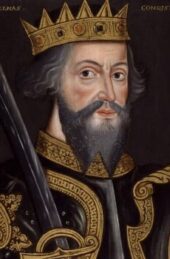

The Other Conquest: England’s Forgotten King
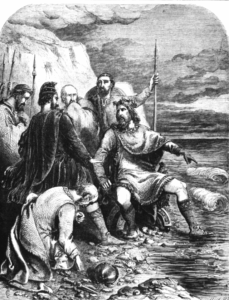
Though obviously not as well-known as the events of 1066, many people will have heard of King Knut (also rendered as Cnut or Canute), who became King of England in 1016, if only to the extent of knowing him to be the fellow who supposedly tried to halt the tides. What a fool, eh?
Note: this event – if it even happened – has often been misinterpreted as an example of Knut’s hubristic arrogance, whereas in fact it was intended to take his fawning counsellors down a peg or two by showing that even though he was king, he was nothing before God.
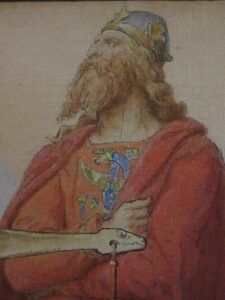
Although Knut completed the conquest of England, helped in no small measure by the fact that he outlasted his English rival, Edmund Ironsides (son of Aethelraed Unraed), his relative fame has served to cast another key figure into the shade, namely his own father, Sweyn Forkbeard who – despite being acclaimed King of England – does not even feature in our regnal list (a fate he coincidently shares with Edgar Aetheling).
Who was Sweyn Forkbeard?
Sweyn was the son of the equally wonderfully named, Harald Bluetooth (after whom the short-range wireless technology that allows the interconnection of electronic devices [I had to google that] is named – the logo of which derives from his runic initials).
Probably born in the early 960s, not much is known of his early years, other than to say his father was the first Danish king to accept Christianity. Though Sweyn was also baptised, it’s not clear how willing a convert he was. Certainly, Adam of Bremen would describe him as a rebellious pagan who rose up against his father (in the mid-980s), though his account is often far from reliable.
Nevertheless, the uprising was successful, resulting in Sweyn becoming King of Denmark in place of his exiled father, who died shortly after.
After a period of consolidation, Sweyn’s focus shifted to England in the early 1000s. John of Wallingford records that he was involved in a series of raids on England between 1002-1005. The dates tie in conveniently with what has since been claimed as the key motivation for the attacks: that is, the St Bryce’s Day massacre. Ordered by King Aethelraed, this took place in November 1002 and possibly resulted in the death of Sweyn’s sister and brother-in-law (as well as a significant but unknowable number of Danes).
More recently, historians have suggested that Sweyn’s key motivation was actually financial. England was known to be wealthy (perhaps the wealthiest state in western Europe at that time), and Sweyn may well have fancied getting in on the act that his forebears had started in the 9th century. Even so, the massacre would have provided a useful pretext.
After his first campaign in Wessex and East Anglia was cut short by famine in 1005, Sweyn returned in 1006-07 and 1009-12. Such was the scale of devastation wrought by the Danish raiding armies that King Aethelraed was left with little choice but to buy Sweyn off with massive payments (known as Danegeld – literally, Dane tribute).
Then in 1013, he was back, this time at the head of an army of conquest. The Anglo-Saxon Chronicle describes how he landed in Kent, moved quickly to East Anglia and thence along the Trent to Gainsborough. Before long, Northumbria had sworn allegiance to him, followed by Lindsey and the Five Boroughs.
With a strong powerbase behind him, Sweyn then took his army south into Wessex and Mercia: first to Oxford and thence to Winchester (the traditional West Saxon capital). But when he turned east to London, he was met with strong resistance from a city emboldened by the presence of the English king within its walls.
It proved to be no more than a temporary setback, however. Having travelled west to Bath (where the nobles of the west country submitted), London then capitulated, in fear of what Sweyn’s revenge might be if they didn’t. King Aethelraed was forced to send his sons, Alfred and Edward (the future Confessor) to Normandy for safekeeping before he then followed them into exile, after having spent Christmas 1013 on the Isle of Wight.
While Aethelraed was grumpily tucking into his sprouts on Christmas Day, Sweyn Forkbeard was formally acclaimed King of England in his capital, Gainsborough. He’d done it. All he needed now was a coronation to cement his position, but his untimely death, a mere 40 days later (3rd Feb 1014), put paid to that.
Nevertheless, Sweyn deserves his place in the line of monarchs of England due to the fact that, under Saxon law at the time, acclamation by the council of nobles (Witan) was sufficient to confer kingship (the coronation was more of a ceremonial ratification in the eyes of God). That would change with the Normans when – for a while – it would be the coronation which formally began a king’s reign.
What happened next?
Upon Sweyn’s death, the Danelaw elected his son, Knut, to be the new King of England (while Knut’s elder brother became King Harald II of Denmark – just as William the Conqueror’s eldest son, Robert Curthose, would later take the senior role as Duke of Normandy, leaving England for the second son, William Rufus.
The English nobility, however, had other ideas; instead, they invited Aethelraed back from exile. The former king was able to drive Knut out during the first half of 1014, but the Dane was finally able to secure the throne in 1016 after the deaths of both Aethelraed and his eldest son, Edmund Ironsides removed any effective opposition.
Knut went on to be a strong and effective ruler of a North Sea empire comprising Denmark, Norway and England, for which he was afforded the epithet, The Great.
Post-script: King Sweyn’s death
As is so often the case, the precise cause of Sweyn’s death is unknown, though the most common references are to him either falling off his horse or being killed with a spear.
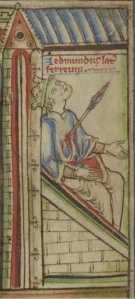
It is also not unusual for colourful rumours to fill the void. His English rival, Edmund Ironsides, for example, may have died from wounds incurred in fighting Sweyn’s son; though it’s far more entertaining to believe the alternative theory that he was impaled on a spear which was thrust up from below while Edmund was ‘at his toilet’.
In Sweyn’s case, we have a macabre tale that the spear which killed him in his bed had been wielded by none other than the ghost of St. Edmund (the Anglo-Saxon King of East Anglia who was murdered by Vikings (tied to a tree and shot full of arrows, apparently) in 869).
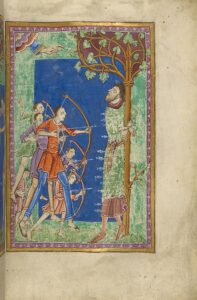
As far-fetched as this seems, there may be a grain of something within the tale. One of the few acts that Sweyn undertook during his short kingship was to impose a hefty new tax regime across the land, including hitherto exempted lands belonging to the abbey of Bury St Edmunds. When the monks complained, Forkbeard threatened to burn the place down and to kill all the monks.
Soon after, a monk by the name of Ailwin told the court that he had been visited by St Edmund in his dreams; the dead king had threatened Sweyn with divine vengeance should he not desist from his evil taxes. An unimpressed, drunken king booted Ailwin out, before himself going to bed. It was not long before the king could be heard crying out “Help me, my soldiers, help me. Behold, St Edmund comes to kill me.”
Two possibilities come to mind that may explain this tale (three if you believe it was actually the ghost of St Edmund). Firstly: the monk, Ailwin. Who’s to say he didn’t put a sheet over his head, and sneak into Sweyn’s bedchamber to kill the king (presumably while making some suitably ghostly wailing noises)? I’m thinking of the scene in Back to the Future, where Marty pretends to be an alien from the future to scare his dad into continuing with his comic books.
Alternatively, someone else took advantage of Ailwin’s dire warnings to do away with Sweyn, knowing that it would be blamed on the prophecy. The perfect crime.

Paul Bernardi is the author of Uprising, published by Sharpe Books.