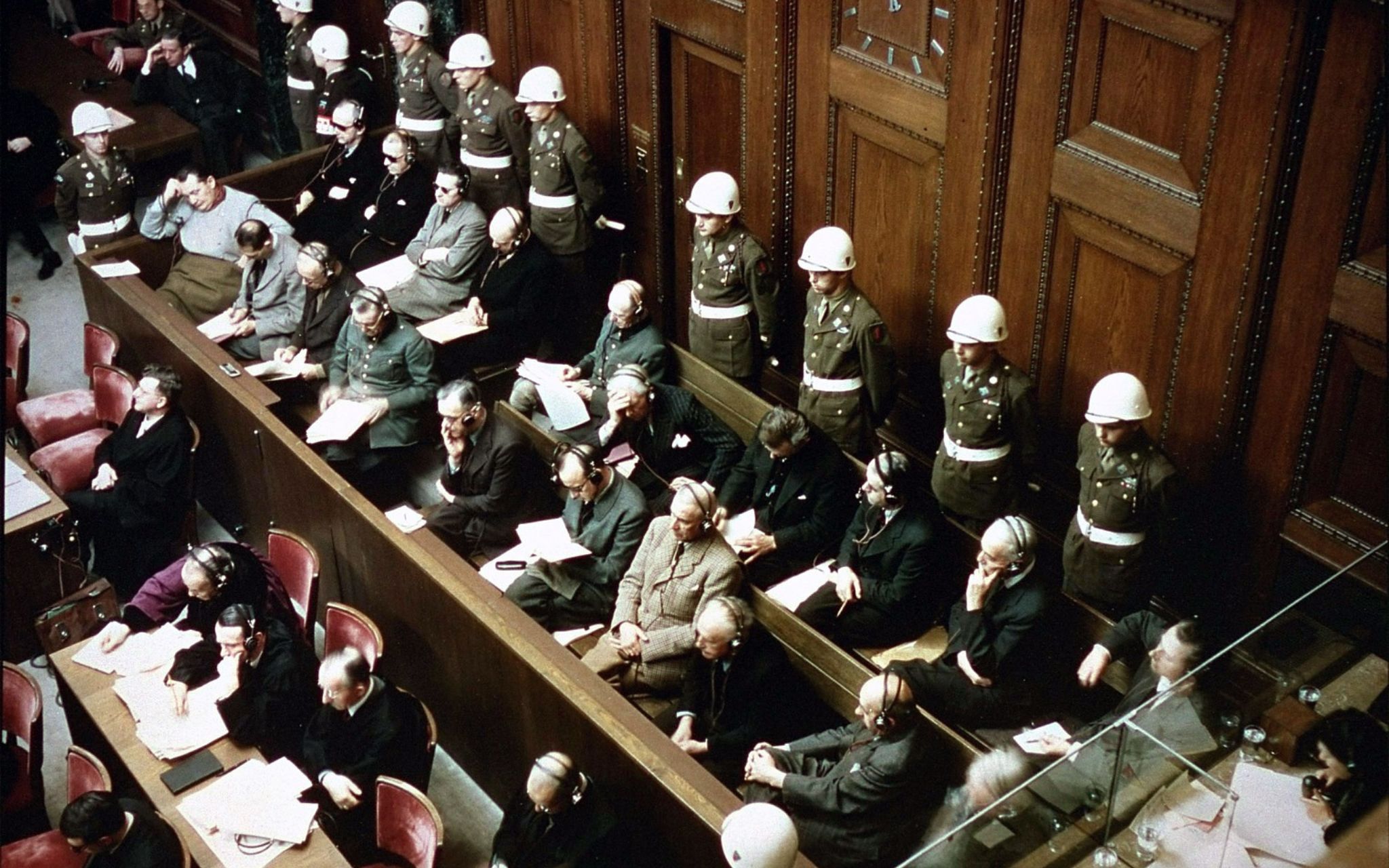
On 20 November 1945 twenty-one defendants flanked by US guards were brought along the covered walkway from the prison cells, up the stairs, through a door behind the prisoners’ box and into the courtroom. This was the opening day of the Nuremberg Trials, where the architects of the Holocaust and the machinery of Nazi terror faced justice for the first time on an international stage. The Trial convened in the shattered city that had once hosted Hitler’s triumphant rallies and marked a watershed in international law. Twenty-two high-ranking Nazis, including Hermann Göring, Rudolf Hess, Joachim von Ribbentrop, Julius Streicher, and Albert Speer, were indicted for crimes against peace, war crimes, and crimes against humanity. The trial was a first and a test for international law and co-operation. Four charges, never tried before in a court of law. In the coming months, the world would hear detailed accounts and see graphic images of the atrocities committed in the concentration camps; images that were shown on screens in the courtroom. It caused universal shock. The little evidence that had been reported on these crimes during the war seemed to have been largely dismissed as exaggerated Allied propaganda. Now the world would see the incontrovertible evidence.
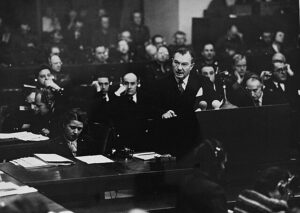
US Chief Prosecutor Robert H. Jackson at the Nuremberg Trials, 1945
The day after the trial opened, 21 November 1945, the US prosecutor Chief Justice Jackson gave his four-hour defining opening address, during which he said poignantly: “The privilege of opening the first trial in history for crimes against the peace of the world imposes a grave responsibility. The crimes which we seek to condemn and punish have been so calculated, so malignant and so devastating that civilization cannot tolerate their being ignored because it cannot survive their being repeated.” Yet, behind the courtroom drama lay the grim reality of the prison, a fortified complex where these defendants were held under strict Allied guard.
One figure in this story has remained largely obscured from the historical spotlight. He was Howard Triest, a German-Jewish refugee who fled Hitler’s regime only to return to Germany at the end of the war as a soldier in the American Army. He was posted to Nuremberg Prison and became the sole translator for the psychiatrists in the jail. His story, drawn from hours of my personal interviews with him, reveals not just the inner workings of the prison during those pivotal months from November 1945 to October 1946, but the profound human confrontation between a survivor of persecution and the men who orchestrated the deaths of millions, including his own parents. His life became one of resilience, justice, and the unyielding pursuit of truth amid the ruins of war.
Howard arrived at the prison in September 1945 and immediately assigned as personal translator first to American psychiatrist Dr Douglas Kelley, then to Dr Leon Goldensohn. Every day for a year he accompanied the psychiatrist into the cells for the task of assessing the mental fitness of the prisoners, probing their psyches to determine and ensuring these men were fit to stand trial. For him, the experience was especially painful. He already knew the awful truth that his parents had perished in Auschwitz, deported there from France in August 1942.
The experience at Nuremberg was unique for Howard as he had been born in Munich in 1923, into a world already shadowed by the nascent Nazi movement. His father Berthold, a decorated veteran of the First World War, had fought valiantly for Germany and earned an Iron Cross for bravery. Like many assimilated Jewish families, the Triests initially believed their loyalty to the Fatherland would shield them from the gathering storm. But as Hitler ascended to Chancellor in 1933, the illusions shattered. By 1938, the noose tightened with Kristallnacht, ‘the Night of Broken Glass’ in which synagogues were burned and Jewish shops looted. Howard’s father was arrested and sent to Dachau concentration camp, emerging weeks later a broken man, his health ruined by brutality in the camp. In a harrowing journey, the family fled to Belgium, then France. Then after a perilous Atlantic crossing, Howard arrived to safety in New York to be greeted by an uncle. Enlisting in the US Army in 1943, Howard underwent rigorous training, his fluency in German marking him for intelligence duties. He landed in Normandy on 7 June 1944, before advancing through France, Belgium, and into Germany. In April 1945 he was amongst the liberating US forces of Buchenwald concentration camp, an experience that haunted him forever.
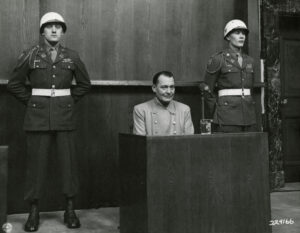
Hermann Göring on trial at Nuremberg 1946
By September 1945 Howard had been summoned to Nuremberg Prison, a sprawling facility under American command, ringed by machine guns and floodlights. The twenty-two defendants were housed in solitary cells along a stark corridor, each under suicide watch by a guard. Howard’s role was pivotal: as the only German-Jewish translator assigned to the psychiatrists, he accompanied the psychiatrist into the cells every day and interpreted their questions to the defendants and the responses by Hitler’s surviving members of government. Kelley, a pioneering psychiatrist, used Rorschach inkblot tests and interviews to probe the defendants’ psyches, while Goldensohn focused on personal histories and motivations. Sitting just inches from Hitler’s henchmen men, Howard confronted the evil men of Hitler’s regime. Hermann Göring, the rotund Reichsmarschall, was found to be charismatic yet defiant, boasting of his Luftwaffe exploits while dismissing the Holocaust as exaggeration. “He was the great showman,” Howard told me, “always performing.”
Rudolf Hess, Hitler’s deputy, feigned amnesia, at times he seemed erratic in his speech, his eyes wild, and believing the guards were trying to poison him. When Howard entered one day, Hess passed him some carefully wrapped samples of food in envelopes with labels. He asked Howard to have them analysed. Howard concluded that, ‘the irony of the whole poisoning phobia was that Hess outlived all the defendants.’ Then there was Julius Streicher, the venomous publisher of the anti-Semitic propaganda newspaper Der Stürmer, who spewed anti-Semitism and hatred unchecked during the interviews in his cell. Howard translated it all, his voice calm and his emotions compartmentalised. Dr Kelley concluded that Hess was medically unstable and suffered sporadic paranoiac behaviour.
On entering Hoess’s cell, Hoess was found to be the bland bureaucrat as he sat impassively answering the questions put to him. But the tragic horror was that Hoess had overseen the murder of over a million Jews in Poland, including Howard’s own parents. How did Howard manage to keep calm whilst sitting next to these evil men? And during these visits by Howard and the psychiatrist, Hoess showed no remorse for his crimes and even boasted about how many Jews he had killed. It was a stark reminder of the industrial scale of the genocide, reducing human lives to statistics. With all these defendants, Howard felt no surge of vengeance; instead, a quiet belief that justice would, in the end, prevail through law, not retribution. He said to me, “The only right way to punish these twenty-one defendants was to put them into the death camps and subject them to the same treatment they gave millions of others. But we couldn’t do that as civilised people. Maybe for this reason, I was chosen for the job.”
In the end, the psychiatrists’ reports influenced the court because all defendants were declared sane, fit to stand trial and accountable for their actions. Ten were hanged, others imprisoned; Göring cheated the gallows by swallowing a cyanide pill on the eve of his execution. In all this, Howard’s story shed light and an important reminder on the role of refugees in Allied victory: over 14,000 German and Austrian Jews fought for America, their knowledge of the enemy and fluency in German proved to be invaluable. He bore no bitterness. I found myself compelled by Howard’s story. Here was a man who got as close as one possibly could to the surviving leaders of the Nazi government on a daily basis, and yet bore no bitterness or desire for revenge. I wanted to hear his anger, feel his hatred, but it was surprisingly not there. There was no outpouring of trauma or hate. For him, it was as simple then as it was in Nuremberg Prison: justice would have to be done if Germany was to be rebuilt.”
Like so much about the World War Two Nuremberg has passed into almost mythological status in history. There is a continued fascination with the rise and fall of Hitler and Nazi Germany that does not appear to abate with time. However, for Howard, the memories of the liberation of Buchenwald haunted him in a way that his experiences of Nuremberg did not. Every time he looked at photographs of the death camps he searched the faces of the survivors for his parents. Even though he knew they had died in Auschwitz, still he instinctively looked for them amongst the haunting eyes staring back.
Eighty years after the trial, Howard’s personal testimony reminds us of Nuremberg’s enduring legacy. It was a trial that set precedents for the International Criminal Court, holding leaders accountable regardless of rank. In an era where authoritarianism resurfaces and atrocities persist, Howard’s encounter with evil urges us to remember that justice is not vengeance, but a civilised world’s reckoning. In a way Howard’s role at Nuremberg echoed a quiet heroism. In his story – and those of other veterans – lies the real defeat of tyranny and the restoration of humanity.
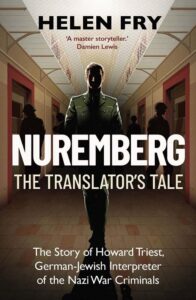
Nuremberg: The Translator’s Tale by Helen Fry is published by Yale University Press in March 2026.