This novel explores the story of Carausius and Allectus, two Britons who rebelled against Roman rule in the late 3rd century AD. This took Britain out of the Roman Empire for ten years. The narrative combines historical facts with fictional elements to fill gaps in the historical record, creating a detailed and imaginative account of their lives, motivations, and the events surrounding their rebellion.
The story delves into the rise of Carausius, a descendent of the Menapians who settled in Wales. After gaining a military reputation, he was appointed as a Roman naval commander tasked with defeating pirates, only to be accused of embezzlement by Emperor Maximian. Carausius rebels, declares himself Emperor of Britain, and rules for seven years with widespread support. The novel also focuses on Allectus, his cousin and minister of finance, who ultimately assassinates Carausius and assumes power for three years before being defeated by Roman forces led by Constantius and Asclepiodotus.
The book explores themes of loyalty, betrayal, ambition, and the complexities of leadership during a time of political upheaval and examines the impact of Roman rule on Britain and its tribes. The author uses historical research, archaeological findings, and genealogical studies to create a plausible narrative that bridges the gaps in historical records.
It also includes extensive author notes, historical context, and references to support the story’s foundation in history, and greater research detail can be found on www.carausius.org
Discrepancies and anomalies.
Losing the island of Britain must have been politically and militarily embarrassing for the Roman empire. The bones of the story are recorded in history but full of unanswered questions. How did Carausius gain a military reputation? Why was he put in charge of creating a fleet to deal with the pirate raids? Why was his rebellion so well supported? Why was he buried in Snowdonia? How did Allectus become ‘minister of finance? Why did he not surrender?
And the major one of their origins. Two accounts of the origin of Carausius compiled many years after his death suggest ambiguously that having Menapian roots he came from the tribal homelands in the modern day Netherlands. These seafaring traders appear in history around 500BC and established other colonies at Anglesey, the Isle on Man and Brittany and were fading from history at the time of Carausius at the end of the third century.
However, described as a citizen of Menapia when the only town of that name was charted by Ptolemy in AD150 at Wexford in eastern Ireland, (founded around 200BC) by Aurelius Victor who also lived in Alexandria could suggest that he had access to that map. Eumenius used the description of ‘an alumnus’ (old boy) of Batavia (the Roman name for the old tribal lands) which also could be interpreted as suggesting otherwise. Indeed, other research points to his origin in the Welsh town of Menapia, founded after its Irish counterpart, at Whitesands Bay near modern day Saint David’s in south-west Wales.
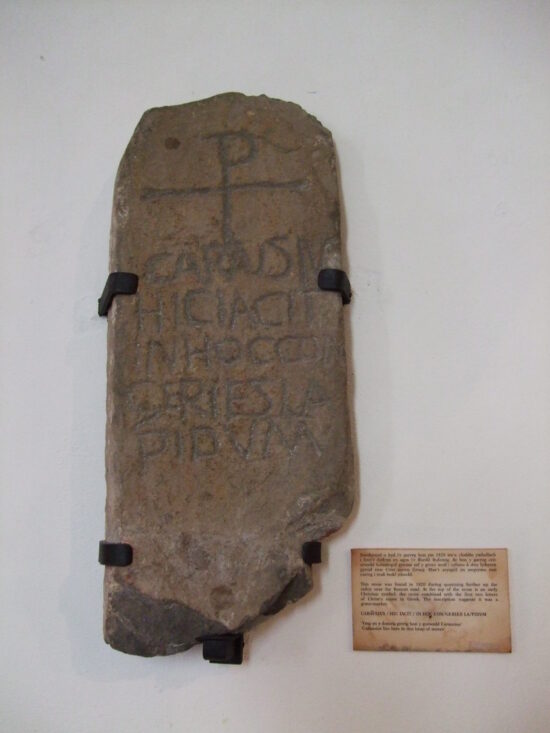
Of particular note is that his grave marker was found in Snowdonia. While this would accord with attempting to take his body home after his assassination in York, this stone is ignored or dismissed by contemporary historians because it does not fit with the prevailing narrative. It is written in a classical extended Latinate five line form on a type of stone not found in Snowdonia. It also has a Christian tau-rho symbol that came into usage in the early fourth century, soon after his death. It is reasonable to accept its validity and recognise the respect and effort made to transport the stone to mark his grave site.
Little is recorded about Allectus other than names such as ‘pirate’ and ‘rebel’, a role as ‘minister of finance’ and his final battle against Roman re-occupation. Research suggests that he was a cousin of Carausius from the adjacent kingdom of Siluria.
This all led to the challenge of writing a novel that has a factual base to shape it, while creating plausible explanations for the missing links.
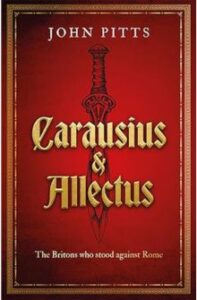
John Pitts is a retired doctor and an author based in Wales. Carausius and Allectus is his first novel.