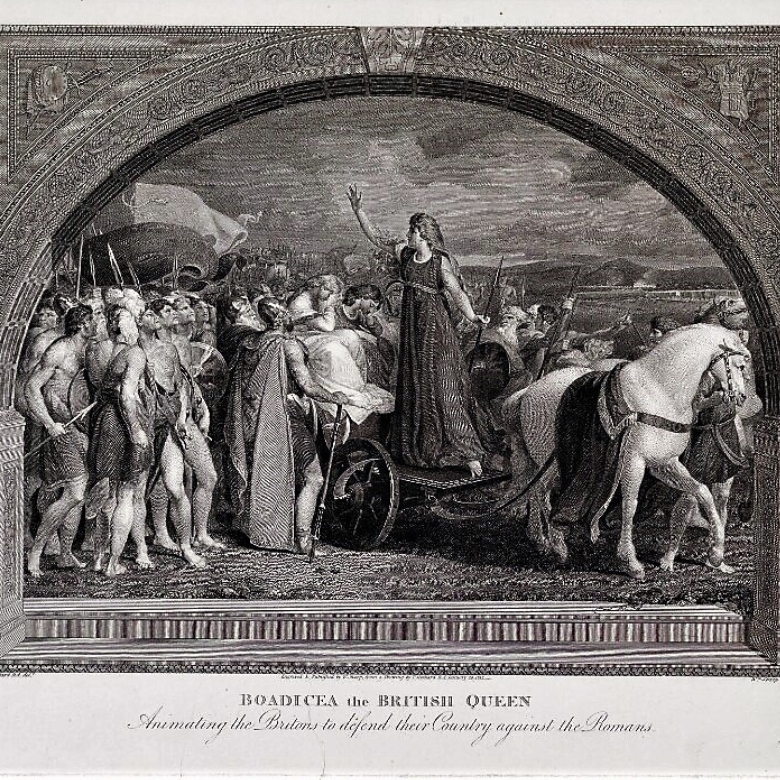
The flogging of Queen Boudica and the rape of her daughters after the death of King Prasutagus of the Iceni remains an enigma. As a client kingdom of Rome, the Iceni royal family undoubtedly had Roman citizenship; whipping Boudica and raping her two daughters were unprecedented in Roman imperial history. How did this happen? And does this alone explain the Britannic uprising in 61AD?
For this scenario we have only Tacitus’s Annales, and the Roman historian doesn’t mention it in his other source for the revolt, The Agricola. Dio Cassius tells us the revolt was due to taxes and the calling-in of loans. Yet, both agree Boudica led the rebellion and most writers accept the more disturbing story of the flogging and rapes. Yet if this is true, how can it be understood in the light of Roman law?
Roman writers such as Tacitus, Dio Cassius and Suetonius, tell us that executing a virgin Roman citizen was ‘unprecedented’ and ‘unlawful.’ In order for it to become legitimate the condemned virgin first had to be raped, as was the case with Sejanus’s daughter during Tiberius’s reign of terror: the girl was raped by her executioner and then strangled. Sejanus was a traitor, and, as such, he and his whole family were condemned to death. This might have been the case with Boudica’s family, but they were not executed. Another point to make is that Roman women were not flogged.
We can perhaps surmise that Boudica’s revolt began first with a smaller sign of discontent following the king’s death when the royal estates and Iceni lands (a little larger than present day Norfolk) were incorporated into the Roman province of Britannia – as had been agreed upon by the king himself when he first signed the client agreement with the Emperor Claudius. We think this was in 43AD when eleven Britannic tribes signed client agreements with Rome. The client agreement allowed a kingdom to maintain its nominal independence but only during the lifetime of its ruler: upon the monarch’s death the kingdom would be incorporated into the Roman province of Britannia.
However, there was a disturbance in 47AD which led to the disarming of many of these friendly, but still independent, tribes along the frontiers of Britannia and that shows us that anti-Roman factions were still rife. We know that when Prasutagus died his kingdom was incorporated into the Roman Province. However, despite leaving half of his wealth to his daughters, Prasutagus’s personal will was ignored: his lands were plundered by Roman officers and slaves. Other members of the royal family also saw their lands taken. There may have been complaints and threats lodged with the Roman procurator, Catus Decianus in Londinium, certainly there would have been murmurings, outbreaks of violence. With no military training, Catus, who had to manage the financial and economic policies in Britannia on behalf of the Emperor Nero, would have felt uncomfortable, even vulnerable, with so few military resources in the south. He needed to stop any movements or disturbances that were beginning to show in Iceni lands.
The subjugation of the royal family – the whipping of Boudica, the rapes of her daughters – seems to work as a warning shot. Not only does it humiliate and end Prasutagus’s dynasty, it clearly indicates that since the two princesses are no longer virgins they can be condemned and executed if there were to be further signs of revolt in the territory.
Revolt, of course, did come since the Roman general-governor, Suetonius Paulinus was far away on the western frontier putting down the druidic holy site on Anglesey, an act in itself which shocked the Celtic peoples. The confiscation of land, wealth, goods and the forced conscription of men to fight in the Roman army abroad, along with the humiliation inflicted on the Iceni royal family, all contributed to the combined uprising of the Iceni tribe and other factions in 61AD.
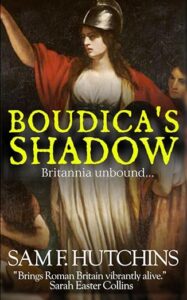
In my book, Boudica’s Shadow, I work on the premise that Catus was following the legal advice given to him by the Roman jurist assigned to the province by Nero.
Sam F Hutchins is the author of Boudica’s Shadow and is a senior lecturer at Orléans University, France.