It is hard not to feel for a petrified young man cowering in the dark, his underwater home groaning, cracking and springing leaks, as high explosives detonate yards away and there is just eighteen millimetres of steel holding back oblivion.
Yes, even if he is a Nazi.
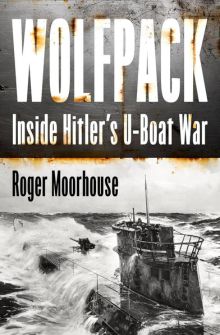
Coming soon after Victoria Taylor’s Eagle Days, which captures the Luftwaffe perspective on the Battle of Britain, Wolfpack feels similarly exciting and, yes, a little bit transgressive. A classic British hero story – celebrated in countless books and films – reinterpreted and made more complete by a switch in narrative voice.
Moorhouse is never less than engaging but he is also brave, stating clearly at the start that this is to be a chronicle of many deaths foretold, that the U-boat service never had the numbers or the technology to win. ‘So much for jeopardy’ you might think. But in fact, such honest revisionism makes what follows even more interesting and intense – especially the remarkable opening story of U-47 and its commander, Günther Prien, sinking the battleship HMS Royal Oak in 1939 inside Scapa Flow, Britain’s most secure naval base.
We follow Prien’s slow, harrowing approach: U-47 forced to dive to avoid a merchant vessel, a terrifying scrape along the anchor chain of a ‘block ship’ meant to safeguard the anchorage, and anxious minutes searching for a target. Prien’s success creates a sensation back home, with headlines proclaiming Britain’s lost mastery of the seas. Yet, the author immediately balances this with the sober reflections of the leader writers of The Times, who acknowledged the skill and daring on display, while warning that ‘Command of the Sea… is not lightly won.’
Indeed, it is not. Prien’s boss, U-boat chief Karl Dönitz, entered the war with just 56 submarines, only 22 of which were truly suited for Atlantic operations. The spring of 1940, a moment when British resolve seemed brittle in the wake of France’s collapse, could have been decisive – yet the U-boat force was simply not large enough to deliver a telling blow.
As the war develops Wolfpack captures the tension and discomfort that defined every submerged hour: days spent in deathly silence, rags muffling bootsteps, and nights filled with frenetic activity—engines humming, meals hurriedly prepared, and torpedoes meticulously greased. The relentless reliance on coffee and adrenaline, the glow of weak electric bulbs, clothes that never dry. You can almost feel the sweat and condensation.
There is the big picture too: the importance of convoys and Allied arguments about how best to deploy them; the technical and intelligence arms race (and why the Allies win it); changing ideas on whether survivors should be rescued (by either side); and the occasional tragic mistake that dooms civilians – even evacuee children- as liners are deemed ‘legitimate targets’.
Moorhouse’s account of the pivotal Atlantic convoy battles of late 1942 and spring 1943 is especially good; as first the U-boat fleet grows stronger, threatening for a few months to cause real damage, but then finds itself outmatched and driven from the one ocean where it could have made a difference.
In all, Wolfpack is a real achievement—a meticulously researched, empathetically told, and thoroughly engrossing chronicle. Highly recommended for anyone interested in naval history, World War Two, or simply a brilliant story well told in a surprising new way.

Phil Craig is a bestselling historian and the author of 1945: The Reckoning: War, Empire and the Struggle for a New World, released earlier this year.