
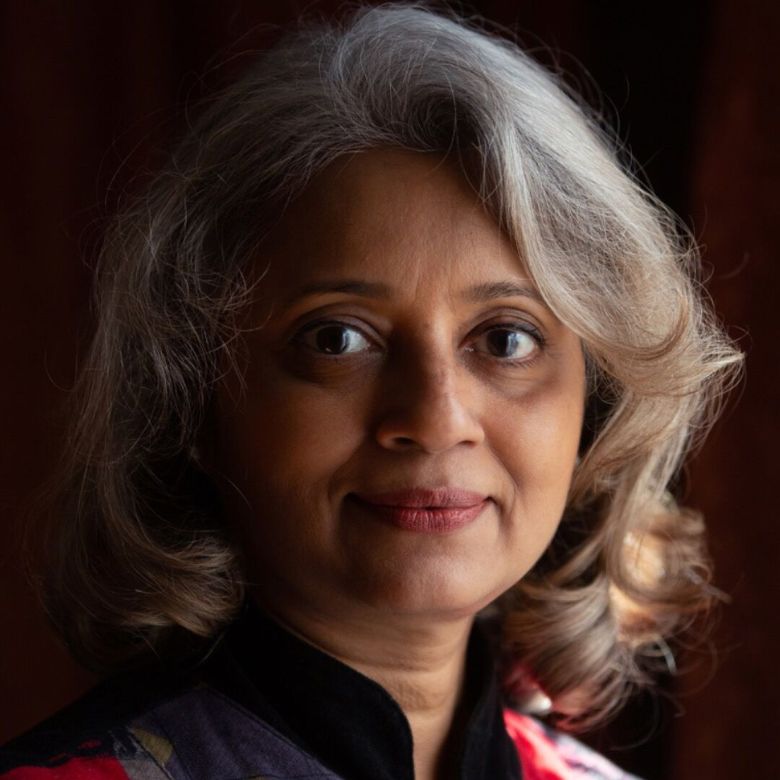
Your novel Blood Caste is a historical crime thriller set in 1895 India, featuring two detectives Soob and Wilberforce, who investigate three murders that bear a distinct resemblance to those committed by Jack the Ripper. What drew you to the idea of transplanting Jack the Ripper’s crimes from Victorian London to 1895 Hyderabad?
Our ideas, I think, come from experiences in our childhood, what we love to read, and the mysteries we concoct – all of which jostle about in our unconscious. I’ve always loved gaslight mysteries, especially Sherlock Holmes and the Ripper tales about the hunt for the killer in the dark, eerie, and crime-infested alleys of Victorian London. A part of my childhood was spent in Hyderabad, a city built in the late 16th century by a Shia ruler and later ruled by a Nizam. This fable-like old city with its needle-thin alleys and cobblestone avenues, its stories of princes and autocrats, brocades and muslins, jewels and elephants somehow entwined with the Ripper tales in my imagination. Blood Caste took shape around the question: what if Jack the Ripper had come to Deccan?
Soob and Wilberforce have a tense, oppositional partnership. What inspired their dynamic, and how did you develop their contrasting worldviews?
Initially, I’d used a real-life person, Inspector Aberline who led the Whitechapel investigation into the Ripper murders. In the story, he came to India in pursuit of the Ripper. However, the middle class Aberline somehow did not spring off the page, and his dynamic with Soob just did not work. I decided to make up a fictional character, and Wilberforce sprang into my head. He grew out of my reading memories: I loved James Herriot’s vet series set in the Yorkshire Dales. A Yorkshireman of farming stock, Wilberforce’s earthy sense of humour, his impatience with artifice, his resentment at being treated as an inferior by the upper-class Englishmen, local nobles, and the upper-caste Hindus – all of it came alive on the page. His origins neatly contrast with Soob’s, a highly educated South Indian Brahmin born into the top tier of the Hindu caste hierarchy, and whose approach is cerebral and dispassionate.
Developing the contrasting world views took time, playing with contexts, and many iterations. Our world views, I think, come from our upbringing, our sense of belonging somewhere, and the sensibilities we develop through our experiences. Soob and Wilberforce’s backstories collided on the Ripper case: one had killed the Ripper while for the other, unknowingly, the Ripper was a friend.
It was important for me not to be judgmental about their beliefs. So, in the dynamic, I let their views play off each other and showed how they justified their stances in their own minds. I brought them closer through their shared experience of being shunned, a passion to see justice done, and a dislike of hierarchy.
The novel examines caste, colonialism, and spiritual conflict, among other things. How did you balance these complex themes within the framework of a crime thriller?
Crime thrillers, I think, are wonderful vehicles for exploring the societal values and ills. Agatha Christie’s books show the class and racial hierarchies of early and mid-20th century England, the impoverishment of the middle-upper classes (Miss Marple), and the refugees (Poirot) displaced by the world wars. For me, the idea that birth into a particular caste or a class or a race would determine a person’s value for the rest of their lives is outrageous. The murder investigation allowed me to balance these complex themes through the dilemmas faced by Soob, Wilberforce, and Shiraz, and put readers in their psyches.
Wilberforce is of the imperial race, but his farming background subjects him to class prejudice, which he fiercely resents. Shiraz, as a woman, struggles against gender prejudice. Soob stands at the intersection of the three themes. As an excommunicated Brahmin, he struggles with the existential question of returning to a system that shuns merit in this life and assigns a value at birth. As a native officer working for the British, he is uneasily embedded in the colonial structure. As a modern man stuck in a traditional world, his spiritual questioning comes to the fore. The investigation allowed me to chart a path through these complex themes.
Soob’s personal guilt and spiritual crisis add emotional depth to the story. Was this always part of his character arc, or did it evolve during writing?
These evolved during the writing. Though I had always visualised Soob as an excommunicated Brahmin, his personal life saw several changes. I made him an alcoholic, an opium eater, and in one version, his wife was still alive. Only when I considered what would give him agency, make him choose to remain excommunicated – that’s when his personal guilt in his wife’s tragedy came into focus.
The novel incorporates real conspiracy theories about Jack the Ripper. How did you decide which ones to include, and how did you adapt them to the Indian setting?
Logic dictated my choices. Conspiracy theories have made Jack the Ripper a refugee, a British or foreign aristocrat, an English or a foreign sailor, a medical man, a Hellfire Club member, and a policeman whose crimes were hushed up. For Blood Caste, the Ripper suspects had to be in the Deccan; nobles had the money to make the sea voyage to and from London, and could also be members of the Hellfire Club. Choosing the aristocrat, hellfire club and policeman theories allowed me to connect them to imperial politics and to the back stories of Soob and Wilberforce.
Dr Shiraz Daruwalla plays a pivotal role and faces significant danger. What inspired her character, and how does she challenge traditional gender roles of the time?
Her character was inspired by a real Parsi woman who was sent from Bombay to London in the late eighteen nineties to study medicine. I chose her religion quite deliberately. As a Parsi in Hyderabad, she did not have to comply with religious rules for Hindu and Muslim women which included being veiled and remaining inside the home. Of course, the Parsi community was highly insular and practiced gender discrimination, but with the support of the men in her life, Shiraz could challenge the traditional roles of wife, mother and homemaker. She is a widow, has no children, and works as a doctor. More importantly, she exhorts and supports her patients to challenge the societal strictures.
You mention in the endnotes of the book that it took you ten years to write the book, it must have been quite a labour of love. Did you blend the writing of the book with the research as an ongoing process, or were there two distinct phases to the writing?
Initially, there were two distinct phases to the writing. I came up with an outline of the story and then dived into researching everyday life and politics in late 19th-century Hyderabad. It took me to the national archives, newspaper offices, PhD theses, flaneur-like wanderings through the old city alleys talking to longtime residents. Once I felt comfortable with the era, it became a blend of writing and researching the gaps.
What’s next? Are you planning a sequel to Blood Caste?
I have written the sequel, Scorpion Palace, which will be published in October 2026. It is a closed circle mystery set in Faluknama Palace with a fabulous diamond, a panther, a perfect storm, and Soob’s arrest as a traitor.
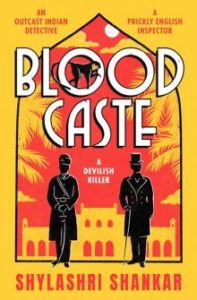
Shylashri Shankar is a crime fiction writer, food historian and social scientist. Her non-fiction book, Turmeric Nation, won the Author award for best non-fiction in 2021. Her debut novel, Blood Caste, was released in July 2025.
Alan Bardos is the author of historical fiction set around the World Wars. His latest novel is Rising Tide.