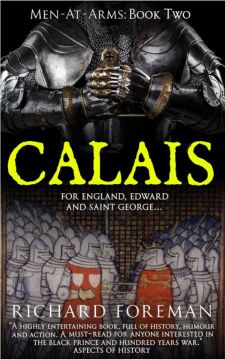
This is the second book in the ‘Men-at-Arms’ series. What was your previous book about and how did it lead into this one?
The first book Men-At-Arms: Crecy centers around the famous battle and introduces us to the characters of William Gower (a seasoned man-at-arms) and Sir Hugh Grey (a spy). The purpose of the series is also to tell the story of Edward of Woodstock, the Black Prince. At Crecy the prince was just sixteen-years-old – and fought at the vanguard of the English army, winning his spurs. He became one of the foremost warriors of the age and was the father of Richard II.
We fast forward several years to 1349 for Men-At-Arms: Calais. The worst of the Black Death is over. France has a plan to capture the port of Calais and resume the war with England. But Edward III, accompanied by the Black Prince, possesses a counterplan. Gower and Grey are on hand again to assist with proceedings. Although the Siege of Calais is prominent in history books about the Hundred Years War (and Dan Jones recently released a novel about the episode) the Battle for Calais is less well known, but no less dramatic in its own way. Edward III may have been captured or killed, but for the intervention of his son. The Black Prince won his spurs – again. The battle took place on New Year’s Eve. Suffice to say that there were more than just sore heads in the morning.
What prompted you to write about 1340s England and the Hundred Years War?
Several years ago I wrote Band of Brothers, a series about Henry V and the Agincourt campaign. The books sold well and I enjoyed my foray into writing about medieval England. Around that time I read a biography of the Black Prince, by Michael Jones, which sparked the idea about writing another medieval series about Edward of Woodstock and his major battles. Edward III also bestrides the age like a colossus. The period encompasses the rise of England as a military and political power, the increasing cult of chivalry and the Black Death, among other things. For sales reasons, it also helps that we won Crecy and Calais. In some ways we know plenty about the life and times of the prince, but there are also plenty of gaps which fiction can attempt to fill in. As with my other titles, my hope is that readers are promoted to read the real history after enjoying my fictional take on things.
How did you conduct research for this project and what would you recommend to authors starting out in historical fiction?
There were a fair few key books that I read in preparation for writing the series, including the aforementioned book by Michael Jones. Other titles included The Perfect King by Ian Mortimer and A Great and Glorious Adventure by Gordon Corrigan. The Grail Quest is also one of my favourite series by Bernard Cornwell, which opens with Crecy and gave me a feel for what was needed. As much as I read a number of books, I am also fortunate to know a number of historians, like Michael Jones and Gordon Corrigan, who I can chat to as well.
The best thing that any writer can do before starting out is to read. Before you find your own voice it’s important to listen to others. Be aware of what the market and reader wants. Depending on genre and period, read the likes of Bernard Cornwell, Robert Harris, Conn Iggulden and Jean Plaidy. These people sell for a reason.
Your fictional characters Sir Hugh Grey and William Gower generally take precedent over the historical figures in this novella, and both have interesting positions as a spy and man-at-arms. Do you find these sorts of ‘outsider’ characters to be more engaging to write about?
There are exceptions (Augustus Caesar, Dick Turpin), but for the most part the wholly fictional characters in my books are the central protagonists. Real events and real personages such as the Black Prince, Julius Caesar and Henry V are the hooks on which to structure the narratives. Outsiders provide a certain amount or freedom, or even licence. Gower is a character representing the ordinary soldier of the time (and in some ways represents soldiering today), whilst Grey adds an espionage element to the novel. He also provides some black humour. Whether or not they are more engaging I don’t know. They are perhaps equally engaging, but for different reasons.
You wrote from both English and French perspectives in this novella, outlining their different mindsets, strategies, and less pleasant traits. How challenging was it to balance these perspectives and maintain nuance within your English and French characters?
In some ways it was quite easy, in that the English are the heroes and the French the villains. The two sides share plenty of similarities, however, as well as differences. After reading about Geoffrey de Charny, a famed French knight of the age, I wanted to give him his moment in the spotlight. It would be nice of course to be familiar with medieval French in order to mine more sources and tell more of the French story. But there are only so many hours in the day. I need to sleep – and drink.
What can readers expect from the next ‘Men at Arms’ novella?
They can expect more of the same. Plenty of dead Frenchmen, some history, some jokes and more than one bloodied sword. The third and final novella will cover the Battle of Poitiers, arguably the Black Prince’s finest hour. It will also be about finishing off the stories of Grey and Gower. I’ve still got to do some research and plotting – and write another book in the meantime, for a separate series – but my plan is to complete the trilogy by the end of next year. Time – and drinking – permitting.