

Yet it is more complicated than that, as I’m not interested in triumphalism or glorification. Yes, we do love the Boy’s-own stuff, and there are incredible stories of gallantry to celebrate, and now and again we enjoy a little humour and relish in the odd ‘what if?’ or something quirky. However, I love equally the truth of things, and I think the magazine has a duty to tell its stories warts-and-all.
To me, this is a rather human approach that somewhat mirrors the myriad experiences of those who witnessed or participated in the conflicts we cover. Humour, stoicism, (a perspective of) truth and lies, alternative thinking, these were all on the minds of people in war as much as the actual fighting.
How has the magazine evolved under your editorship, and what do you feel now sets it apart from other military-history publications?
One of the magazine’s strengths is that it is a broad church when it comes to the subjects we cover, but I have changed things a bit. I believe it important to appreciate the entirety of Britain’s wartime history. i.e., 1707 to present, and even to occasionally explore near-future topics. This is more in line with the content commissioned by the founding editorial team, than those occupying the position between them and me.
I’ve also been wanting to get away from only commissioning ‘standard’ eight-page, approx. 3,000-word main articles and include more innovative ways of presenting information, such as the relatively new Debrief section, or our semi-regular ‘By Numbers’ format.
However, as far as we can, everything we do centres on the people involved. Human-interest stories are key for us, which is why in something that is predominately technical – such as the Weapons of War series – it’s as much about the inventors and solving problems as it is the nuts and bolts of how a firearm or armoured vehicle works and is used.
Britain at War has a very loyal readership. What do you think keeps readers returning issue after issue?
Looking beyond the readers’ passion for the subject matter, I’d like to think it is trust and honesty. We’re genuine in the perspectives we offer and we do our research, and I’m always happy to amend an error – I’m a big believer that mistakes should be corrected on the same platform they were made, so if I become aware of an error that we have printed, I will publish a clarification.
I think that enables readers to trust the content they are reading is accurate to the best of our ability – we are human after all!
When you’re commissioning or selecting features, what makes a story stand out as unmistakably a “Britain at War” story?
It sounds clichéd but having worked on almost 130 issues (and with approximately six years in the hot seat as editor), it becomes instinct!
Sometimes contributors or readers will approach me with an idea, other times I might pick up a strand of detail from a TV programme, a book or a YouTube video that I pull and pull on until a feature is created. One example would be our recent coverage on the Legion of Frontiersmen, a formation I knew absolutely nothing about and had not heard of, but that I discovered while searching for something else entirely. I followed it up with the Legion’s historian, and, two articles later, our coverage has met with a flurry of positive responses.
However, what all these articles will have in common is that the ideas are entertaining as well as informative. I think it is easy to forget Britain at War is a leisure product, so it can’t just be all about the detail. The pressure is on me to collate that history and present it in a format that people want to engage with.
Are there particular themes or periods of history that seem to resonate especially strongly with readers at the moment, and why do you think that is?
This is actually a challenge to gauge. When I started as the magazine’s assistant 11 years ago, I would receive a dozen letters a week – many handwritten – with comments, feedback, and suggestions. Forward to 2026, and I get a dozen letters a year. You may think email has replaced that communication, but it hasn’t!
When readers and subscribers do write in, they are thankfully quite confident in expressing their opinions. Even if they are simply adding a detail or a perspective to an article they have enjoyed, that tells me that they were interested enough to be motivated to contact me about a topic.
Readers seem to connect best with the stories in which they have some kind of stake. They, or their relatives, may have worked in a particular factory or served in a specific unit or during a certain campaign. There are a few subjects that transcend this boundary, but this usually means readers are most invested in the Second World War. HMS Hood appears to be a very popular topic, as was my article on the Abdiel-class fast minelayers – which probably had the most responses of any feature I have written.
You’re currently organising the Big Debrief conference, something you’ve wanted to do for some time. What inspired its creation, and why does now feel like the right moment to launch it?
It’s increasingly common for a magazine to have an associated event, but for Britain at War this was never really the case. We’d rock up at the War & Peace Show or similar, with the editorial team and a trade stand, and we’d meet readers and subscribers. However, realistically, people were there to see tanks or mock battles. They were not there for us, so, honestly, these events weren’t necessarily a good fit.
The conference format is different, however. Britain at War can position itself at the heart of an event that follows exactly what the magazine is about: people and stories. It’s something we can direct and grow, and see flourish, while providing delegates with the Britain at War experience.
As for why now, everyone working in print has some grasp of the challenges we face as an industry, and we must develop ways to strengthen our brands and reach out to our customer base. Events are just one of the increasingly diverse means that should help us improve our presence.
What can attendees expect from the inaugural Big Debrief — in terms of speakers, topics, and the overall experience you want to create?
I think we’ve been a bit clever, here, as by inviting six expert speakers covering a variety of topics, we are, in effect, creating an issue of the magazine in live form!
I’m looking to create an event that follows the magazine’s leisurely and entertaining format, while also maintaining our strength in disseminating good history in the way we know best. Two speakers, Jonathan Ferguson and Andrew Robertshaw, have been announced, so delegates can expect a pair of talks in their specialisms: firearms and trench archaeology respectively, but there are four more speakers to announce yet. No spoilers for now, but I will tease this: those looking for something on generalship, or on naval matters, will not be disappointed.
Looking ahead, how do you hope the Big Debrief will grow, and what role do you see it playing alongside the magazine in the future?
Well, I’m looking to ensure the first conference is a success before thinking too far ahead, but I have already had conversations about ways to, for example, add value, grow the scale, or to increase accessibility for future iterations – ideally while remaining close to our current price point.
There are differences in opinion about whether the Big Debrief should be small gatherings that ‘tour’ and take place multiple times a year, or a flagship event that we grow and expand. What I can say, is that I think the Royal Armouries is a perfect launch venue for us, and I hope we continue to work with this brilliant institution.
The creation of historical content is really something I think must become more collaborative. We’re all competing against lifestyle choices these days as much as we are against misleading information and market conditions – and it’s increasingly difficult. I’m not just competing with the ‘traditional’ events in the history sphere, but more generally with how people spend their time outside of the history hobby.
A little co-operation across print media, podcasts and other digital outputs, museums and institutions, and our associated events such as conferences will go a long way. I’ve always been impressed with how museums in Europe, and increasingly, in the UK, embrace new trends and while print media has some catching up to do, it is important to remind people that it also has much to offer.
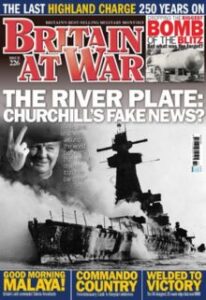
John Ash is the editor of Britain at War magazine which can be found here.
Alan Bardos is the author of historical fiction set around the World Wars. His latest novel is Hunter Class.


