In a lonely corner of eastern Poland, not far from the River Bug, there is a stretch of countryside that looks entirely unremarkable. The villages are small and sleepy, the roads narrow and uneven, the fields flat and windswept. When I visited last November, a cold drizzle hung over the landscape, and smoke drifted lazily from chimneys into the darkening afternoon sky. There was little to suggest that this quiet agricultural region had once been the centre of one of the most important intelligence operations of the Second World War.
The small town of Sarnaki now possesses a stylised monument to, of all things, a V-2 rocket, nose first into the ground. Why is it there? In Poland, this is a tale that is remembered with much pride. Schoolchildren learn about it. Historians celebrate it. Locals point out where events unfolded. Yet in Britain, the story remains astonishingly obscure. Mention the V-2 and most Britons think of rockets falling on London, or perhaps former Nazis eventually helping America reach the Moon. Very few know that some of the most vital intelligence gathered about Hitler’s terrifying secret weapon came not from British spies, but from the Polish resistance operating under the noses of the Germans in occupied Poland.
This forgotten story is not merely one of espionage. It is also about courage, improvisation and scientific ingenuity. Above all, it is about an extraordinary wartime alliance between Britain and occupied Poland that has somehow largely slipped from British historical memory.
When Adolf Hitler first authorised the development of long-range rockets before the war, few people fully grasped what was being created. The German army’s rocket programme was centred at Peenemünde, an isolated testing facility on the Baltic coast where scientists and engineers worked under Major-General Walter Dornberger and the brilliant but morally compromised young engineer Wernher von Braun. The weapon they developed, later known as the V-2, was unlike anything the world had ever seen.
The rocket stood nearly fifty feet tall and carried a one-ton warhead. More alarming still, it travelled faster than the speed of sound. Once launched, it could not be intercepted. There was no warning siren because the explosion arrived before the sound of the rocket itself. The V-2 represented the beginning of an entirely new age of warfare: the ballistic missile era.
British intelligence struggled to understand exactly what Germany was building. Reports filtered through from across occupied Europe describing strange experiments, mysterious test sites and unusual aircraft activity. Yet many officials remained sceptical. Some regarded the idea of a giant rocket capable of crossing the Channel as fantasy. Others feared that Germany really was developing revolutionary weapons beyond anything yet seen in modern warfare.
One of the few British figures who consistently took the threat seriously was the scientist and intelligence officer Reginald Victor Jones. Jones believed that Germany’s rocket research posed a genuine danger, but proving it was another matter. Intelligence remained fragmentary and contradictory. Aerial reconnaissance photographs revealed unusual structures at Peenemünde, but their precise purpose was unclear. Human intelligence was difficult to obtain. German security surrounding the rocket programme was immense.
The breakthrough would come hundreds of miles away, in occupied Poland.
By 1943, after an RAF raid on Peenemünde had disrupted German operations, large-scale testing of the V-2 increasingly shifted eastwards to occupied Poland, particularly to the region around the village of Blizna. The area offered secrecy, open terrain and relative safety from Allied bombing. For local inhabitants, however, the arrival of the rockets brought terror and confusion. Strange roaring machines streaked across the sky before crashing into forests, marshes and fields.
The Germans believed the remoteness of the region would guarantee security. They badly underestimated the sophistication and reach of the Polish underground state.
The Polish Home Army, or Armia Krajowa, had already built one of the most impressive resistance networks in occupied Europe. Its members gathered intelligence, sabotaged German operations, maintained clandestine communications and operated secret laboratories and courier routes. Now they turned their attention to the mysterious rockets falling from the skies.
Whenever a V-2 crashed, local Home Army units tried to reach the site before German recovery teams arrived. This was exceptionally dangerous work. The Germans guarded the rocket programme obsessively and the penalties for interference were savage. Yet Polish resistance members repeatedly risked torture and execution in order to gather fragments from the crash sites.
The task required immense courage and organisation. Farmers, villagers, scouts, engineers and underground operatives all became involved. Pieces of rocket casing were hidden beneath haystacks or buried in fields. Components were transported secretly across occupied Poland. Scientists working for the underground examined the fragments in clandestine laboratories in Warsaw. Reports were then passed onward to London.
The operation gradually produced remarkable intelligence. The Poles identified fuel systems, guidance mechanisms and construction techniques. They developed a surprisingly sophisticated understanding of the rocket’s capabilities. British scientists and intelligence officers began receiving increasingly detailed information from occupied Poland that transformed Allied understanding of the V-2 programme.
And then came the breakthrough that changed everything.
In May 1944, one of the rockets fired from Blizna malfunctioned and landed in marshland near the River Bug, not far from Sarnaki. Crucially, the warhead failed to detonate properly. Instead of being reduced to scattered debris, much of the rocket remained relatively intact.
This was an extraordinary opportunity, and the race now began between the Polish underground and the Germans.
Home Army units moved swiftly to secure the crash site before German recovery teams could fully organise themselves. The operation demanded secrecy, speed and nerves of steel. Local resistance figures coordinated the concealment of major rocket components while keeping watch for German patrols. Sections of the missile were hidden, moved and disguised under extraordinarily difficult conditions.
When the British found out the Poles had got their hands on a whole rocket, their response was immediate – get it to Britain. The story of how that happened is told in my latest book, and the extraordinary events have an almost cinematic quality.
The recovered rocket components were eventually transported to Warsaw, where underground experts conducted a detailed examination. Among the scientists involved was Janusz Groszkowski, one of Poland’s leading radio engineers. Others analysed the rocket’s metallurgy, fuel systems and guidance apparatus. Working in secret under German occupation, they assembled a picture of Hitler’s wonder weapon that was far more advanced than anything the Allies had previously possessed.
The sheer scale of the underground effort to get the rocket to Britain remains astonishing. Secret workshops operated beneath the constant threat of discovery. Resistance members coordinated between villages, forests and cities while German forces searched relentlessly for evidence of espionage. At every stage, exposure meant probable execution.
Yet despite the operation’s extraordinary success, it remains little known in Britain today.
Part of the reason is that British memory of the Second World War can too often remain stubbornly national. We remember the Battle of Britain, Bletchley Park, Churchill and D-Day. In Poland, of course, the wartime experience is not viewed through such a lens. Poland fought from the very first day of the war to the very last, while enduring destruction and occupation on a horrific scale. The achievements of the underground state became a source not merely of pride, but of national identity.
That contrast feels particularly striking because the V-2 operation itself was so profoundly Anglo-Polish in nature. British intelligence desperately needed information about the V-2. The Poles provided much of the crucial groundwork at enormous personal risk. It was an extraordinary collaboration forged amid occupation, fear and uncertainty.
The landscapes where these events unfolded possess a haunting quality today. At Blizna, where many of the test launches took place, a museum now stands amid forests and open countryside. Fragments of rockets, ceramic components and remnants of launch infrastructure are displayed in glass cabinets. Outside stands a reconstructed V-2, pointing skyward like an artefact from another world. It feels less like the relic of a weapon than the first harbinger of the Cold War and the missile age that followed.
For that, ultimately, is what the V-2 represented. Although it arrived too late to alter the outcome of the war, it transformed the future. The rocket pointed directly towards intercontinental ballistic missiles, the nuclear stand-off of the Cold War and the space race itself. Modern rocketry was born amid terror and dictatorship.
And at the height of that terror, in the summer of 1944, the recovered rocket components were analysed and plans began to form for what should happen next, the participants understood that they were now embarking upon something even more audacious.
What struck me most during my own journey through these places was not simply the drama of the wartime story, but the curious fragility of historical memory itself. At Motyl — the codename for a remote landing site in southern Poland where an RAF Dakota would land in about attempt to recover the rocket — there is now little more than quiet countryside and a lake edged with fishermen.
In Sarnaki, life moves slowly beneath vast skies that seem utterly detached from the violence that once convulsed the region. Yet standing there, speaking to locals and walking the same roads once used by underground couriers, it became impossible not to feel that this story still matters profoundly in Poland in a way that it simply does not in Britain.
Perhaps that is beginning to change. For hidden among these peaceful landscapes lies the story of an extraordinary alliance, and of ordinary men and women who helped uncover one of Hitler’s greatest secrets while living under the shadow of occupation and death. Eighty years on, their achievement deserves to be remembered far beyond the banks of the River Bug.
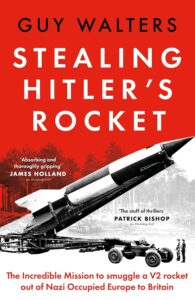
Guy Walters is an historian, journalist and the author of several books on the Second World War, including Stealing Hitler’s Rocket: The Incredible Mission to Smuggle a V-2 Rocket Out of Nazi-Occupied Europe to Britain, published by Head of Zeus.