Vortepir: A Tale of a Tyrant is the third book that I have written about characters who have cropped up in my wife’s family history. In many ways this has been the hardest. Carausius and Allectus are recorded in history and in writing about them I was able to challenge, with evidence, some of the received wisdom about their origins. The second book, Sir Gruffydd Donne, was similarly grounded in fact, with the rebellion of Owain Glyndwr, and service to English kings which included the battle of Agincourt being well-known.
This book, however, is different. I have had to create a third party, a fictional character, Madoc, to bind the story together, in the way of writers such as Bernard Cornwell and Simon Scarrow.
In the 5th and 6th centuries, often referred to as the ‘Dark Ages’, with the exception of the writings of the monk Gildas, contemporaneous material is non- existent, as the Romans and their literary tendencies had departed.
Though defined as dark, much history was being made. The work of the partially rehabilitated Geoffrey of Monmouth was not created until five hundred years later, when the written word returned. The history was handed down followed the oral tradition, some of which was recorded in scraps of surviving Welsh manuscripts. Books and articles from which I have drawn, or rather sometimes sought inspiration, are listed in the bibliography, but few facts can be agreed upon as certain. I have worked within a chronological structure created within the range of variation quoted in historical records.
A ‘good king’, Aircol Lawhir, (wide, or open arms, to recognise his generosity) held court in his kingdom of Dyfed. That his son Vortepir (in Welsh: Gwerthefyr) was a ‘bad king’ largely depends on the inclusion by Gildas in his list of five hated tyrants. ‘Seated on a throne of blood and steeped from head to toe in murder’, and ‘the bad son of a good king’ were his possibly biased assessments. Rumours of his treatment of his wife and daughter crop up, so his image as one of evil is, in a way, triangulated.
As the only writing that can be considered as a primary source, it is important to look further into what Gildas said. He was writing a Christian moral condemnation of British rulers. He deliberately portrays such kings as examples of sinful leadership, using biblical imagery. His accusations are predominantly moral and sexual. There is no evidence in Gildas that Vortepir was considered militarily incompetent or generally incapable. In fact, Gildas clearly recognizes him as a reigning ruler of the Demetae.
The establishment of Brittany by the Welsh is generally accepted, along with the two-way flights from the threat of persecution of Ambrosius by Vortigern to the first king Budic, and the flight of his nephew, the second king Budic to Wales when he was losing his kingdom.
There are several areas where a historian could take issue with my interpretations. Aircol’s court at Lydstep, (Lis Castell) is documented, and the logical place would be a promontory fort at the beautiful site I have pictured in the book, but no evidence one way or another has been found.
A major one involves the parentage of Arthur. Geoffrey of Monmouth maintained that Ambrosius and Uther were brothers. Documentation in another source states that Uther was the son of Custinnen, (Welsh for Constantine), thereby excluding Ambrosius altogether. But there were two Custinnens. Yet another source places Uther as the son of Constantine III , the title adopted by Custinnen of Brittany, brother of Aldroen, not the Custinnen son of Constans I have used here. Another researcher draws Uther as the son of Ambrosius using plausible chronological time-lines and generational gaps to support this conclusion.
Based around these opinions, I have used my imagination to provide a plausible and hopefully enjoyable narrative that to my mind, accords with the little we know. Whether I have succeeded is, of course, up to the reader.
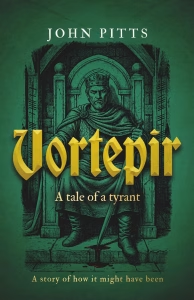
John Pitts is a retired doctor and an author based in Wales. Vortepir: A Tale of a Tyrant is his third novel.