Welcome to Aspects of History, Alanna. What first drew you to the history of medicine, and how did you come to write The Surgeon, the Midwife and the Quack?
Partly by accident and partly by design. I was doing my English Renaissance Studies MA and I found this woman’s diaries. She was talking about being afraid of getting cancer from getting a bruise. At another point she says that an acquaintance of hers has breast cancer and everybody knows it’s because her husband pushed her down the stairs. I thought that was strange, so I went looking for the research on it and it turned out there wasn’t any. That was my MA and then my PhD. After looking into cancer for the PhD, I knew they were doing mastectomies and I thought, well, what other surgeries are they doing? That led me on to the surgery book.
The book challenges the idea that Renaissance surgeons were reckless, heartless hacks. If I became ill during this period, where would I go for help?
It would really depend on how rich you were, where you lived and what was wrong with you. We have this vision of Renaissance medicine as a few doctors and everybody else quacks, and it is much more complicated than that. At the top of the tree you have your physicians. They’re quite expensive, and there aren’t very many of them around, especially outside London. Then you’ve got your surgeons, who are supposed to deal with anything on the outside of the body. But in the countryside, the surgeon’s doing everything because there are no physicians around.
You also have apothecaries, midwives and loads and loads of women healers who are practising medicine very cheaply or for free, and probably providing the vast majority of medicine that everybody takes every day. There are numerous other little sub-groups, like bonesetters and dentists. Basically, anything you can think of: if there’s a niche, somebody is filling it.
One of the surgeons you discuss is Ambroise Paré. What made him such an influential figure?
Paré’s a fascinating guy. He starts out as a military surgeon and, quite early on in his career, discovers that putting boiling oil on wounds is not a good idea. That’s really revelatory at the time, because this is what everybody had been doing.
He discovers this because he goes to a battle and runs out of oil. He was panicking that the next day everybody was going to be dead because he hadn’t put it on them, so he put just a bit of ointment on instead. When he goes back the next day, the people who haven’t been treated with the oil are doing much better. He tells everybody about this.
But he’s also a real polymath. He works in obstetrics, is a physician to the royal court and makes amazing advances in prosthetics. He comes very close to losing a leg himself after being kicked by a horse, and is very invested in what can be done for people who come home from battles changed, perhaps not accepted by their communities and unable to work.
Was this kind of experimentation typical of medical practitioners? How did they work out what was effective?
This is what people get wrong. They suppose that there are these reckless sawbones who are just hacking off limbs with no care for the patient or their mortality rate. Actually, medicine is really, really dangerous and that’s unavoidable, but they are looking at what works.
They don’t quite have evidence-based medicine in the way that we would understand it, but if they cut off a leg in a certain way five times and all five people die, they’re not doing that again. They have debates over whether, if somebody’s leg is shattered at the ankle, it’s better to amputate halfway through the tibia or at the knee.
Even the women healers, whom we think of as just operating off magic and old wives’ tales, are actually fairly systematic. In their recipe books, you can see that they’ve written down next to each recipe: I tried this on so-and-so; I put in a bit more of this or a bit less of this. The ones they really like, they write est probatum, which means it is proven.
How important were anatomy theatres and dissection to the development of medical knowledge?
After Andreas Vesalius publishes The Fabric of the Human Body in the 16th century, anatomy is kind of turned on its head. Up until that point, they’ve been anatomising people with the book of Galen in front of them, and they’ve just taken it as read that what’s in the book must be true. Vesalius says, actually, no: there are fundamental inaccuracies here, largely because Galen didn’t anatomise humans very much; he mostly stuck to pigs.
Later, in the 17th century, William Harvey discovers the double circulation system, with blood going round and round the body and round the lungs. Those things make a palpable difference to medical practice and allow experiments.
The bodies are mostly being supplied as hanged criminals. There’s a piece of law that means the College of Surgeons get, I think, six hanged bodies each year, and they really make the most of them. When you anatomise somebody, you always start with the viscera – the stomach, the intestines and all that – because that goes bad first. Then you work your way outwards, in order of what can keep. They really only do this in the winter as well. In the summer it’s too hot and everything goes off very quickly.
What medicines would I find in a typical household, and how did people think about the relationship between food and health?
The most common things that everybody wants medicines for are coughs and colds, backache and stomach upsets – very similar to today. You would have various herbal medicines. Things like rosemary and sage get used a lot because they are antibacterial and antiseptic.
The one thing you’re probably either going to have in the house or pop to the apothecary around the corner to get is a medicine called theriac. It’s a kind of cure-all, made from boiled snake’s flesh, opium, honey and a bunch of herbs. Probably the opium is doing most of the heavy lifting, but people use it for everything.
Their attitude to diet is really interesting because they are obsessed with it, but it completely lacks any kind of moral dimension in the way that it does today. Your basic tenet is that you will have humours that are hot, cold and dry, and your food should counterbalance those. If you are a hot kind of personality, with a lot of choleric humours, you will want cold foods, such as freshwater fish, lettuce and poultry.
You can treat most illnesses in the first instance with food. You can also fundamentally alter aspects of yourself. If you eat a lot of hot foods all the time, the chances are that you’re going to increase your hot humours, and that’s going to make you a more angry person.
Women feature prominently in your book, particularly as healers and household writers. Who were some of the most important figures?
Hannah Woolley is massively important. She deserves to be better known. She marries, and she and her husband run a school together. Eventually he dies and she has six children, so she needs to do something. What she knows is reading and writing, and how to manage a household and household economy and look after people. She puts these things together and makes a household recipe book.
Household recipe books had traditionally been passed down in manuscript form, from mothers to daughters and aunts to nieces. But in the middle of the 17th century, a lot of people are moving to urban centres, dislocated from the kinship networks they’ve been relying on. Woolley identifies this and essentially self-publishes a book. It’s a huge hit. Her books contain medical recipes, recipes for food and practical things like how to get stains out of clothing and how to starch ruffs. Household receipt books in printed form become so popular that they account for 20 per cent of books sold in the second half of the 17th century.
There are other fantastic women, too. Lady Anne Conway is skilled at science in her own right, probably a genius. She teaches herself Greek and Latin and is very gifted in philosophy. Jane Sharp writes the first female-authored book on midwifery. It’s a popular book, 400 pages long, and frank about sex and anatomy as well as giving practical advice on sick babies, sick mothers and difficult births.
Finally, who were the quacks, and what do you hope readers take away from the book?
It’s one of my favourite things, the word quack, because everybody thinks it’s quack, quack, quack, like a duck, because they made a lot of noise. It’s actually not. It’s from a Dutch word, kwaksalver, and it means somebody who boasts about their medical credentials in order to sell ointments. It’s marvellously specific.
People call each other quacks with great regularity. A quack is basically anyone you don’t like. The physicians are always calling everybody else quacks, but the surgeons will call the apothecaries quacks, and the apothecaries will call each other quacks. The people it’s most commonly used about are itinerant practitioners, or people without a fixed premises from which they operate.
Often, the people selling medicines are selling things that are, at best, useless and, at worst, actively harmful. Some of them are actually quite skilled, though. Your quacks who are bonesetters, for example, don’t have any training. But they set legs every single day of the week. If you’ve broken your leg and have a weird fracture, do you want the guy fresh out of medical school who’s maybe seen a couple of these, or do you want the bonesetter? I’d probably opt for the bonesetter.
The one factual misconception I’d like to dispel is this idea that women healers were witches, white witches, cunning women or cunning folk. It drives me nuts, because actually their association with witchcraft is very slight. Often, people who get arraigned as witches will have been doing medicine. But that’s almost like saying all these witches are connected by the fact that they all wear shoes.
More generally, I think it’s what you said about everyone doing their best. We do forget this. Because a lot of stuff from this period is fun, weird and gory, we forget that they don’t purposely do mad things. Everything has an underpinning logic to it. If we meet them on their own terms, then I think you can understand them much better instead of just going, ‘Oh, that’s weird. He’s eating a frog or he’s putting a leech on somebody.’
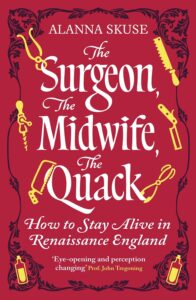
Alanna Skuse is a historian and the author of The Surgeon, The Midwife, The Quack: How to Stay Alive in Renaissance England, published by Oneworld Books.
Nathen Amin is an historian from Carmarthenshire in West Wales who focuses on the 15th century and the reign of Henry VII, and the author of Son of Prophecy: The Rise of Henry Tudor.