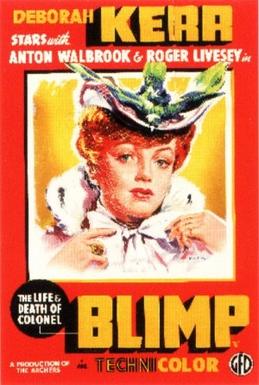
It’s now recognised as a British wartime classic made by one of the country’s finest-ever directors.
But The Life and Death of Colonel Blimp is a film that was debated four times by Britain’s War Cabinet amidst Winston Churchill’s hope that it could be banned.
So what happened? And how close did a film now described by the BFI as ‘one of the finest British movies ever made’ come to never being made at all?
The story starts with David Lowe’s cartoon character, Colonel Blimp, a reactionary imperialist, out-of-touch with modern life, and well-known to a Second World War audience. ‘Blimpishness’ had become a common term for a lack of imagination and dim-wittedness.
Writers and directors Michael Powell and Emeric Pressburger planned to cast Laurence Olivier as Blimp and give him a crueller and more vicious harder edge.
Early in 1942, they went to the War Office and the Ministry of Information with their plan and were told that Olivier – then serving in the Fleet Air Arm – would not be made available for such a production.
Having to recast with Roger Livesey, they softened the character, creating a sentimental but sympathetic figure, who, while still out-of-touch, had an endearing innocence and self-awareness which would help him find his way through the past to deal with the realities of a new total war.
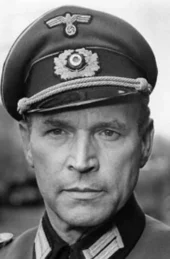
‘Blimp’ became General Clive Candy, a Boer War hero with an ongoing friendship with a German officer with whom he had fought a duel in the years before the First World War. By 1939, he has lost his wife, and his way – and the army no longer wants him.
Despite the changes to the script, Sir James Grigg, the Secretary of State for War, wrote to Powell that this was not ‘the sort of film to which the War Office could give its support’, therefore, denying the filmmakers access to military facilities.
But production went ahead, using props and uniforms from the wardrobe department at Denham and, according to film historian S.P. MacKenzie, army lorries bought and borrowed via the black market.
By September 1942, Churchill and Brendan Bracken, the Minister of Information, were in conversation about ‘special authority’ to get the film suppressed. Churchill supported the idea, but Bracken did not, and that month the film was one of seven items on the War Cabinet agenda, alongside issues such as military operations, aircraft losses, and air raids.
According to the meeting’s minutes, which are now held at The National Archives, Grigg reported that, ‘There was no existing Defence Regulation under which the film could be suppressed’, but an ‘approach’ had been made to the financier (J. Arthur Rank) so that the film could be viewed at the ‘rough-cut stage’ by the Government.
He added: ‘If [the Government] took the view the film was undesirable, [the financier] would arrange for it to be withdrawn.’
By May 1943, Grigg and Bracken – or at least their representatives – had seen the film. Grigg told the War Cabinet that it was ‘unlikely to attract much attention or to have any undesirable consequences on the discipline of the army’. The Cabinet endorsed his view that the film should be allowed to be shown.
Throughout, Powell and Pressburger remained convinced that the primary message of their film – which seems obvious today – was that a new type of mindset and warfare was needed to defeat the Nazis. Indeed, this is exactly the message delivered by the German character, Theo Kretschmar-Schuldorff, as he tries to shake Candy out of his old way of thinking. ‘Dear old Clive,’ he tells Candy. ‘This is not a gentleman’s war. This time you’re fighting for your very existence against the most devilish idea ever created by a human brain – Nazism.’
But the very suggestion that Britain would not fight a ‘gentleman’s war’ was one of things that so offended many in the Government.
And having a central German character who was attractive, sensitive and intelligent went very much against the grain at a time when films generally presented Germans as comic or cruel, or both.
Churchill was given a special screening of the film shortly before its premiere in May 1943 and, according to Roger Manvell, who worked for the Ministry of Information and became one of the foremost experts on films made in Britain during WW2, he found the film ‘disgraceful’.
At a subsequent meeting of the War Cabinet, the senior civil servant taking notes for the minutes, Sir Norman Brook, scribbled that Bracken reported that the ‘PM says doesn’t want it to go abroad. Can’t prevent it. And if I could, how [could] I stop it when so many Ministers attended the premiere.’
Brook had previously noted the Cabinet had concluded: ‘V. dull film.’
While the War Cabinet had wisely let the film go ahead, their judgement as film critics was somewhat lacking.
On release it became the second-most popular British film of 1943, with the Mass-Observation survey recording that people loved it for its fine acting and engagingly human characters. There was no evidence that this Technicolour masterpiece stoked any anti-army feeling in the lives of the wartime British public.
They loved it then, as many do today.
As the BFI notes, it remains ‘as deep, dark, delicately nuanced and quietly devastating as an Elgar symphony’.
Greg Lewis is the author of The Nazi Ghost Train: Evasion, Betrayal and Escape in Occupied Europe.