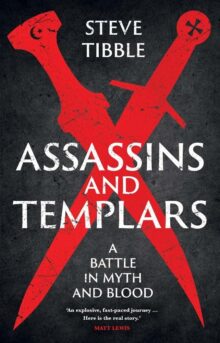
Assassins and Templars by Dr Steve Tibble is a panoramic history of two legendary organisations who appeared, grew and then faded away in a remarkably parallel way. So often these two groups are presented as foils to one another, in some ways defined by their mutual enmity, and yet Tibble’s book is all the more interesting because it focusses on their similarities rather than their opposition to one another.
Tibble steps back and a takes a broader, less Eurocentric view of the geopolitical context of the region across the centuries of the Crusading period. In doing so he presents both groups as they truly were; tiny minorities in a region that was dominated by major Sunni Muslim powers. The Assassins, as a minority Shia sect, and the Templars, as foreign Christians, were always at risk of being overwhelmed and both had to take similar actions to survive and to make themselves significant.
It is fascinating to see how both groups adopt the same strategy and tactics. Both use castles as force multipliers, both rely on a fanatical devotion to their cause with an unflinching acceptance of death at its heart, and both adopt a ‘corporate’ structure that gives them a surprising resilience in the face of unlikely odds. This corporate structure give both the Assassins and the Templars stability amidst the chaos of the dynastic struggles that beset both the Crusader Franks and the regional Muslim powers.
Indeed, Tibble points out that it is this very corporate structure that meant that the Templars were relatively invulnerable to the Assassins tactics. The Assassins’ primary modus operandi was the murder of powerful individuals. This was extremely effective at destabilising dynasties, but relatively ineffective against an organisation who could simply replace the man at the top with the next most competent person.
Tibble presents us with a story of Assassins who are not simply the scourge of the Crusaders, but players in a much bigger game in which the Crusaders and Templars are just other participants. It is a much more intriguing story and one that sees a real ebb and flow of power in the region meaning that, not only were the Templars and Assassins frequently at odds with one another, but there were times when their goals were aligned and, occasionally, periods when they were actually in alliance. It is a story of two groups that were constantly on the edge of annihilation and responded to this by projecting a ferocious image out to the rest of the world.
Tibble gives us the history in sweeping arcs of time punctuated by specific stories of courage, intrigue, and misadventure allowing a picture of both groups to emerge that is far more nuanced than the traditional view of them as mysterious death cults filled with super-heroically dangerous men.
The book does culminate in a slightly odd, extended review of the computer game Assassins Creed which will leave you wondering whether the book was funded by the game’s creators, but overall it is a very engaging and enlightening read that offers a fresh perspective on this compelling era.

Adam Staten is the author of Crusader, the most recent instalment of the Honour Bound series.