
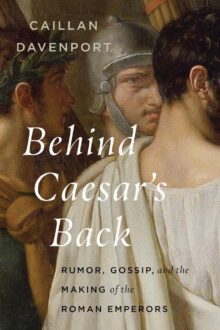
Caillan Davenport’s Behind Caesar’s Back is, for me, a rare book, in that it covers a subject I have not come across before and therefore opened up all sorts of new research ideas for me. The book investigates examples of gossip and rumour in Rome, from the end of the republic all the way to the Byzantine era, and the way these interact with the emperors in power. The first thing that struck me is what a wealth of evidence is considered here which many people would not even notice. Graffiti, stories and shows of satirical content, private letters and the like are all examined, as are songs and poems, and even images. Where many readers would content themselves with information gleaned from the histories of men like Cassius Dio or Herodian, it is surprising how often such historians themselves recount rumour and gossip, which gives a clue as to just how revealing and important these sources are.
The book examines said sources, from all across the empire, from all strata of society, men and women, various religions, examines the scale and the credibility of the information they contain, and presents a very solid and informative view of the effect of these tales. Once again, I had not always considered just how important they could be. In a form of “Chinese Whispers”, some gossip was so oft-repeated, and recorded by serious historians, that it has become the accepted ‘truth’, regardless of where the information originally came from, and so such gossip even colours our image of emperors today. Davenport gives numerous illustrations of how these rumours and stories actually affected the emperors they concerned, even forcing the emperor’s hand into changes in law and rule. In other cases emperors have acted in certain manners in order to quell rumours or even to avoid them starting in the first place. Gossip could even bring emperors down, changing public opinion and blackening names. Such words could, of course be deliberate smears, intended to bring about change, rather than base rumour.
The sources and their potential effects are studied in the book in the form of several different subjects, each also subdivided, so that we can examine sexual gossip, rumour surrounding the deaths and succession of emperors (remember the False Neros?), taxation, and so on, each subject teaching us different angles on the matter. It has to be said that the one thing I struggled with was the layout, and the approach to the subject, since throughout the book, I kept finding myself drawn back to certain ideas that I had already examined in earlier chapters because of the subject-driven form, and I feel it could perhaps have been a more straightforward read. That being said, not once over a week of reading did I pick up the book and not find myself drawn in and wanting to keep reading, burrowing down that research rabbit-hole, and that is a rare thing in an academic work at this level.
In all, for me the most important thing about the book is not that it introduced a new subject, but that it explored a subject we all knew was there, yet have rarely given much attention to. It made me think repeatedly on my own works and my own research, finding parallels in things I have written about, such as the altar from Dura Europos that uses the grandiose titles and names Commodus claimed, even many months after the man had died. In fact the notion that rumour and satire could so affect a ruler, I realised, is elegantly illustrated by the play-in-a-play in Hamlet. As Virgil said, “No other evil we know is faster than Rumor” and, like the modern internet, once rumour was spreading in Rome, it became virtually unstoppable.
My Roman reference library is large, and I do not often find a book that does not rehash a subject or idea already covered in it somewhere. This book does. It is new, interesting, and informative. Recommended.
Simon Turney is a bestselling novelist and historian and author of Caligula, the first in his Damned Emperor series.