
Annie Elliot – welcome to Aspects of History. What spurred you to write about Catherine Dickens? How did you first hear about her story?
I read Hamnet by Maggie O’Farrell and thought writing from the perspective of a famous man’s wife was a great idea. Charles Dickens became my favourite author when we studied his novels at school. Over the years I read many biographies and visited the Charles Dickens Museums in London and Portsmouth, so I already knew quite a lot about his personal life. When I watched the film Love Actually, I was moved by the scene where, in December, the wife sees her husband buying a beautiful gold necklace but, on Christmas morning, she gets a CD. I thought something similar had happened to Mrs Dickens and started my research, which showed she had received a bracelet Charles had bought for his mistress. When I read that, on her deathbed, Catherine Dickens had asked one of her daughters to give her letters from Charles to the British Museum ‘So the world may know he loved me once’ I was determined to use these letters to fulfil Mrs Dickens’s dying wish.
Has grappling with Catherine’s mistreatment at the hands of Charles Dickens altered how you read Dickens’ work?
There are many celebrated authors and artists with questionable private lives. It is debatable how much we should let this effect how we value their work. I have chosen to separate the despicable man from the genius author so I can enjoy all his wonderful novels without feeling guilty. It is important to remember he did much to highlight the plight of the lower classes and to bring about social change. He set up a home for ‘fallen women’ backed by Angela Burdett-Coutts who was one of the wealthiest women in the country. Prostitutes were given the skills to earn their living as domestic servants and seamstresses and to start a new life in the colonies. Despite all this, there is evidence that Charles used prostitutes and contracted VD. Another example of how he could not live up to his public image.
Why do you think it is so imperative to probe and understand the life and troubles of Catherine Dickens?
Because we may feel we have made progress since those days, but women still suffer in similar ways at the hands of rich powerful men today and children are still weaponised when their parents separate. Mrs Dickens was maligned during her lifetime and could not defend herself as she was totally dependent on Charles. When Victorian women married, they, their money, property and any children, belonged to their husband. Charles said his children would be free to visit their mother, but he made their life hell whenever they asked to see her. Mrs Dickens could not earn her own living. The best middle-class women could hope for was to become a governess. These teachers were regarded as little more than servants in the homes of rich families and, although Charles resented the cost of supporting her, he could not have any wife of his degraded as this would reflect badly on him.
It has been well established that Catherine’s younger sister Mary, a close companion of Charles, was the inspiration for characters such as Rose Maylie and Little Nell. Do you think there is a Dickensian character that bears a strong similarity to Catherine?
No-one can possibly know with any certainty what was in Charles Dickens’s head when he wrote but it’s fun to compare real-life and invented characters. I can’t see Catherine portrayed in his novels, but when Charles met Ellen Ternan, he published a vivid description of falling in love in Household Words, the periodical which he edited. There was also a particularly chilling article describing his feelings of contempt for someone who he wished dead because she was ‘in the way.’ I couldn’t help but think this was directed at Catherine. Charles had been really cruel to his first love – Maria Beadnell. He was very keen to arrange a secret meeting with her more than twenty years after she broke his heart despite her warning that she had become ‘fat, old, ugly and toothless.’ Charles didn’t believe her until they met. Seeing she had told him the truth he avoided her in life but not in fiction, using Maria as the model for pretty little Flora Casby, in Little Dorrit, and turning her into silly, old, fat Mrs Finching in later life.
As is evident through his numerous statements concerning their marriage, why do you think Dickens went to such lengths to villainise his wife in the public eye?
Charles sacrificed his wife’s reputation to protect his own when he decided to get rid of her to make way for his mistress. He invented the story that they had never been well-suited and that Catherine had always wanted to live apart from him and their children. Despite documentary evidence to the contrary – including what he wrote in his hundreds of letters to and about his wife over the years – he now stated she was lazy, incompetent, and suffered from a mental disorder which made her a cold distant mother. He would stop at nothing to get what he wanted whilst also safeguarding his reputation. Charles was terrified he could lose everything if the truth about his relationship with Ellen Ternan came out. Not only was she younger than his two daughters but she was an actress and they were considered on a par with prostitutes in Victorian times. He had never recovered from the trauma of being dragged out of school, aged 12, and forced to work long hours in a stinking boot polish factory when his father was locked up in debtors’ prison. Charles lived in fear all this life that the same could happen to him. He was about to embark on another reading tour, and a scandal would doubtless reduce ticket sales. He was a high earner but had spent a considerable sum of money leasing and refurbishing Tavistock House in London. He had also fulfilled his life-long ambition to purchase Gad’s Hill Place in Kent and improvements there, which included sinking a well, were extremely expensive. To his annoyance, family members, including most of his nine surviving children, also needed his financial support although he did not seem to resent all the money he spent on Ellen Ternan and her family.
Having researched meticulously into the life of Charles and Catherine Dickens, do you have any personal theories surrounding his estrangement and later separation from Catherine?
I believe Charles suffered what we would now call a mid-life crisis when aged forty-five and having been married for twenty-two years he fell in love with an eighteen-year-old actress. He blamed his wife for getting pregnant at least twelve times and, weighed down with the pressure of parental responsibilities, publishing deadlines, running a home for fallen women, reading tours, amateur theatricals and hosting the great and the good at dinner parties, he yearned for freedom from all this before it was too late. He feared old age was creeping up on him so was desperate to turn back the clock. He had attempted to recapture his youth with Maria Beadnell, but when this did not work out, he tried again three years later with Ellen Ternan. Her mother and three sisters were struggling to make a living on the stage, so it was hardly surprising that Mrs Ternan grasped the opportunity for financial security when a world-famous wealthy benefactor showed an interest in her youngest and least talented daughter.
It is understood that Catherine published a recipe book entitled, “What shall we have for dinner?” under the pen name Maria Clutterbuck. Are there any standout recipes in there?
Some of the puddings sound delicious and Catherine’s achievement in writing a best-selling book should be celebrated. But, having been a vegetarian since my teens, I was sickened by the variety and quantity of birds and animals they consumed. Finding a lamb’s head and liver on my plate would have sent me fleeing in horror from their dining room table. Mock Turtle sounds innocuous enough until further research revealed it uses calf heads, brains, tails, and trotters to replace the more expensive turtles.
Do you have any upcoming literary projects?
I am extending my initial research to include more about the children. My next novel will tell their stories. All the boys were sent to boarding school in Boulogne when they were about seven years of age. After that, Charles packed most of them off to the colonies in their early teens and they never came back. One died in India aged twenty-two and another was buried at sea aged twenty-five and so deeply in debt his father had refused to have him back in the house. Only Henry who became a barrister was a success in his father’s eyes. His eldest daughter succumbed to alcoholism and her younger sister entered a loveless marriage to escape the unhappiness at home after her mother was forced to leave. Just before he died Charles did express regret that he had not been a better man.
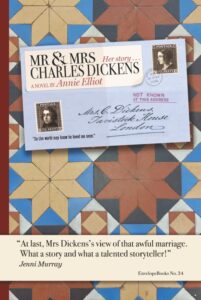
Annie Elliot is a writer and performer, and the author of Mr & Mrs Charles Dickens – Her Story – “So The World May Know He Loved Me Once”, her debut novel.
Dominic Mullens is an Editorial Intern at Aspects of History.