80 years ago, one of the great courtroom dramas of the 20th century took place in Germany: the Nuremberg trials of the top Nazi leaders. But while the whole world was focusing on events in the court room, a second, less well-known drama was also taking place in their prison cells. A team of Allied psychologists had been tasked with interviewing each of the defendants in an attempt to see what made them tick. What they discovered would never be used as evidence in court, but it might shed some light on how these seemingly ordinary men had been capable of directing the most appalling crimes against humanity in history.
All three of the psychologists involved in this project would eventually leave accounts of their interviews. But perhaps the man who had the most intimate contact with the prisoners was not the psychologists themselves but their translator, Howard Triest. It was Triest who spoke directly to these war criminals, forged personal relationships, even befriended them. His experience was utterly unique – and doubly so, because Triest himself was Jewish. His own family had been destroyed during the Holocaust, and for almost a full year, he had to sit face-to-face with his parent’s killers.
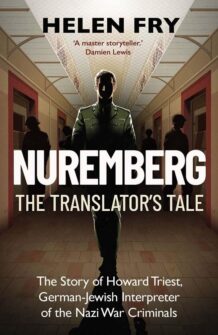
This book is the only full-length description of Howard Triest’s life, and the extraordinary time he spent in Nuremberg Prison during that year. It came about almost by accident, when Triest reached out to author Helen Fry in 2009. He had never told his full story before. But now he was ready.
Howard Triest was born in Munich in March 1923, and grew up in Germany during Hitler’s rise to power. As the Jews all around him faced more and more persecution, Triest himself seemed to be largely immune: his blond hair and blue eyes made him look like the Aryan ideal, and few people ever took him for a Jew. But his family’s relatively good fortune could not last forever. In 1938, after Kristallnacht, they finally fled. Howard was put on a boat to America; his younger sister was sent to Switzerland; but his parents were captured during the fall of France and sent to a concentration camp. Howard would never see them again.
In the following years Triest learned English, joined the US Army, and took part in the long liberation of Europe, starting with the landing at Omaha Beach just after D-Day. Because of his language skills he was eventually transferred to the Military Intelligence Service. He spent some time trying to find his family, and especially his parents, but eventually was forced to give up.
The rest of Nuremberg: The Translator’s Tale tells the story of Triest’s time as the interpreter at Nuremberg Prison. Day after day he was obliged to sit with Nazi war criminals, who trusted him, confided in him – but never knew that he was a Jew.
This book holds no new revelations about these Nazis themselves, beyond a few inconsequential details: we learn, for example, that the Nazi ideologue Julius Streicher was incredibly fastidious, and that the former foreign minister Joachim von Ribbentrop was contrastingly slovenly. What makes the book interesting is the story of Triest himself. How did he cope with spending so much time with these disgusting men?
According to Fry, Triest never held any bitterness or anger towards the men who had destroyed his family. But he was glad to see them facing justice. “Nuremberg was a great consolation,” he told her. “It could not bring back any life that I had lost, but it was satisfaction to have these monsters in a prison cell in front of me.”
Keith Lowe is a historian and the award-winning author of Naples 1944: War, Liberation and Chaos.