
Why did you choose the SOE as a subject for a novel?
The SOE occupies a special niche in Second World history. How could it not? The brilliance of its founders who conceived and wrestled into it into being, its personnel, the agents and exploits, both successful and disastrous, are the stuff of legend. Writing a novel about it offers the opportunity to dramatize its short but hugely impactful existence, its ambiguities plus the demands it made in summoning characters who metamorphose from one identity to another and the cunning and bravery demanded by the undercover operations.
What made you choose Ribérac in the Dordogne as the French location?
Familarity. I had been holidaying in the area for several years and knew the town and the villages surrounding it. A market town, Ribérac was in the unoccupied zone (until the total occupation of France in November 1942) but there was active resistance activity in the area. Knowing it so well, I could write about the topography, the buildings, the distances involved, the surrounding villages, including the house which the Gestapo used for interrogations. Whenever I went past it, I shivered.
How did you set about researching SOE?
Always the dangerously addictive moment in the process of wrangling a novel onto the page. I read whatever I could lay my hands on, beginning with M.R.D Foot’s SOE in France (the 1966 edition with fold-out maps of the circuits slotted into the back) and George Millar’s Horned Pidgeon, and went from there, via Pierre Lorain’s Secret Warfare: The Arms and Techniques of the Resistance to the biographies of agents of which there are now many. But the extraordinary moments arrived when I received a letter from Harry Rée, one of the fabled figures of the SOE, and when Francis Cammaerts, an equally fabled SOE figure, agreed to meet me in the Special Forces Club. Both men were generous with their information, especially with the small details. Francis Cammaerts told me that to appear authentic in the field as a farm worker – which at a certain point was one of his covers – he had to consume quantities of red wine before lunch. It tested him.
What are the themes in Light of the Moon?
I was very struck when Francis Cammaerts said to me: ‘war taught me to love people’. This tied in with another strand about which I had been thinking. Directly after the war in 1946, my aunt married a German who had fought on the Eastern front – a war begun, as he put it, brought about ‘by a political criminal’. He was a wonderful man and their marriage which flew in the teeth of what had so recently gone before was an object lesson both in the power of a romantic relationship and the power to reconcile and to forgive.
Light of the Moon has recently been reissued. Would you write the same way today as you did originally?
I would tighten it and prune some of the language. I certainly bring more experience to characterizing what happens to the psyche when someone is put into an abnormal and dangerous situation, such as the SOE agents in the field were. However, the struggle between loyalty, patriotism and deep feelings would remain a central part of the novel.
Have you had any comeback?
After it was originally published the phone went and a female voice asked if I was the author. Intrigued I replied I was. ‘Good,’ she said. ‘My name is Noreen Riols. I worked in F-Section in Baker Street and in Beaulieu and I loved your novel’. Thereby began a friendship that lasted until her death in 2025, a friendship I treasured. She was incredibly generous with details and anecdotes and fierce about proselyting the work of the SOE. I visited her at her Paris home and liked to think that my urging her to write her memoir, The Secret Ministry of Ag. and Fish: my life in Churchill’s school for spies (2014), helped to act as a catalyst.
The SOE continued, continues, to fascinate. I went on to write a second novel about it, I Can’t Begin to Tell You, this time set in Denmark. It was triggered by the extraordinary story of Monica de Wichfeld. Born into an Irish family, she married a Danish landowner with a house and estate on the island of Lolland which included a lake. During the war, she worked with the resistance (her son-in-law worked for the SOE). She hid men on the run and guided the RAF weapons drops into the lake and rowed a boat across it to collect the materiel. She was betrayed, tried and died in Waldheim. Rightly, she is now considered a Danish heroine.
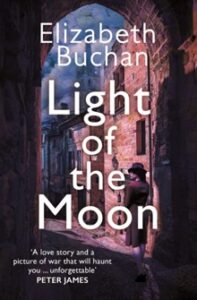
Light of the Moon is the Aspects of History Fiction Book of the Month. Elizabeth Buchan’s latest novel, Woodspring (Corvus), will be published on April 2nd.