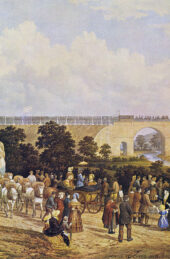

In 1756, the East India Company decided to strengthen its position in Kolkata by investing heavily in new fortifications. The Indian city had grown from only a few thousand people to around 400,000 in only fifty years – larger than any town in Britain’s American colonies. For the Company, this booming prosperity represented opportunity; for the Nawab of Bengal, Siraj-ud-Daulah, it looked like a threat. Alarmed by the city’s expansion and the independence of its wealthy new residents, he launched a sudden attack.

Scene of the Black Hole (c.1905)
Overrun and captured, the British inhabitants were imprisoned in a cramped dungeon that became infamous as the ‘Black Hole’. Dozens died of suffocation and heat exhaustion within hours. Survivors’ accounts, published in Britain soon after, shocked readers and turned the episode into a symbol of Indian cruelty and British suffering. Pamphlets, sermons, and newspaper reports retold the story, blending outrage with a call for retribution.
Retaliation came swiftly. The Company’s forces retook Kolkata within months, and fresh conquest followed. Its commander, Robert Clive, urged London ‘in the strongest manner to send out as large a military force as you can’. He was not to be disappointed. The Company dispatched a fleet of 19 heavily armed ships to Asia, while the British state lent five Royal Navy warships to the private armada. It was a muscular demonstration of how public and private enterprise could act in concert, fusing commerce, capital, and military power – and it was the first overt sign of the ruthless system that would define Britain’s rise.
Over the following year, Clive and the Company’s private army fought their way to dominance in Bengal. After victory at the Battle of Plassey in June 1757, the Company overthrew the Nawab and replaced him with its ally, Mir Jafar. The new ruler granted Britain’s merchants extensive trading privileges, territorial rights, and a massive indemnity to compensate for their wartime losses.
Officially, the Company portrayed the campaign as a defensive measure – a necessary act to protect British lives and property in Kolkata. Yet the correspondence that crossed between the Company’s agents in Asia and its directors in London revealed a deeper strategy at work too. For Clive and his contemporaries, conquest was not simply a matter of imperial prestige or political control: it was an investment. Victory in Bengal promised improved commercial opportunities and access to the revenues of one of the world’s most productive regions. The Company’s directors justified the vast costs of troops, fortifications, and fleets on the grounds would yield returns greater than any venture at home. Peaceful commerce secured with the roaring fire of guns.
The conquest of Bengal added yet another territory to Britain’s expanding dominion. In the previous century, warfare and colonisation transformed the empire’s scale and ambitions. Naval power protected commercial shipping and disrupted rival economies, while the demands of war spurred new industries that turned out unprecedented volumes of cannon, muskets, and ships. Every campaign, from the Caribbean to the Low Countries, generated contracts, commissions, and commercial opportunities. Conquest, defence, and manufacture became intertwined, each feeding the other.
By the mid-18th century, warfare was a booming business. From generals and investors to suppliers and shipwrights, a growing number of Britons found ways to profit from violence. The pursuit of profit through war was just one example of how Britain’s economy had learned to maximise gains from every form of enterprise, even destruction.
The Longer History of Improvement
Britain’s violent imperial expansion was one crucial factor that helps explain Britain’s rise to wealth and power. But it was not the only one. The battlefields of Bengal, like the steam-powered mills that followed a generation later, were outward expressions of broader changes in Britain’s economic culture and organisation that had been developing for more than a century. Long before Clive’s soldiers marched at Plassey, Britons had been boosting profits by expanding extractive industries, exploiting workers, and investing in innovation across the economy.
When Charles II returned to the throne in 1660, the kingdom was still recovering from the shocks of Civil War. Yet, his Restoration also coincided with a burst of optimism about what human ingenuity might accomplish. Across agriculture, manufacturing, and trade, people began to speak of “improvement” – a word that meant profit, progress, and productivity at once. Land could be improved by enclosure, metals by new smelting techniques, ideas by experiment, and an imperial domain expanded through conquest.
This changing intellectual milieu was vital, but its impact depended on a much broader set of conditions. Inventors did not change the world with an idea alone. They needed partners to invest in and implement their vision, workers to execute it, natural resources to fuel their machines, and markets to buy their products. Creativity and invention mattered, but they thrived within economic systems that were as ruthless as they were dynamic. Britain’s transformation into a global economic power rested not only on new technology, but on changes in how people exploited land, labour, and the rapidly globalising world.
At home, workers left the fields for cities, mineral wealth was wrenched from the earth in ever-greater quantities, and a manufacturing base that had long perfected woollen cloth turned to cotton. New centres of wealth emerged in Manchester, Liverpool, Birmingham, and Glasgow, with mills built first along rivers and later beside the canals that carried goods to distant markets. Overseas, Britain violently expanded its empire, conquering and claiming lands across the world, and trafficking millions of enslaved labourers to work on them. These colonies supplied raw materials and tropical produce for consumers in Britain, rewriting the map of supply and demand.
It was this array of changes that were taking place in Britain that has made it so difficult to identify the cause of Britain’s remarkable transition into the first modern economy. Was the Industrial Revolution the result of new machines, which produced goods with miraculous efficiency? Or did it rest on natural abundance, which provided coal, ores, and food for its labourers? Or was it colonies, where a brutalised enslaved workforce produced the cotton that its factories consumed? In truth, it was all of these at once – a confluence of forces that can only be explained by understanding how it was possible for all these triggers for profit to be pulled together. Understanding Britain’s rise means seeing it as a vast web of interconnected activities – mining, manufacturing, agriculture, war, and empire – that changed together and reinforced one another.
Cotton, Slavery, and Steam
By the early 18th century, these patterns of enterprise were reinforcing one another – in ways that could be seen in the muscular display of hard power by the East India Company in Bengal. Metallurgists in the Midlands supplied the iron fittings that armed the navy’s ships; those ships protected the trade routes that carried sugar, timber, and cotton into British ports; the profits from trade financed further invention. It was a self-reinforcing system in which each act of improvement created new opportunities for others. The links between war, commerce, and manufacture became impossible to untangle.
By the final decades of the 18th century, the logic that had driven Clive’s conquest of Bengal had spread to every corner of Britain’s economy. Profit was not merely a motive but an organising principle behind a vast, interdependent system. Nowhere was this more visible than in cotton: a global commodity that linked Britain’s workshops and mills to the plantations of the Caribbean, the ports of Liverpool and Glasgow, and the markets of India.
When the East India Company first imported Indian cottons in the 17th century, their lightness and colour transformed European fashion. Muslins and calicoes dazzled consumers and inspired imitation, but they also posed a problem: Indian artisans produced cloth of a quality Britain could not match. Parliament responded with protectionist Calico Acts, banning Indian cottons to defend domestic woollens and linens. Yet behind those restrictions, manufacturers were already experimenting – spinning, weaving, and dyeing in new ways – to capture the same lucrative trade.
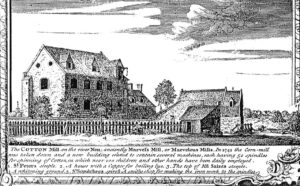
Marvels Mill, Northampton – the earliest pictorial representation of a cotton mill (1746)
The necessary material, however, could not be grown in Britain. From the 1750s, the same networks that carried sugar, tobacco, and enslaved people across the Atlantic began shipping raw cotton from the Americas. Imports surged from a few hundred tons early in the century to tens of thousands by the 1790s. The port of Liverpool, enriched by its role in the slave trade, became the main gateway for this new fibre. The profits of slavery and the demands of manufacturing became intertwined. As enslaved workers in the Caribbean and North America planted and picked the crop, British ships carried it home to be spun and woven in Lancashire mills. The same shipbuilders, insurers, and financiers who had once traded in people now underwrote an industrial revolution.
Inside Britain, the mechanisms of improvement honed over the previous century found a new outlet. The infrastructure of patents, partnerships, and practical experimentation coalesced around cotton. Figures such as Richard Arkwright, Jedediah Strutt, and Samuel Oldknow turned the craft of spinning into an industrial process. Their achievements depended not only on invention but on the networks that linked inventors to investors, mechanics to merchants, and engineers to empire. Water and steam power multiplied labour; iron tools increased precision; and every new device fed into another industry.
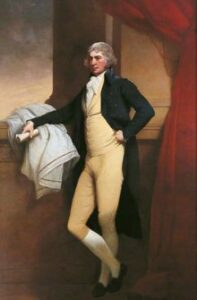
Samuel Oldknow, by Joseph Wright of Derby (1790-92)
By 1800, this entanglement of war, empire, and enterprise had become the defining feature of Britain’s economy. The proceeds of colonial trade financed industrial expansion; industrial tools supplied empire; and empire, in turn, created new markets for British goods. Each link in the chain added value to the next. The same incentive to ‘improve’ that justified draining a marsh or perfecting a pump could just as easily be applied to reorganising labour on a Caribbean plantation or replacing Indian textiles with British imitations. The ruthless pursuit of profit could be applied as readily to human labour as to land, machines, or markets.
The Machinery of Continuous Growth
By the turn of the nineteenth century, Britain had learned not just how to make goods but how to create a system that made continuous growth possible. Its capitalists understood that wealth came from linking different kinds of resources – human, natural, mechanical, and intellectual – into systems that reinforced one another. Innovation in metallurgy made stronger engines, engines increased mining output, coal fed the furnaces that smelted more iron, with the resultant metal used for rails and machinery that drove industry forward. The same pattern could be seen in finance, trade, and empire. Networks of trust and correspondence connected provincial merchants to colonial factories, inventors to investors, shipyards to foundries, and mills to markets half a world away.
Applying this dedication to efficiency and innovation across such a wide range of activities could not be achieved by any single person, business, or even by the state. It rested on an economic and legal culture that valued profit and allowed capital, skill, and information to circulate freely. The boundaries between the commercial interests of merchants, craftsmen, landowners and colonisers were increasingly porous, with corporations, guilds and partnerships all welcoming financial and intellectual capital from across these groups. Although many people specialised in one area, the opportunity to invest expertise and cash across sectors created the conditions for sustained and connected growth.
Institutions developed that made it easier for capitalists to work together. Informal but widely accepted rules of business were flexible enough to weather political and social change, providing the predictability on which trust and credit depended. Webs of social and cultural interaction tied capitalists together and spread ideas, techniques, and opportunities across industries. In turn, further networks and exchanges multiplied its reach, connecting the exploitation of land and people across Britain and its empire with scientific and technological advancement.
This widespread quest for profit, and the intricate networks it produced, made Britain’s rise extraordinary. It also made it enduring. For better and worse, the habits of thought that turned profit into the measure of progress, and improvement into a universal goal, outlived the empire that first gave them form. The machinery of enterprise that powered Britain’s ascent has never stopped turning and its rhythms still shape the world we inhabit today.
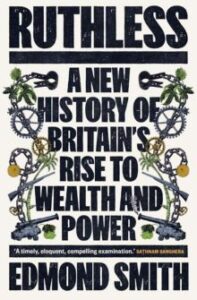
Professor Edmond Smith lectures on Economic Cultures at the University of Manchester and is the author of Ruthless: A New History of Britain’s Rise to Wealth and Power, 1660–1800.