“It is with heavy heart that I tell you we have to cease fighting. Last night, I asked our adversary whether he was prepared, between soldiers, after the struggle and in honour, to seek a way to end hostilities.”
These were the words of France’s new prime minister, 84-year-old Marshal Philippe Pétain, hero of the Great War. He broadcast them on 17 June 1940, thirty-eight days after the Germans invaded Belgium, Luxembourg and the Netherlands, thirteen days after the 40,000 troops of the French rearguard at Dunkirk had surrendered and seven days after German troops had broken through new French lines on the Rivers Somme and Aisne. As he spoke, the Panzers were heading south through the open Champagne and Argonne countryside towards the towards the Swiss border and the rear of the Maginot Line.
The Maginot Line fortifications had achieved their primary purpose, which was to seal the German border and thus force the enemy to take the riskier Belgian route. That was a sensible strategy, but it depended on not losing the first battle. Now, the 400,000 men defending the Maginot Line risked being netted like those in Belgium, but with no hope of evacuation.
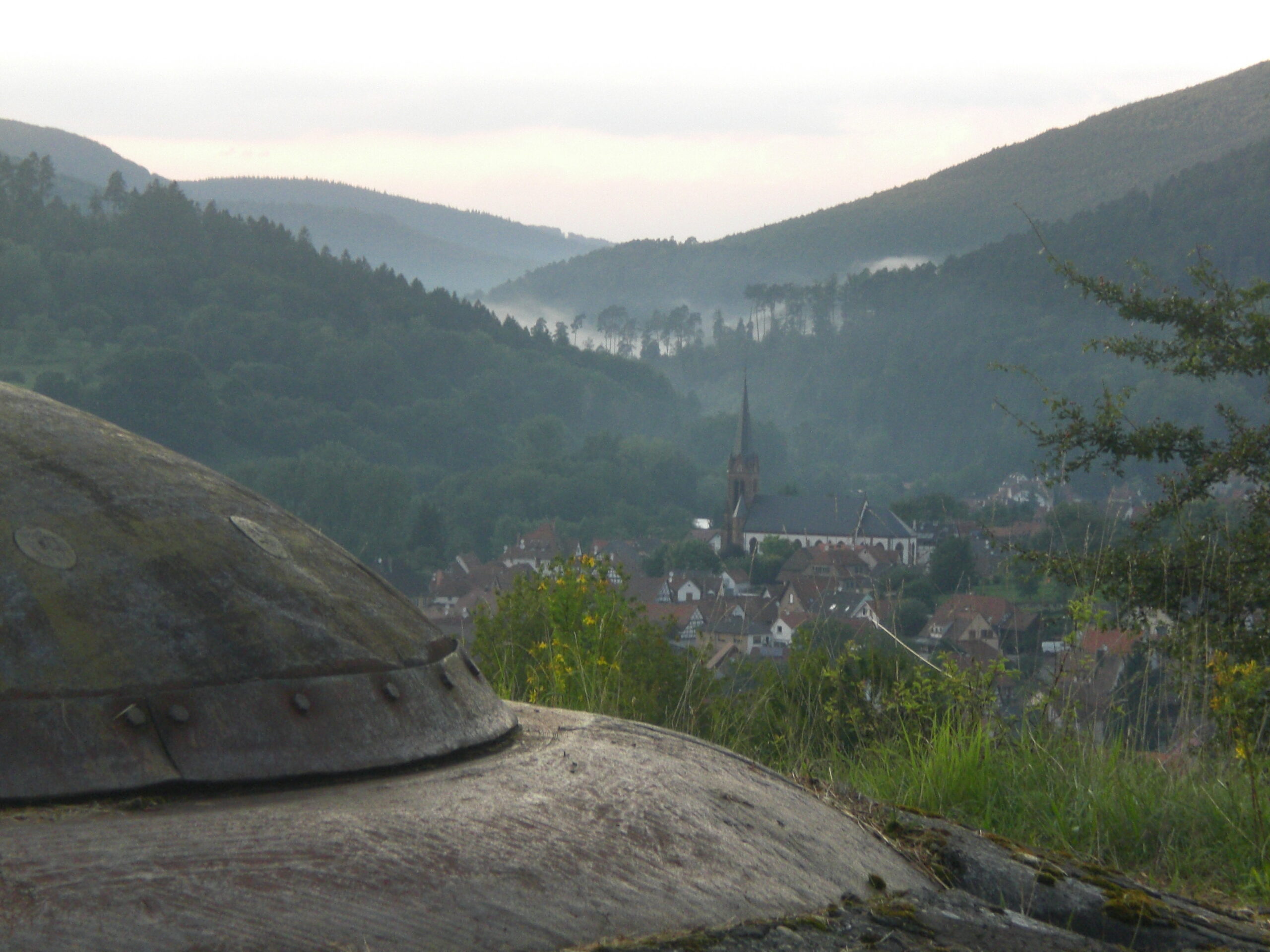
On the 270 kilometres from the intersection of the French, Belgian and Luxembourg borders to the Rhine, the fortifications consisted of nineteen huge artillery forts (gros ouvrages), and twenty-six infantry forts (petits ouvrages) armed with machine guns and antitank guns. They were supported by thousands of artillery and machine-gun casemates, infantry shelters and small blockhouses. The Rhine was defended by machine-gun casemates at the major crossing points and smaller works between and behind them.
The fortifications were constructed using the most modern radio, telephonic, electrical and mechanical technology. They were commanded using new managerial methods borrowed from modern corporations and from the navy. Combinations of flanking casemates, turrets and indirect fire howitzers and mortars allowed the forts – in principle – to mutually support each other and cover all angles of attack. Command posts, power plants, barracks and hospitals were deep underground, connected by galleries – often with electric trains – to multiple combat blocs at the surface. Maginot Line forts were meant to be capable of resisting for three months, even if surrounded.
Pétain’s broadcast over, Captain René Lhuisset, commander of the Welschhof fort, assembled its crew in the main gallery, deep underground. But what should he say? Pétain’s words were ambiguous. He had told the French to cease fighting. Yet asking the Germans for talks was not the same as a ceasefire. Was the war over or not? Although next morning the papers and radio rephrased Pétain’s words to say that ‘we must attempt to cease fighting’, the damage was done. Lhuisset decided to remind the crew that their mission was unchanged: ‘resistance without considering retreat’. Doubtless in the back of Lhuisset’s mind was often-repeated expectation that the commander of a Maginot Line fort, like the captain of a warship, must go down with his ship.
Lhuisset was aware too that Welschhof was not invulnerable. The Maginot Line as it existed, never matched the grandiose plans of its architects. It was a petit ouvrage armed only with machine guns and antitank guns. Since supports for its 50mm mortars had never arrived, it was vulnerable to enemy infiltration through dead ground and shell holes. The artillery of the neighbouring gros ouvrage, Simserhof, could cover Welschhof only in favourable winds. Unlike larger forts, Welschhof did not possess a long gallery leading to entrance blocs in the rear, which provided an escape route and fresh-air. Its intakes and exhausts were positioned in the fort itself. Lhuisset knew that that the entire crew of a similar fort had suffocated thanks to explosives thrown into the fort by enemy infantry.
Lhuisset packed his personal effects for departure and wrote an order advising his men how to behave towards the Germans. His lieutenants, after a ‘painful discussion’, persuaded him not to issue it, for they were determined to hold out until the armistice came into effect, so that they would not, they expected, become prisoners of war. Among the officers most committed to resistance were men from the largely German-speaking province of Alsace-Lorraine, in which most forts were sited.
The Maginot Line belongs not only to the military history of the Second World War, but to the troubled history of the ethnic and linguistic minorities in disputed European borderlands – a history that is far from over. The Germans had annexed Alsace-Lorraine following French defeat in the war of 1870-1 on the grounds that since its inhabitants largely spoke German dialects, they must be German. France recovered the province in 1918 following World War One. Most Alsace-Lorrainers probably preferred French to German rule, but their loyalties were complex. Some were fiercely French, while others saw their province as a bridge between France and Germany and most were attached to their province’s linguistic and cultural difference. Many supported regionalist and autonomist parties. A few backed the Nazis. The army and security services saw autonomism as a façade for German attempts to recover the province. They believed that Alsace-Lorraine would be Hitler’s next target for inclusion in the Reich after Austria, the Sudetenland region of Czechoslovakia and Danzig (now Gdansk in Poland). In all these regions, there had been considerable support for union with Germany. The Maginot Line had been built partly to demonstrate to Germany and to Alsace-Lorrainers that the province was irrevocably French.
Yet the army faced a dilemma. Since the fortifications had be ready to respond to a surprise German attack, they required reinforcement by reserves resident within ten kilometres – necessarily, most such men were Alsace-Lorrainers. After mobilisation in September 1939, up 60 per cent of fortress regiment troops were recruited from among them. Many did not speak French and some had fought for Germany in the 1914–18. Although vetting ensured that most Alsace-Lorraine officers in the ouvrages – like those at Welschhof – were nationalists, troops from the so-called ‘Interior’ distrusted them. Relations between French and German speakers were never good. The material difficulties of life in the underground fort during the eight long months of the phoney war did nothing to improve interpersonal relations.
The ouvrages had been designed to improve the conditions of the troops, thus countering communist criticisms of the treatment of conscripts and improving their combat effectiveness. Yet even in peacetime, living in an ouvrage was a trial. It was close to intolerable during the eight long months of the phoney war. Thanks to a shortage of trained replacements, crews had little hope of relief or leave. In one of the worst winters on record, the men could not even leave their forts to breathe fresh air. The galleries were cold, usually no more than 13 degrees, though central heating had been installed in the sleeping quarters of most forts. Water from multiple underground springs seeped into masonry-lined galleries, for there was insufficient money to concrete or even render them all. Soiled air from kitchens, latrines and weaponry spread through the forts. In summer, warm air from outside condensed in cooler combat blocs. Ventilators were usually turned only for eight hours per day. Cold, damp and lack of natural light contributed to a state of low-level depression and lethargy which the crew called ‘bétonite’ – ‘concretitis’.
The day after Pétain’s broadcast, the Welschhof crew learned that the Germans had broken through the Sarre sector (Saar in German), which was defended only by casements and planned flooding, and that on the following day they had crossed the Rhine too. By 19 June, enemy troops were in the rear of their own little ouvrage.
As tension rose between advocates of resistance and capitulation at Welschhof, wild rumours spread across the fortified zone, fuelled by German loudspeakers urging crews to surrender or suffocate like their comrades elsewhere. Alsace-Lorrainers who had been born in Germany or who had deserted the German army during the First World War to fight for France feared being shot as spies (the administration had issued some of the latter with false identities). Some soldiers became convinced that their commanders were Germans masquerading as French. Doubtless many had read the novel Double Crime sur La Ligne Maginot, authored pseudonymously by a serving officer, or seen the 1937 film adaptation, in which a model French officer turns out to be a German spy in disguise. They might also have read Commandant Cazal’s 1939 pulp novel, Maginot – Siegfried, in which a German secret weapon, capable of penetrating three metres of concrete, falls like a ‘shining meteor, streaking through the air like a steel cone’, exploding with a ‘flash brighter than the sun’, turning a fort into twisted scrap metal. In one ouvrage, the rumour spread that if the crew capitulated, it would be allowed to return home, but that if it did not, one in three men would be executed.
The defenders of the Maginot Line did not know that their fate depended on a titanic battle in high places. On one side stood General Charles de Gaulle, backed, somewhat less resolutely, by leading politicians, including Prime Minister Paul Reynaud. They had urged a staged retreat of French troops either to Brittany or to France’s North African Empire, from where they would continue the fight. Few, if any, knew that de Gaulle had flown to London, or that on 18 June he appealed to the French people to resist. On the other side stood Pétain, the Generalissimo of French forces, Maxime Weygand, and almost the entire high command. They had planned a last stand for honour on the rivers Somme and Aisne, followed, in the likely event of a German breakthrough, by the rapid conclusion of an armistice. They forbade Maginot Line troops to retreat in the expectation that an armistice would save them from capture. They hoped thus to save the French army to keep order and prevent communists from profiting from the defeat. Yet the armistice was not signed until 22 June, and became effective only on the 25th. Hitler was determined to delay conclusion of an armistice until his troops had assaulted the famous Maginot Line and recaptured Alsace-Lorraine.
Kevin Passmore is a Professor of History at Cardiff University and the author of The Maginot Line: A New History, published by Yale University Press.