
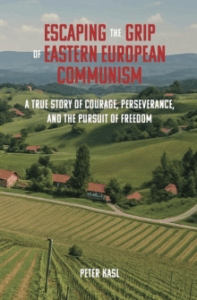
In an exploration of some of the most difficult times of his life, Peter Kasl details his trip as an 11-year-old with his family to flee the communist rule of Czechoslovakia. Escaping the Grip of Eastern European Communism allows a first-hand insight into the intensely frightening yet courageous path many Eastern Europeans found themselves on as they faced possible imprisonment and punishment in the hopes of securing political and personal freedom. Many of us will have learnt about or lived during the tumultuous times of the reign of the Soviet Union, yet few can say they know what it is to experience the grinding gloom of dictatorship and yet persist in emancipation.
One thing Kasl gives us that is so important is that account of the whole experience, and the all-important individual perspective. Though clearly not a seasoned writer, his memoir nevertheless succeeds in providing something more valuable than exceptional writing; he tells us of the fear people had of the regime, the fear of being betrayed, of not even trusting those you think are close to you, and moreover, the fear of certain captivity and possible death should you pursue a better life for yourself. In making the decision to leave Czechoslovakia through evading authorities, and make for asylum in the USA, Kasl’s parents created this better life for their two sons, and did so by denouncing communism to the last.
We are able to gather a proficient insight into both Czechoslovakia under Communist rule, and mid-80s USA through this documentation. Going from an existence where your thoughts themselves are urged to hinge upon the idea of communism, your religion is to be communism, and your future depends on your membership to the Communist party, to a completely different world of capitalistic venture and religious freedom, Kasl details plainly and practically the differences that occurred both in society and in people’s inner world at the time in the two countries. As a man who has experienced being a national of two separate countries with vastly different cultures and politics, he tells us of the ideological discords from a Communist country to a capitalist one, and within that, the discord between the status quo of Czechoslovakia under communism, and Czechoslovakia after the fall of the Soviet Union. Everyone is not as cheerful after the Velvet Revolution as they thought they might be…
This is not only an incredibly poignant record, but it also serves to remind us that history is cyclical, and it informs everything we know today. This story may ring true for today’s asylum seekers, Britain’s hotly-debated few who face discrimination from right-wing rhetoric, or perhaps even the USA’s immigrants facing persecution in pursuit of the American dream. As Kasl’s own narrative shows through the alarming attitudes of West German villagers once his family successfully makes their escape, breaking free from oppression by way of international travel is never easy. Not many are able to even make it far enough to find out what prejudice awaits them.
Through this anecdote we are able not only to understand much more about life under Eastern European Communism, but are also able to listen to a tale of immense bravery and cunning. Perhaps we may not think these fairytale notions befit any true story, yet Peter Kasl’s family’s (and others alongside) abilities and actions show us such strength of character we may be inspired to rethink that idea. Something that millions of families have gone through probably throughout the history of time, that is, fleeing persecution and seeking asylum in a foreign country, is put to us here intimately. It is a tale of survival and of humanity’s knack for it, in times of despair.
Carmina Gallus is an Editorial Intern at Aspects of History.