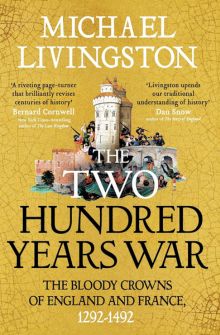
Michael Livingston’s new book pours fresh wine into a very old bottle: the subject of the Hundred Years War has been covered in detail by many historians, notably the multi-volume work by Jonathan Sumption. Livingston attempts to break new ground by extending the timespan of the conflict (from 1292-1492) and moving away from Anglocentric narratives. Instead he views France as the main driver of the war, and incorporates other rival powers into the mix. These are, principally, Scotland, Brittany, Flanders, Navarre and Burgundy.
Livingston’s ambition is commendable, but the subject is too vast, especially for a single book. The early section is marred by some factual errors and questionable interpretations. The author states that Edward I did not lead his armies in Scotland in 1304-5, when the king was very much present and in command. His suggestion that Edward meant to take possession of Flanders, by marrying his heir to Count Guy’s daughter Philippa, is unconvincing. Guy had several male heirs, and there is no reason to suppose Edward entertained such a scheme. Flanders and Scotland aside, Livingston makes little of the vast network of alliances Edward and Philip IV assembled from 1294-97. This is a strange oversight, especially since Edward’s strategy of encirclement was copied by his grandson, Edward III. More attention could be paid to Welsh infantry, since the first three Edwards could not have waged effective war without them.
After this rocky start, the book improves considerably. Livingston has a knack for writing accessible history, and keeps the narrative flowing without getting bogged down in detail. He is especially good at describing battles with taut, vivid prose that sticks in the memory: the description of Bannockburn as a “slow-rolling horror” for the English; Henry V’s bowmen at Agincourt using daggers to “dig for arteries”, and so on. Away from the famous battles, Livingston also devotes space to lesser-known engagements such as Cassel (1328), Cravant (1423) and Verneuil (1424). His expertise as a military historian shines through, and it is difficult to pick holes in his analysis of strategy and battlefield tactics.
I was less convinced by Livingston’s argument that the timeframe should be extended to the Peace of Étaples in 1492. The ‘Hundred Years War’ is a later construct, and one could shift the dates about endlessly. Why not go all the way back to Henry II’s marriage to Eleanor of Aquitaine, for instance, or King John’s loss of the Angevin territories? The end of the war is traditionally dated to the fall of Aquitaine in 1453, and this remains persuasive. The subsequent French expeditions of Edward IV and Henry VII were little more than shows of force, with strictly limited objectives. After 1453 the English could not realistically aim to conquer France, and knew it. Even so, they would launch further invasions, until Calais, the last English possession, was lost in 1558. That would seem as good a marker as any, though The Two Hundred and Sixty-Six Years War has less of a ring to it.
David Pilling is a historian, specialising in the wars of Henry III and Edward I in Wales, and the author of the Outlaw Knight series, the latest of which, Empire, is out now.