
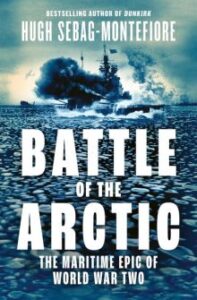
In Battle of the Arctic, a magisterial and exhaustive chronicle, Hugh Sebag-Montefiore lays out the perils faced by Allied merchant and naval forces ferrying supplies to Stalin’s Soviet Union with a very well-judged mixture of original testimony – much of it mind-bendingly dramatic – and cogent political analysis.
For those on convoy duty in these latitudes, plunging temperatures and incessant storms compounded the threat from German aircraft and U-boats. Some of the most evocative passages of this ‘you are there’ book are about ice-coated decks, skin frozen to metal and the struggle for relief from the incessant cold via duffle coats, sweaters, long johns and endless mugs of cocoa. And that was the fate of those lucky enough to be still afloat! Stories of sinking ships, with injured crewmen adrift in overcrowded lifeboats, or lashed to rafts in frozen seas, make up the book’s most powerful and poignant passages.
Stalin constantly begged his new Western allies for a second front to ease the pressure on Moscow. Pending D-Day, Churchill and Roosevelt sought to assuage him with war material instead. The political pressure to sustain the convoys was thus immense.
The low point came in the summer of 1942 with the disastrous Convoy PQ 17, a cinematic story that Sebag-Montefiore tells particularly well. Alarmed by decrypts suggesting that the battleship Tirpitz was poised to attack, First Sea Lord Admiral Sir Dudley Pound directed the convoy to scatter. But Tirpitz remained in port and so, but bereft of naval escort, well over half of the merchantmen fell prey to the submarines and aircraft. Sebag-Montefiore mounts a spirited defence of Pound, long pilloried for this decision, contending it was defensible, even sensible, given the intelligence at hand. Stalin’s fury – and his suggestions of British cowardice – was predictable, and voluble. In fact the small quantity of Soviet gratitude for the astonishing sacrifices made by British-led Allied forces in the Arctic is a common theme of this book, as is the surprisingly cold welcome these heros sometimes received when arriving in Murmansk or Arkhangelsk.
But it wasn’t only the British who suffered. The horrors endured by the crew of the sunken Soviet freight Dekabrist read like a script from a Guillermo del Toro movie, a twisted version of the Shackleton survival epic but with rather more Polar bears munching on human flesh. The endurance of the crews from many nations in situations like this is a constant theme – one of whom, appropriately named Shackleton himself, found that ‘even the atheists who had shirked all church parades were soon calling on God to deliver us’.
With its impressive presentation of data – and some wonderful maps – the book highlights just how critical aid by this ‘northern route’ was in the early years of the Soviet-German war, and Sebag-Montefiore explicitly puts the lie to claims by modern Russian politicians and historians that the Western powers only drip-fed supplies to their ally, and wanted to fight World War 2 largely with Soviet blood.
Every stage of this book is told in an exciting page-turning style, but that leads me to my one criticism – the sheer number of pages there are to turn. No matter how well written, ‘exhaustive’ can become, well, exhausting. I know from my own experience that, after years of research, writers sometimes feel the need to put it all out there but, in this case, a hundred or so pages could probably have gone, making it feel less of a challenge to the general reader, and probably knocking five pounds off the cover price.
But this is but a semi-quaver of criticism of what is a truly symphonic, definitive account that is unlikely ever to be matched in scale and ambition.
Phil Craig is a bestselling historian and the author of 1945: The Reckoning: War, Empire and the Struggle for a New World.