
Welcome Alice, and congratulations on a third book in as many years. This latest release puts a spotlight on the life of Eleanor of Castile, Queen of England and wife of Edward I. Unlike your previous books, Uproar and Eighteen, you have built up the story of her life around your walking of the route her body took from Lincolnshire to London. Take us through the process behind writing Eleanor compared to its predecessors.
The book was led by the physical act of walking itself – which was a totally different approach to my other books. Instead of trawling through archives or poring over library books, I was out in the Lincolnshire countryside, buffeted about by the December weather. But it was only by walking – by travelling at the natural human pace – that unexpected revelations arrived. Small, surprising details – the words on a tombstone, an information sign hidden in the reeds, a clank of a gate – began to jump out at me. I saw so many things that I wouldn’t have done from a bike, car or library desk.
You cover a hell of a lot of ground – both the 200 miles but also historically. As well as tying in so much detail about what life was like in 13th-century England and the fates of the crosses set up in Eleanor’s memory, there are fascinating accounts of the towns and villages you walk through, their quirks and the remnants of the crosses’ legacy. Researching such a book and sifting through that amount of material must have been an equally monumental task?
Unlike previous books I’ve written where there was a clear chronological narrative to work with, the structure of Eleanor was tricky. How does one weave together the walk itself, medieval history, the life of Eleanor, the death of Eleanor, the memorial of Eleanor over 734 years, plus a few interviews with stonemasons and artists along the way? It was a lot to weave together, but the structure of going on a journey was immensely helpful. There is a natural narrative created, and a tension from the constant unknown of whether you’ll make it to the end, and what that end might uncover. Luckily, this journey ended at somewhere pretty spectacular – the tomb of Eleanor, beside the shrine of Edward the Confessor in Westminster Abbey.
In terms of writing a walking history such as this, did you feel the need to lean into the tradition of travel writing as much as historiography? Were there any conscious influences on the composition of Eleanor?
I try not to be too influenced by other writers – though they are all brilliant in their own ways! I try and write how I feel is natural to me, rather than conform to a particular style or genre. I also write the kind of books I would like to read (a lot of which are Bill Bryson-style books). When I have the reader in mind, I visualise them on holiday, on a sunbed – which means the end result is generally light-hearted, chatty and accessible.
As somebody who also attempts to marry writing and walking, you discuss and convey that slightly manic, delirious mindset people reach at the end of a long day trudging 20 or so miles through the English countryside expertly. Did you find those more unhinged episodes conducive to thinking and the creative process, or is it the exhaustion and sometimes agony that make for good writing?
As I walked, I made notes throughout the day and took heaps of photos. It was soon evident how important this was, as very quickly your memory of the journey becomes confused and the order of things is jumbled in your mind. In terms of creating a narrative, it’s certainly more interesting when things go wrong – which they always do in walking! Teaming rain. Flooded fields. Leaking boots. Enormous roundabouts. I also found that the physical experience of walking was an interesting insight into the world of a medieval pilgrim or traveller, for you become keenly aware of their experience. How on earth did they walk those distances without a waterproof, for example? How did they navigate without a map? What food would they be eating? All of these questions I was forced to consider and have tried to answer in the book.
Following on from some of those more surreal incidents on the trip, I especially enjoyed the personal conversations with and the characterisation of Eleanor and the cortège party as companions journeying alongside you. Can you paint us a portrait of the Queen and her personality were she to be transported into the monarchy today?
Eleanor was one of the most formidable queens in our history. She was tough – as so many women of the medieval world had to be. After spending her youth in Castile, at 12 years old she was married to Prince Edward (the future Edward I) and faced all kinds of challenges. The turbulence of civil war, crusades, queenship, plus – and perhaps most impressively – giving birth 16 times. Despite their marriage being one of diplomacy, it turned out they were a brilliant team, only apart by necessity, and truly in love. When Eleanor died, age 49, in 1290, this was the first time Edward had been without her since his teens. So this is really a story of a ‘great and terrible’ warrior king confronting personal grief, which materialised in the twelve stone Eleanor Crosses. In the days after Eleanor died, Edward wrote of his late wife, ‘whom in life we dearly cherished, and in death we cannot cease to love’. Pretty romantic!
Eleanor starts with this personal account about your experience in ‘The Queue’ to see Queen Elizabeth II’s lying-in-state. Revealing the history that lies in commonplace locations in front of people has been the groundrock of a lot of what you put out on social media day-to-day, with a particular focus on younger audiences. Is that still the case and the motivation going forward?
A big message of Eleanor is that there is so much incredible history to discover everywhere, as long as we take the time to look. Sometimes these are clues hidden in old churches, or forgotten medieval monuments, but they can also be more recent. The Queen Eleanor Interchange in Northampton. A statue of Eleanor in Dunstable’s Eleanor Cross Shopping Precinct. An enormous mural of medieval stonemasons on the Northern Line platform of Charing Cross underground station. At the end of the book I’ve included a section with recommendations for locations to visit, and I hope after reading the book people will be inspired to take the next step – going on a stone carving course, visiting an Eleanor Cross, or journeying on a pilgrimage.
And how good do you think the average Brit, and especially the younger generations, are at being aware or appreciating that past or the seismic ‘historic’ moments happening in front of them? Is that improving or getting worse as we proceed through the 21st century? Can it be compared to the audiences who might have witnessed the procession of Eleanor of Castile through England in 1290?
When events unfold before us today, I find it helpful to think about from the point of view of a future historian. In 300 years time, say, how will historians perceive this? Will this be considered a seismic moment, or a mere footnote? Often journalists and conversations on social media sensationalise events in order to sell papers or increase views, so sometimes I think significance is overplayed. For example, a royal scandal often provokes all kinds of articles questioning whether the monarchy will survive the coming decades – which often seems unlikely when you take the long view of the century as a whole. But what about our ancestors, and the death of Queen Eleanor? We know Eleanor was honoured “with great devotion, with services and holy vigils” after she died, and according to the customs of the medieval world, our ancestors of the 13th century would have likely considered her divinely appointed. The funerary commemorations of Eleanor would have been spectacular, so I should think contemporaries were well aware these were events they would remember for the rest of their lives.
And what lies in store for you as we head into 2026? Is another book on the cards and, if so, where will your readers and followers be taken next?
There is another book in the works! All to be revealed soon!
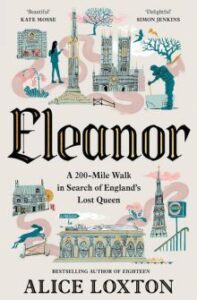
Alice Loxton is a bestselling historian, presenter and the author of Eleanor: A 200-Mile Walk in Search of England’s Lost Queen.
Zeb Baker-Smith is a Classics teacher based in Malawi, a freelance journalist and Editor at Aspects of History.