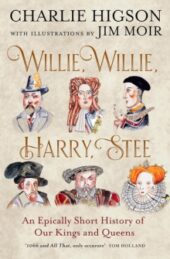

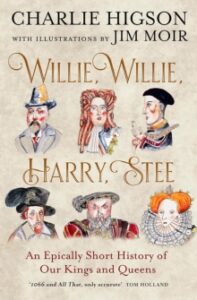
Can you first tell us about the genesis of the podcast and book – Willie, Willie, Harry, Stee?
It all started for me at an old-fashioned, very minor, prep school in the 1960s. I’m probably from the last generation of British children who was taught a straightforward, narrative (and very Anglocentric) version of history. One of the things I learnt was the mnemonic for remembering all our monarchs from William the Conqueror – ‘Willy’ – through to ‘Lizzie 2, and Charlie next to see us through’. I retained fragments of it, but when everything ground to a halt in lockdown, and I was at a loose end, I properly relearned the rhyme and thought I’d like to know who all these people were, what they did and how we got from one to the other. It was a great way of keeping my brain active (and also helping me get to sleep at night, as I went through the list in my head. I’d usually nod off somewhere in the Wars of the Roses).
Also, for more than a decade, I’ve been doing talks at the Chalke History Festival (set up by James and Tom Holland, whom I’d met at literary dos). I was originally asked along to host a humorous history quiz, Histrionics, and I kept getting asked back to do more events. I got to know a lot of historians and I’ve had to come up with lots of history-based talks, and it struck me that the Willie, Willie, Harry, Stee rhyme would be a very good basis for a narrative podcast – starting with William I and doing a monarch per episode, in chronological order. It’s an extraordinary family saga.
The format of the podcast is that I give my take on the monarch in the first half of each episode and then I interview a top historian about them in the second half. I thought the idea had legs – spin-off books, live shows, etc. – and I was delighted when Joel Simons from Mudlark got in touch and asked me if I wanted to do a book. The rest, they say, is history.
The book is an enjoyable romp through our island’s story (with some figures romping more than others), told through the prism of the monarchy. How much was it a case of re-visiting British history and how much were you learning something new?
Well, when I set out on this, I was rather naive. I blithely thought, “Ok, I’ve learned who all these monarchs were, and I can tell you a bit about all of them. It’ll be a doddle doing a podcast…”. Well, whatever the opposite of a doddle is, that’s what it turned out to be. I realised that my grasp on the last 1,000 years of British history and the life stories of these monarchs was very sketchy indeed. But that’s why I enjoyed doing it, because I was learning as I went along. And it was such a pleasure and a privilege to have as guests these great historians to help me out. That’s probably my favourite part of doing the podcast, meeting the experts.
When I came to do the book, I used transcripts of the podcast as the basis, but very quickly realised that I’d been a little bit blasé and had played fast and loose with the facts in order to tell a good story. And, whilst the book was always going to be my personal take on history, written as a storyteller rather than a historian, it was important that I got things right in print. I had an excellent and very knowledgeable copy editor, Nige Tassel, and a brilliant fact checker, Daniel Watkins, who I think nearly had a meltdown trying to keep up with the number of mistakes that I’d made.
I found the material on the medieval monarchs fascinating. There’s more sex and violence than a Bond novel. It was a period when we had some good and bad kings, for want of better terms. During the Medieval and Early Modern eras the kings had much more power to shape the country, for good or ill. So when they were bad, they could be very bad, like King John and Richard II. But, conversely, the likes of Edward III and Henry V could change the country for the better (although the former taxed the nation even more than Rachel Reeves). Can you tell us about your favourite medieval kings that you wrote about – and why you found them of particular interest?
That’s an interesting one about taxes. As I say in the book, everybody wants a well-run and safe country, with free healthcare and education and good public transport & infrastructure – but they always want somebody else to pay for it. But I have to say that the medieval period is the area I’m most interested in. It was a time when monarchs actually did something and had some power. They would ride into battle in suits of armour and twat their enemies with big swords. And, as you say, there were some very ‘colourful’ characters.
It became a bit of a joke, and was considered very old-school, to categorize the monarchs as either good or bad (there’s a lot of mockery of this idea in 1066 And All That), but we did have an extraordinary run of alternately competent and incompetent kings from Henry III (bad), to Edward I (good), Edward II (bad), Edward III (good), onto Richard II (bad), and there’s a lot of fun to be had with that history.
On the whole, the monarchs that I became most interested in were the ones that I knew least about before embarking on this project. Henry III, for instance, had a long and eventful reign, but he’s little known now because he was overshadowed by his extremely rotten father, King John, and his warlike son, the mighty Edward I, Hammer of the Scots.
Henry I is equally fascinating, and is now equally little known. He was a fearsome man, who was brought low and humanised by the death of his son and heir in an awful accident, when the White Ship sank in the English Channel, carrying many of the younger members of the Royal Court. It was a bit of a Titanic moment and was one of those stories that every schoolkid used to know, but none nowadays do.
Also… well, there are so many to choose from, so I’ll stick with the Henrys. Henry VII, who is considered the last medieval monarch, was a wily and canny man, who negotiated an extremely difficult and complicated political situation and managed to unite the country and hold things together after the ruinous chaos and destruction of the War of the Roses. But, again, he’s overshadowed by his predecessor, Richard III, and his successor, Henry VIII.
The English Civil War lies at the heart of our history. Ripples from the period may even be felt today. Would you have been a Roundhead or Cavalier?
It’s interesting that we talk about ‘The English Civil War’ as if there was only ever one. There were many over the last 1,000 years. The Anarchy during the reign of King Stephen. The Barons’ Wars during the reigns of John and Henry III. And what was the War of the Roses if it wasn’t a civil war? But the one we call ‘The English Civil War’ was perhaps the most dramatic in that it led to the official execution of the monarch and the possible end of the whole institution. And then Cromwell couldn’t come up with a solution for how to run the country without having a powerful (male) head of state and he foolishly passed his ‘succession’ onto his son, Richard, who didn’t really want to be in charge and thus left the throne vacant for Charles II to come back and take a seat.
I have to say I’ve always leant towards the Cavaliers rather than the Roundheads. I don’t like the destructive, religious zeal of the Cromwellians, and the moral superiority and certainty that the Roundheads had. They imposed puritanism onto a country that didn’t want it. I find echoes of that whole rupture and rift in British society, that polarisation, in what’s going on today with shaven-headed men painting crosses of Saint George on our roundabouts. It reminds me of the whole Puritan, anti-elite, philosophy of Cromwell’s supporters. And there’s something of King Charles I in Keir Starmer, insisting he stays in place, out of touch with his people, unable to communicate properly and rouse enough support.
I suspect that you have more than one explanation, but why do you think that the British Monarchy endured when other royal families fell by the wayside during 1848 and after the First World War?
It partly goes back to the English Civil War. We had our moment of revolution, we executed our monarch, but then things stalled. There was a reset and, on the whole, people said they would rather have a monarchy than whatever else was on offer. So, instead of weakening the monarchy and bringing it to an end, Cromwell’s actions probably reinforced the strength and popularity of the crown. When the French Revolution came, many in England, particularly the Whigs/Liberals, supported it and said, “What took you so long?”. But then they watched in increasing horror as France fell into anarchy and violence, which led to… well, Napoleon wasn’t a monarch, he went one better and installed himself as Emperor. The view from this side of the Channel was not a pretty one.
Also, since the Magna Carta & the Provisions of Oxford, our monarchs have been constitutional rather than absolute (as they always were in France). It was accepted by parliament, the people and the monarchy that a king or queen only ruled by consent. Clever monarchs learned diplomacy, they learned how to work with parliament, they learned how to keep the people happy and they passed this knowledge down from generation to generation.
George III introduced the idea that monarchs should also be morally beyond reproach and should behave impeccably. His sons disappointed him, but Victoria and Albert built on what he’d started and ever since then the main job of the monarchy has been to keep the monarchy going, at which they’ve done rather well.
I can’t help but be fond of Elizabeth II. I’m only human. Was it slightly different writing about a reign that you partly lived through and experienced too? There is the element of longevity of course, but why do you think that Elizabeth II was so beloved, both in the UK and throughout the world?
I didn’t want to get too many digs in at the current royals, because they’re living, breathing people with emotions and children and it’s not my job to be nasty about them. Elizabeth was really, really popular because she basically did nothing. She didn’t interfere. She was patient and regal and learned from her father that the best way to proceed was not to ruffle any feathers and understand that the monarch works for the people, they have duties and their own personal likes and dislikes must be kept private.
She became an inert icon. She was THE QUEEN and tried to embody some kind of Spirit of the Nation. Decent, uncomplicated, uncontroversial, unintellectual, apolitical, middle of the road. And she was there for so long, the most photographed person of all time, she felt as permanent as the statue of Victoria outside Buckingham Palace, or Nelson on his column, or Westminster Abbey, or Stonehenge. She was the embodiment of Britishness, which is why I think so many people were bereft when she died, and why she will be very hard to replace.
People weren’t embarrassed to be represented by her. She was very diplomatic. Imagine if we had an elected head of state instead of a monarchy, and imagine if that person was, say, Liz Truss. How would we have felt about ourselves with her as the embodiment of Britishness on the world stage.
We are always mindful at Aspects of History of recommending books worth reading to our subscribers. Can you recommend three biographies of monarchs that our readers would enjoy (after they purchase Willie, Willie, Harry, Stee, of course)?
I have to start with Helen Castor. She’s a brilliant historian, a friend, and is one of the people that got me interested in history. She’s also been a generous and regular guest on the podcast. She’s so knowledgeable, and so interesting and is a great storyteller, too. I’m in awe of the depth of her research. All her books are worth reading but with her latest, The Eagle and the Hart, you get two monarchs for the price of one as it tells the parallel stories of Richard II and his usurper, Henry IV.
The White Ship, by Charles Spencer (another guest on the podcast) tells the story of the sinking I mentioned earlier and in so doing gives us a fascinating Life of Henry II. Craig Brown’s A Voyage Round The Queen is a wonderfully entertaining portrait of Elizabeth II, done in his trademark collage style.
There are some wonderful quotes in the book, some humorous but others quite poignant. Do you have a favourite quote about or by one of the monarchs?
Gosh, you’ve put me on the spot there. One that springs to mind is: “Rex fuit Elizabeth, nunc est regina Jacobus” – which did the rounds after Queen Elizabeth I died and James was hastily imported from Scotland. There had been a lot of nasty Madame Macron-style rumours about Elizabeth, and there were also a lot of rumours about James’ sexuality. The quote translates as “Elizabeth was King; now James is Queen”.
Finally, if you could invite three monarchs to dinner, who would you choose and why?
Several of my guest historians said they thought that Edward II was probably the monarch you’d most like to go down the pub with. He was interested in people and was interesting himself. He was very funny and irreverent. He liked mixing with ordinary folk and had no particular airs and graces. He also liked taking the piss out of the high and mighty. I think he’d probably bring a bit of an Alan Carr vibe to the party. Of the Queens, I think I’d pick Matilda, although she was never crowned. She was the designated heir to her father, Henry I, but got usurped by her cousin, Stephen. She was a fascinating woman who’d been married to the Holy Roman Emperor, and so was an Empress. She was tough enough to stand up to her own father, she led armies, she was connected to the whole of European politics and history and founded the Plantagenet dynasty. So, I think she’d have a lot to say. Edward VII springs to mind, he was something of a party animal and would have a host of salacious anecdotes. But he’d struggle a bit in the #MeToo age and would probably try to shag Matilda. So, maybe I’ll go with Charles II instead. He brought back fun after the strictures of the Puritan Interregnum. He was interested in the arts and science, theatre, people, entertainment and he opened up society. Snappy dresser, too.
Charlie Higson is an actor, comedian and the author of Willie, Willie, Harry, Stee.
Richard Foreman is the author of Calais: Men-At-Arms, the second instalment in the Men-At-Arms series.