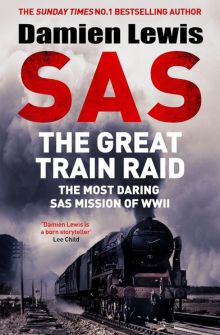
In SAS The Great Train Raid, Damien Lewis recounts the incredible actions of 2 SAS Regiment behind enemy lines in Italy during World War II. The centrepiece of the book is Operation Loco, an audacious raid on the Pisticci concentration camp to free its inmates, the only time an Allied unit travelled behind enemy lines to liberate a concentration camp. Lewis then goes on to discuss the role played by the SAS in helping escaped Allied POWs trapped behind German lines.
In the summer of 1943, 2 SAS’s founder, Bill Stirling, tried to persuade his superiors in the 15th Army Group of the value of guerrilla warfare, but was frustrated at every turn. By September 1943, the SAS were eventually allowed to carry out Operation Speedwell, a near-suicide mission to sabotage the railway networks supplying the Germans through Northern Italy.
Despite the success of the operation, the SAS continued to be denied missions that fulfilled their true purpose. Then the Allies received a report of a concentration camp at Pisticci from an escaped Yugoslav partisan, who explained that the internees were due to be transported east.
The SAS were tasked with liberating the camp and Oswald Cary-Elwes and Raymond Couraud launched Operation Loco. In a raid unparalleled for nerve and daring, they hijacked a train and rescued the captives of the Pisticci concentration camp. Lewis has previously referenced the liberation of the camp, but now, drawing on new material, he is able to provide the full details of this truly remarkable feat, which has largely gone unknown.
The remainder of the book discusses the operations carried out by 2 SAS behind enemy lines to assist POWs and create chaos.
Following the collapse of Mussolini’s government in 1943, the MI9 War Office issued the notorious ‘Stay Put’ order, which prevented Allied prisoners from leaving their camps under threat of court martial, even though their Italian guards had abandoned them. This condemned thousands of men to years of further captivity when the Germans took control of the camps.
Churchill was furious when he heard of the order, and the SAS were sent in to help collect those prisoners who had defied the ‘stay put’ order and were now trapped behind enemy lines. All the while, the SAS continued to carry out their intended sabotage role.
This often involved ‘Robin Hood’ type actions where they would rob and sometimes execute people who worked with the Germans. This money was then used to fund their operations.
The conservative estimate of the men helped to escape is 900, but the overall success of these operations, in terms of tying down German troops and the chaos caused behind enemy lines, can never be calculated.
This is a unique book that brings to light some truly extraordinary men, who, with little more than sheer guts and determination, carried out the impossible, and whose achievements are now largely forgotten.
Damien Lewis is a Sunday Times bestselling author, you can read SAS: The Great Train Raid here.
Alan Bardos is the author of historical fiction set around the World Wars. His latest novel is Hunter Class.