At 3 a.m. on 6 May, 400 Allied guns ‘flamed into action’ on a 3,000-yard stretch of enemy front on both sides of the Medjez-Massicault-Tunis highway. ‘The gunners sweated as they thrust shells into the guns,’ wrote journalist John D’Arcy-Dawson.
The noise mounted in volume as the pace of the barrage increased. Then as the first streaks of light appeared over the far horizon the noise of a multitude of planes could be heard above the thunder of the guns.
Over they came, dim black shapes in the steely light. They dropped their bombs behind the limit of shellfire, deepening the barrage. In front of them clouds of fighters and fighter-bombers scoured the roads and fields, destroying every living thing that moved.
The plan for Operation Strike – devised by General Sir Harold Alexander, the commander of Allied ground forces in Africa – was for the British IX Corps to make a ‘sudden, powerful stroke’ south of the Medjerda river, where the German and Italian defenders had been stretched ‘almost to breaking point’, and into the Plain of Tunis. To help deliver it, Alexander had asked General Sir Bernard Montgomery, commanding the British Eighth Army, to transfer the best formations he could spare. Monty had sent his two most experienced and freshest divisions, the 4th Indian and 7th Armoured, and also the 201st Guards Brigade. These divisions had helped to win the first British victory at Sidi Barrani in 1940 and it was ‘particularly appropriate’, noted Alexander, that they ‘should be chosen for the main role in our last victory, the battle of Tunis’.
The man chosen to command the attack was Lieutenant General Brian Horrocks, one of Monty’s favourites. He could not have been happier. ‘This was the real art of generalship,’ he wrote later, ‘a quick switch, then a knock-out blow. How much better than battering our heads against the strong Enfidaville position. And what luck for me that I should be selected for the job.’
Looking at a map, it was clear to Horrocks that the ‘obvious place to launch the assault was from Medjez el Bab, up the valley, via Massicault, and St Cyprien, straight through to Tunis twenty-five miles away’. But as this was the sector currently occupied by V Corps, he went to call on its commander Charles Allfrey, another ex-instructor from the Staff College that he knew well. Allfrey could not have been ‘more helpful’, wrote Horrocks, and the two cooperated closely for the coming attack – now involving four divisions, two infantry and two armoured, under Horrocks‘ command.
The final plan of attack was heavily influenced by Francis Tuker, the commander of the 4th Indian Division, who, after a lengthy reconnaissance of the battlefield, insisted that the start time should be moved from dawn to 3 a.m. when it would still be dark. He also lobbied for pin-point artillery fire, after the initial bombardment, onto specific targets (identified by air reconnaissance) using 1,000 rounds per gun. After much persuasion, Horrocks agreed. ‘We would have preferred another hour or two so that we could smash right through into the rear areas before the light came,’ wrote Tuker, ‘but this timing would be enough and it would not matter if our colleague division did not get off before dawn, for we should have all that was important by then.’
Altogether, hundreds of guns and tanks – the greatest armoured force yet seen in Tunisia – would be hurled against an Axis force that was thought to number five battalions and 30 tanks in the front line, and another five battalions and forty tanks in reserve near Massicault. A similar force of Axis infantry was stationed to the south in the Ksar Tyr area. Meanwhile, the British V Corps would ‘hold the corridor open’ and be ready to support IX Corps, while the French XIX Corps and US II Corps mounted coordinated attacks to the south and north respectively, and the New Zealanders created a diversion near Enfidaville.
Watching the attack unfold was journalist Philip Jordan whose view was mostly obscured by dust churned up by hundreds of fighting vehicles. ‘You could distinguish the tanks only by the flames when they fired,’ he wrote in his diary. ‘There was no wind to blow the dust away. Every one in high spirits to-night, for we may be in Tunis tomorrow.’
That confidence was also felt by Lieutenant General Horrocks, commanding the battle, who thought the attack ‘went like clockwork’. The two infantry divisions ‘punched the initial breach’, he wrote, ‘and at 7.30 a.m. I was able to order the two armoured divisions forward’. By midday, IX Corps was through the crust and the tanks were ‘grinding their way forward down the valley towards Tunis’. It was perfect use of armour – to exploit a breakthrough ‘deep into the enemy’s heart’ – and Horrocks noted with satisfaction the all-arms nature of the battle as aircraft, guns, tanks, infantry and vehicles worked in close coordination.
By evening, the 6th and 7th Armoured Divisions had reached their objectives of La Mornaghia and St Cyprien respectively. During the attack, two battalions of the 115th Panzer Grenadier Regiment had been overrun and the remainder of the 15th Panzer Division driven back past Massicault which was occupied in late afternoon. Generalmajor Willibald Borowietz’s battered units had then attempted to establish a new defensive line from Djedeïda to St Cyprien, but were unable to do so. ‘St Cyprien,’ noted John D’Arcy-Dawson, ‘which had earlier been prepared for defence by a series of trenches along the hills, was not defended although it was a strong natural position. We were now only about 12 miles from Tunis and our armour was twenty miles in front of the infantry.’
Horrocks and Allfrey met at the end of the day to discuss their next move: as agreed beforehand, the 4th British and 4th Indian Divisions now reverted to V Corps’ control, giving Allfrey five infantry divisions with which to hold the bridgehead; which left Horrocks free to press on to Tunis with the two armoured divisions, 6th and 7th.
Bypassing St Cyprien early on 7 May, the 6th Armoured Division engaged the remnants of the 15th Panzer Division to the south-east of the village and forced them back to Sebkret es Sedjoumi. This allowed elements of 7th Armoured to overcome the remaining defenders and take St Cyprien. Away to the north, the Germans abandoned Tebourba, while more tanks and armoured cars from the 7th Armoured Division entered Le Bardo, a suburb of Tunis.
The armoured cars of the 11th Hussars – veterans of the desert fighting since late 1940 – would claim the honour of being the first Allied troops into Tunis, a full five months after the last serious attempt had got within a few miles of the city. Horrocks was standing by a road near Tunis when a soldier wearing the famous brown beret of the 11th Hussars leant out of his vehicle and said, with a grin, ‘First in again, sir!’
In truth, the armoured cars of the 1st Derbyshire Yeomanry had entered Tunis by another route at almost exactly the same moment, if not slightly earlier, as Horrocks himself acknowledged.
Free at last from Axis control, the French inhabitants of Tunis greeted their liberators with ‘hysterical delight’. Some jumped onto the running-boards of journalist Alan Moorehead’s car, and one girl threw her arms round the driver’s neck. Many of the women were clutching flowers hastily picked from their gardens which they threw at the Allied vehicles. Moorehead was hit full in the face by a ‘clump of roses’ and there were flowers all over the car bonnet. ‘Everyone was screaming and shouting,’ he recalled, ‘and getting in the way of the vehicles, not caring whether they were run over or not.’
When Horrocks heard that Tunis had fallen at 4 p.m., he made straight for Major General Charles Keightley’s HQ and ordered him to turn his tanks of the 6th Armoured Division to the south-east through the town of Hamman Lif and down the road that ran along the neck of the Cap Bon Peninsula to Hammamet. As the Allies now had complete air superiority, Keightley was to ‘forget all about open spacing’ and drive his vehicles nose to tail, two abreast if necessary, ‘as long as he got there quickly’. By reaching Hammamet, Keightley’s armour would trap any Axis troops who had escaped into the Cap Bon Peninsula and prevent them from linking up with Messe’s army to the south at Enfidaville.
The day ended on a slightly sour note when Keightley’s tanks failed to force the pass at Hamman Lif – barely 300 yards wide at its narrowest point – which was stoutly defended by the remnants of the Hermann Göring Division and a strong force of 88-mm dual purpose guns, withdrawn from airfield defence. But its significance was summed up by war reporter Philip Jordan who noted in his diary: ‘These words are written in Tunis. The great expedition that began in wind has finished in rain; and at long last – 181 days, six months in all but a day – so much patience and fortitude have had their reward. It has been a wonderful day.’
Also on 7 May, American troops entered the port of Bizerte, and Joseph Goebbels, Hitler’s propaganda chief, wrote in his diary: ‘When you think that 150,000 of our best young people are still in Tunis, you rapidly get an idea of the catastrophe threatening us there. It’ll be on the scale of Stalingrad, and certainly also produce the harshest criticism among the German people.’
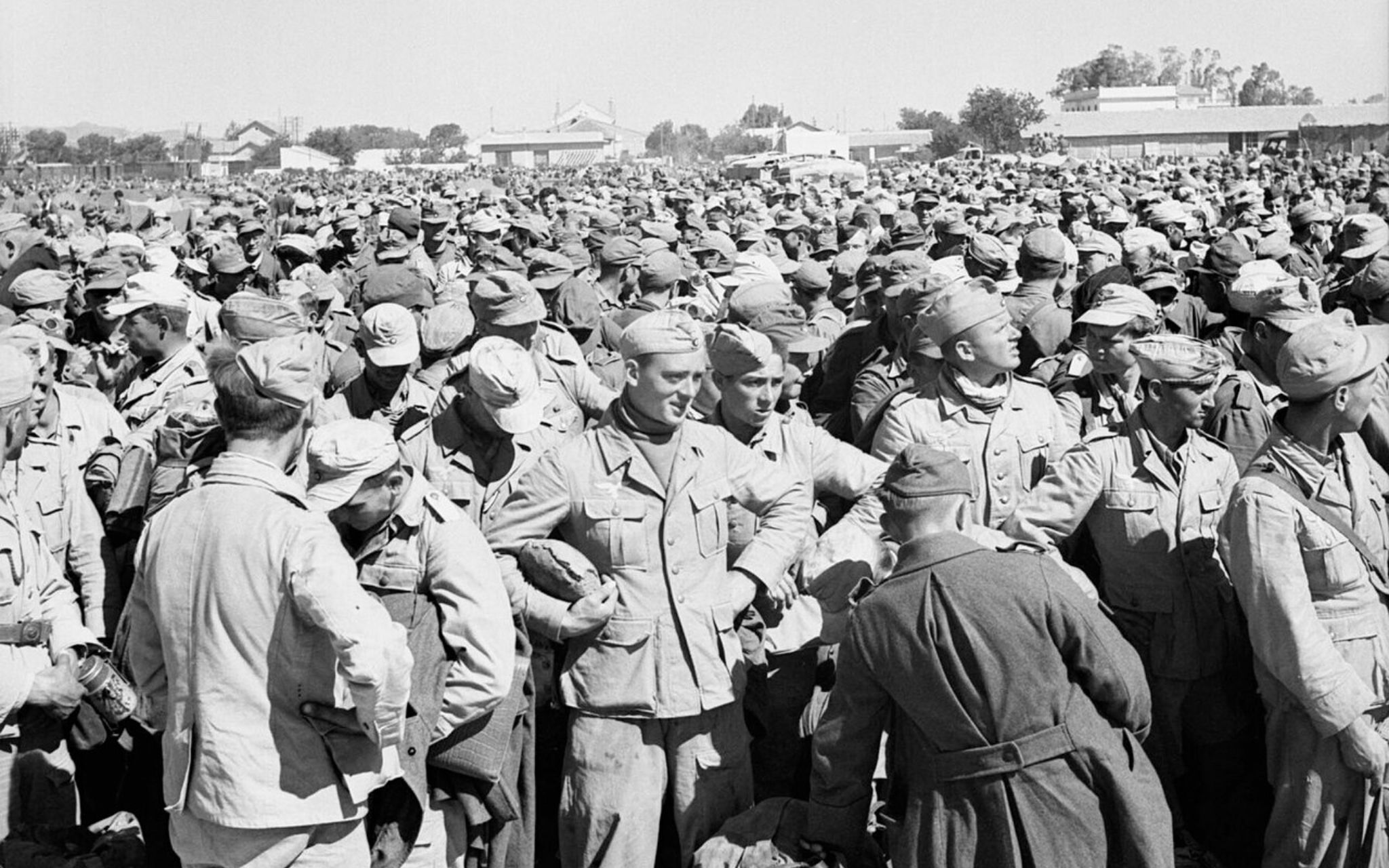
The end for Axis forces came on 13 May, north of Enfidaville (now Enfidha), when Giovanni Messe surrendered the remnants of his First Italian Army to Bernard Freyberg, commanding the British X Corps. Generaloberst Hans-Jürgen von Arnim, the Axis commander-in-chief, and his staff had been captured a day earlier. ‘Sir,’ Alex reported to Winston Churchill. ‘We are masters of the North African shores.’
Churchill was ecstatic. ‘We have struck the enemy a blow,’ he told a joint session of the US Congress in Washington DC on 19 May, ‘which is the equal of Stalingrad and most stimulating to our heroic and heavily engaged Russian allies… We have destroyed or captured considerably more than a quarter of a million of the enemy’s best troops, together with vast masses of material… The African war is over. Mussolini’s African Empire and Corporal Hitler’s strategy are alike exploded… One continent, at least, has been cleansed and purged forever from fascist and Nazi tyranny.’
For the Western Allies, the scale of the Tunisian victory was unprecedented. At a cost of just over 70,000 casualties – including 10,000 dead – they had captured – as Churchill pointed out – more than a quarter of a million Axis troops, many of them veterans from crack formations. The victory ‘clearly signified to friend and foe alike’, wrote Ike, ‘that the Allies were at last upon the march’. It had, moreover, welded together a team of Allied commanders – including Ike himself, Patton, Omar N. Bradley, Alex, Monty and Arthur Coningham – that would go on to direct all major Allied operations in the Mediterranean and Europe for the rest of the war.
It was – along with Stalingrad in Russia and Guadalcanal in the Pacific – one of three Axis defeats in early 1943 that changed the course of the war. Historians have recognized the significance of the others, but not Tunisia which has either been ignored or characterized as a sideshow. Yet it ended Axis seapower in the Mediterranean and destroyed more than 2,400 Axis aircraft, 40 per cent of the Luftwaffe’s strength. More German and Italian troops were captured in Tunisia than at Stalingrad. Such was the scale of the defeat that the German public wryly dubbed it ‘Tunisgrad’.
Saul David’s Tunisgrad: Victory in Africa was published on 11 September 2025.