“Subandrio! Subandrio! Subandrio! Can you hear us Subandrio? Of course you can! For you can never close your ears to our voices. The voices you tried to smother in the Well. The voices of us the dead. Those voices will always ring in your ears, calling you a traitor and murderer… for it was you who planned our torture and mutilation… Worms may feed upon our rotting flesh, but our voices have becomed [sic] the voices of the Nation’s conscience…”
The eery, disembodied, voice, continued, echoing into the night.
An attempted coup against President Sukarno threw Indonesia into turmoil at the height of the Cold War. The Indonesian army launched a swift and violent crackdown on the left, resulting in mass killings on a scale that still haunts the country. As soldiers and vigilantes mobilised, waves of propaganda targeted supposed collaborators in the coup, men such Indonesia’s foreign minister, Subandrio. Strangely however, one of these voices trying to shape events did not exist at all.
“Yes! Subandrio, we are waiting for you… Waiting… Waiting… Waiting…”
The voice came from beyond the grave: floating up from the twisted mouths of murdered generals, vowing vengeance from the bottom of a well where coup plotters had dumped their mutilated corpses. Or so it was claimed.
In reality, the voice came from British offices and regional outposts miles away, part of a top-secret covert propaganda operation known as The Voice from the Well. This macabre plot sought to hasten the collapse of Sukarno’s regime.
60 years on from that point in spring 1966, by which Sukarno’s authority had fatally dwindled following months of violence, the “The Voice from the Well” offers a revealing window into how the Cold War was fought with fakes and forgeries.
In the 1960s, Indonesia was flashpoint where Cold War rivalry met decolonisation. President Sukarno, the charismatic leader who had guided the country to independence, claimed a path of non-alignment, a path the British feared actually involved cosying up to Communist China and the Soviet Union.
The UK, meanwhile, had high stakes of its own given that Indonesia was simultaneously waging an undeclared confrontation against the newly created state of Malaysia. British intelligence saw Sukarno as a destabilising force, undermining the UK’s position in the region.
The British turned to propaganda to help counter Sukarno. Indonesia, like parts of Africa and the Middle East, became a frontline in a global battle of shadowy political warfare where the UK, US, Soviets and others competed for influence as empires retreated – and, it must be remembered, where local actors, Indonesia included, had propaganda arsenals of their own. Far from being an era of puppet-masters, it all made for a decidedly murky ecosystem of influence and counterinfluence beyond the clutches of any one party. The battle encompassed secret newsletters, planted newspaper stories, forged documents, fake organisations, and unattributable radio broadcasts: all tools designed to influence audiences without revealing the hand behind them.
At the centre of Britain’s effort was a little-known and distinctly shadowy arm of the Foreign Office: the Information Research Department (IRD). Established in 1948, the IRD spent three decades conducting covert propaganda around the globe. Its staff included journalists, refugee writers, linguists, and veterans of wartime psychological warfare.
By the early 1960s, the IRD was running hundreds of black propaganda operations, often in coordination with MI6. Its techniques, put simply, involved laundering intelligence through fake groups, writing as locals, mimicking authentic formatting, and exploiting existing fears rather than inventing new ones. The IRD had targeted Sukarno for a while already, seeking to expose Communist infiltration and undermine his leadership of the non-aligned Islamic world. Amid growing violence, they now also saw an opportunity to help remove him entirely.
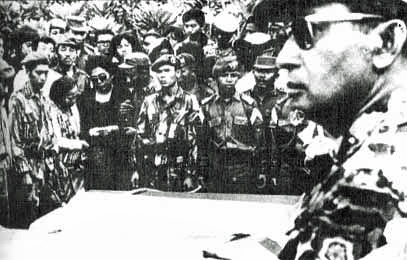
On 30 September 1965, a revolutionary group kidnapped and killed several senior Indonesian generals. The army quickly blamed the local Communist Party. Major General Suharto seized the initiative, marginalising Sukarno and unleashing a campaign of repression. For British officials watching from Jakarta, Singapore, and London, this was a moment of grim opportunity. The British ambassador, a colourful and opinionated Scot called Andrew Gilchrist, proposed one of the most extraordinary propaganda ideas of the Cold War: record messages supposedly spoken by the ghosts of the murdered generals. These bodiless voices would denounce Sukarno and his foreign minister Subandrio, accuse Communists of unspeakable brutality, and call for vengeance. It would, he feverishly hoped, add more pressure on the so-called guilty men.
From the outset, the plan divided opinion, alarming the professional propagandists back in London. Gilchrist muttered excitedly about invoking the ghost of Hamlet’s father, as they worried about deniability and cultural misjudgement. They were far from timid themselves but, on this occasion, the professionals feared the tapes were too theatrical and too obviously foreign in tone. They worried that they could be traced back to the UK.
But events were moving fast and those in London struggled to maintain control from so far away. Tension broke out among the propagandists in Whitehall and their compatriots deployed to the region, with the latter crying backseat driving and paralysing caution. As London objected and rebuked, arguments, sometimes farcical, broke out about whose linguists were better and the ease of getting hold of an echo chamber. Ultimately, London’s efforts to slow things down proved futile as the recordings were distributed in Jakarta and beyond, including by being dropped in hotel plant pots. They were destined for sympathetic radio outlets already engaged in anti-Sukarno broadcasting, and, once released into the wild, there was little London could do.
Importantly, “The Voice from the Well” did not exist in isolation. It formed part of a wider torrent of propaganda flooding Indonesia amid the chaos. The Indonesian army itself produced lurid, often exaggerated, accounts of Communist atrocities. As was (and still is) often the case when it comes to covert propaganda and disinformation, British efforts did not have to invent this narrative, instead amplifying existing narratives and divisions. Meanwhile, the Americans, Chinese, Malaysians, and Australians all added propaganda material of their own into the mix of half-truth, exaggeration and lie.
Meanwhile, “The Voice from the Well”, was merely one drip, albeit a notable one, in the steady flow of British covert propaganda targeting Sukarno and his inner circle. Alongside the ghostly recordings, the IRD waged a number of other operations, spewing material designed to look as though it came from Indonesians themselves. One was a bogus newsletter, circulated from Singapore, which claimed to speak for students, Muslims, nationalists, soldiers, or anyone else alarmed at the direction the country was taking. Its reporting egged on the generals, amplifying their lines, and accusing Sukarno’s regime of corruption. One aggressive issue described Subandrio as Sukarno’s cockerel. “So far the Army has only pulled out a few of the cockerel’s many feathers, they haven’t even clipped its wings, but the time will come – it must come – when that bird which has done so much to foul our nest will have its neck wrung; and the whole of Indonesia will rejoice.”
British propagandists in London planted articles and laundered intelligence through covertly controlled news agencies to attack the president’s personal conduct and financial excess. They forged Muslim Brotherhood leaflets, in which middle-aged Brits preached from Whitehall like some sort of strange ventriloquists, accusing Sukarno of being an embarrassment to Islam, of cavorting with prostitutes, of sex-trafficking, of driving one of his wives to suicide… “There is no God but Allah and He is quick to punish.”
By early 1966, Sukarno’s authority was collapsing. Andrew Gilchrist, the ambassador, watched him wither and Suharto emerge as Indonesia’s new strongman. The UK and its allies quietly welcomed the outcome, especially the annihilation of the Indonesian Communist Party as a political force. As the British propagandists, at home and abroad, dissected the scene, they discussed the “The Voice from the Well” – and more disagreement broke out. Some claimed the campaign contributed to the psychological pressure that marginalised Sukarno. Others downplayed its importance, as just one current in a stormy sea.
What is clear is that British officials seemed most concerned with external deniability and internal point scoring. The files suggest less worry about death tolls, with the propagandists treating the violence as someone else’s responsibility. The nature of their business, nudging history along, afforded sufficient ambiguity for the London team to take credit for their own work but, for reasons of bureaucracy and ego, to question the impact of their locally based colleagues. And vice versa. Success was conjured in the eye of the beholder; it was ultimately political.
By amplifying the generals’ lines and avoiding any move that might embarrass them, British propagandists became entangled in a larger machinery of violence. They did not cause the killings, but they were complicit in greasing the wheels.
Cold War propaganda, epitomised by “The Voice from the Well”, was deliberately crude, attempting to unsettle and shock. It aimed to exploit existing divisions in a way which benefited the UK. In Indonesia, one of its voices claimed to come from the dead. In today’s supposedly post-truth world, its echoes, however, are very much alive.

Rory Cormac is an academic, specialising in the study of covert operations and secret statecraft, and the author of Fakers: A Top-Secret Tale of Phantoms and Forgeries on the Disinformation Front Line.