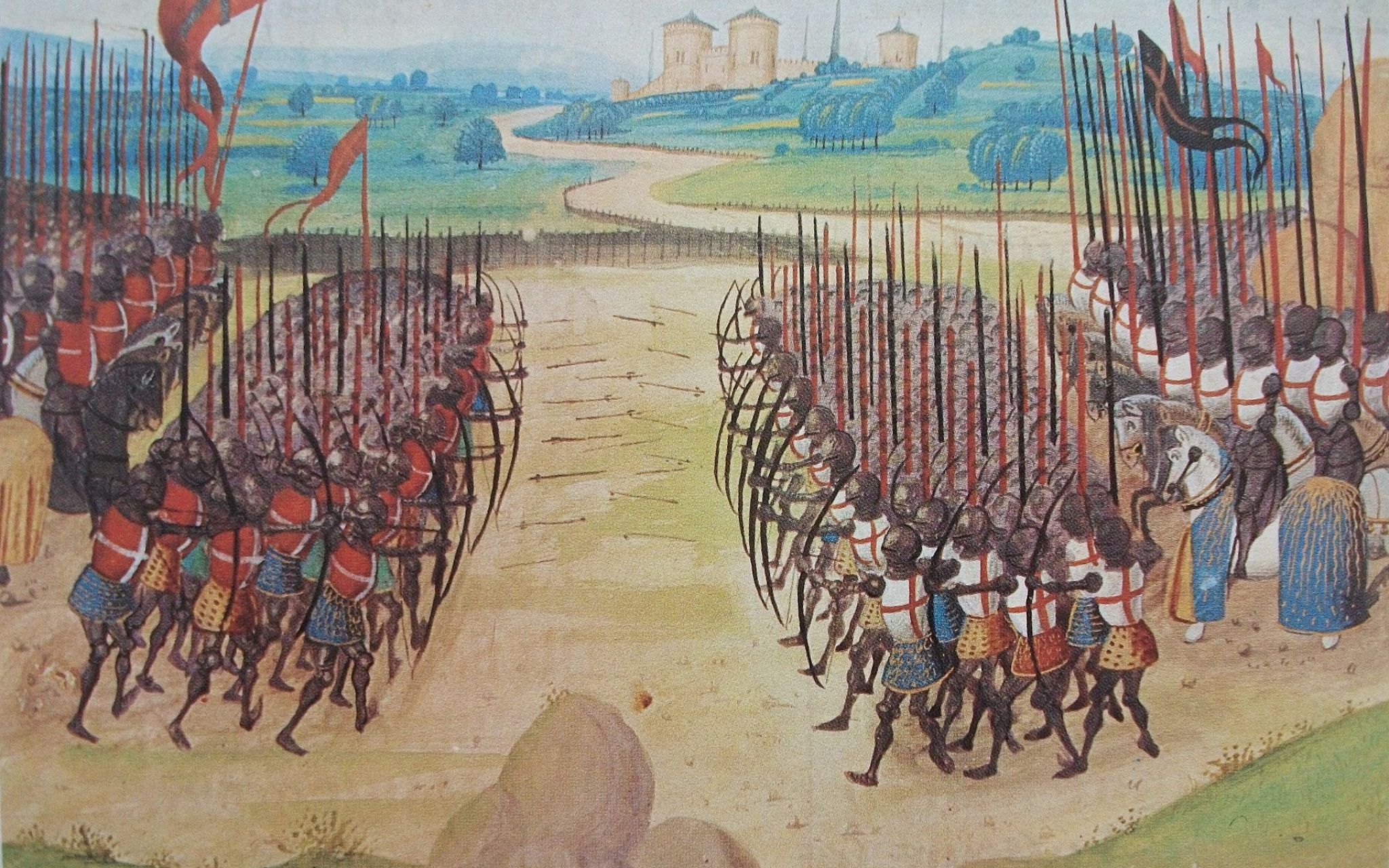
The Hundred Years War is a label coined in 1823 as a chapter heading for a French textbook. It was both a matter of convenience and a way of furthering our understanding of the past: we name things to talk about them, so creating a label for this turbulent period of French history allowed it to be examined more closely. It was in no way malicious. The subsequent acceptance of the label by generations of historians was likewise conducted with the best of intentions and some genuinely remarkable results. The Hundred Years War, typically defined as a dynastic conflict between England and France running from 1337 to 1453, contains some of the most-studied and best-understood events in the Middle Ages.
Like any modern effort to periodize history, though, the invention of this war cut it off from surrounding events, isolated it in ways that those living through those events would have neither recognized nor understood. And the generations of scholars studying the period have largely furthered this isolation. The deep and impactful connections that the two supposed combatants maintained with other political and economic powers in Europe are very often neglected, and indeed the interests of England alone tend to dominate the historiographical landscape. Beyond that, by drawing boundaries across time, the acceptance of the idea of a Hundred Years War has made it difficult to see the broader connections between this tumultuous period and subsequent historical events that directly shaped our world today.
Periodisation might be necessary, in other words, but we cannot lose sight of the fact that something is always lost when we create order out of the chaos of our history. It behoves us to be as “eyes open” about these losses as we can be.
Re-conceptualizing the Hundred Years War into a Two Hundred Years War, as I do in my new book of that title, for instance, serves to redress some of the old label’s deficiencies by highlighting the European drivers of the conflict and broadening its dates to 1292 and 1492. That said, my new label also draws a line between what was happening in England and France across those centuries and what would unfold between them in the centuries to come, a line that can falsely disconnect these periods.
To the point, 1492 is the cut-off for the Two Hundred Years War as it is the date of the Peace of Étaples, which was signed between King Charles VIII of France and King Henry VII of England on 3 November after the latter had invaded the continent with tens of thousands of men. But this is not remotely the most famous event on the world stage that year: on 12 October, Christopher Columbus made landfall in the Americas and opened up the age of European exploration and colonization in the so-called New World. While we aren’t accustomed to connecting these two periods – we have, as historians, been quite literally trained to think of them as separate events – the reality is that the one not only flows from the other but is also fundamentally dependent upon it in ways that we are only beginning to understand.
Some of the points connecting the Two Hundred Years War to the Age of Exploration are relatively straightforward. One of the most significant figures in laying the groundwork for the voyages of Columbus, for instance, was Henrique of Portugal, better known as Prince Henry the Navigator. Following the 1415 conquest of Ceuta by his father, King João I, Henry pushed for more and more voyages to explore the West African coastline and the Atlantic archipelagos of Madeira and the Azores. Why João and Henry were looking to the sea for their future has a lot to do with João’s English grandfather, John of Gaunt, who had tried and failed to claim the crown of Castile in a proxy fight of the Two Hundred Years War. Portugal, consequently unable to expand into the Iberian Peninsula, had no choice but to look south and west for its future.
One of Prince Henry’s exploring captains was Bartolomeu Perestrello, who left behind a daughter, Filipa Moniz Perestrelo, when he died in 1457. Twenty-two years later, Filipa married a Genoese sailor and passed her father’s priceless navigational charts to him. His name was Christopher Columbus, and he’d go on to make his own great voyages under the flag of Spain, Portugal’s immediate rival, newly born from the marriage of Isabella of Castile to Ferdinand of Aragon. They, too, needed to look south and west for their future thanks to the rising power of their immediate neighbor. In their case, it was the crown of France, newly resurgent in its strength as the French consolidated their victory over the English. The end of the Two Hundred Years War settled the map of Western Europe into something very close to what we would recognize today, “locking in” their inward borders and forcing their eyes outward.
Their own loss to the French had the English similarly looking west into the Atlantic. John Cabot made his first voyage to the America from Bristol in 1497. But if Alwyn Ruddock’s claims are ever proven correct, Bristol seamen were in contact with North American shores as early as the 1470s. Certainly from 1480 onward we know that they were sending ships out into the Atlantic in search of the mythical island of Hy-Brasil – efforts that neatly coincide with the loss of a realistic English future on the Continent.
What Columbus, Cabot, and the many other exploratory mariners of the time discovered changed the map of the globe. The European encounter with the New World, Africa, and Asia opened up vistas unimaginable during the Middle Ages. And the fact that these new vistas would provide a new stage for the colonial wars that continue to shape the globe today was also an outgrowth of the Two Hundred Years War.
Richard Hakluyt (1553-1616) is widely considered the architect of English colonialism: his writings, and the direct influence he had on Elizabeth I and James I, encouraged the exploration and conquest of North America and what became a far wider Empire beyond. In his new book The Invention of Colonialism: Richard Hakluyt and Medieval Travel Writing, Sebastian Sobecki has shown the medieval underpinnings of Hakluyt’s work and thought, most notably how English failures on the Continent forced the kingdom to seek its fortunes elsewhere. To this end, among the most important of Hakluyt’s forebears is a widely read work of Middle English, The Libelle of Englyshe Polycye [The Little Book of English Policy]. This 1,100-line poem was first composed in 1436, at a key turning point in the Two Hundred Years War. In 1420, flush from his success at Agincourt and subsequent victories in Normandy, Henry V had negotiated an alliance with the duchy of Burgundy that had very nearly broken France. But Henry’s death, and the sudden, transformative appearance of Joan of Arc, had brought about a resurgent French monarchy and a long series of setbacks for the Anglo-Burgundian Alliance. In 1435, representatives of the English, French, and Burgundians all met in Arras, in the medieval equivalent of the great peace conferences of the 20th century. The results were not good for the English: the Burgundians abandoned them and left them to face France alone.
It was in the wake of this devastating turn of events that the unnamed poet behind the Libelle – Sobecki has argued that the author was Richard Caudray, who had just stepped down as clerk of the king’s council – put pen to paper. The poem deftly calls for an expansion of mercantile protections upon the sea, and the projection of a corresponding sphere of interest across the British archipelago and England’s ports on the Continent: it was no coincidence that the same year that the Libelle was composed, the duke of Burgundy had besieged Calais, that most vital port for England’s maintenance of the wool trade. The poet was, in short, redefining England into a seaborne power, the very ideal that Hakluyt would use to argue for English colonization of North America and elsewhere. And the existence of the Libelle – its origins, its motivations, its conceptions – is undeniably tied to the story of the Two Hundred Years War.
It is, of course, a fairly easy thing to say that events rely on the events that preceded them. But what ties the events of the 14th and 15th centuries to the period that followed is beyond the commonplace of preceding time. Re-defining the Hundred Years War as a Two Hundred Years War makes this trajectory even clearer. It reveals a struggle that was not about England’s interests alone. What was happening in Europe was an international conflict with international ramifications. The subsequent globalization of England and France – and all that colonialism has wrought in our world – was driven by the end of the Two Hundred Years War. Like Portugal and Spain, these European powers were made stable in what they were in the present. To look to the future, they had to look elsewhere to dream of what they could become. Thus the Two Hundred Years War did more than give birth to England and France as we know them. It gave birth to our world.
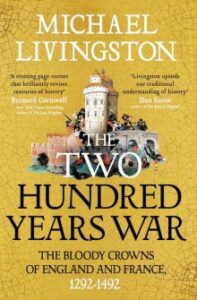
Michael Livingston is an academic and writer and the author of The Two Hundred Years War: The Bloody Crowns of England and France, 1292–1492, which was published in October.