
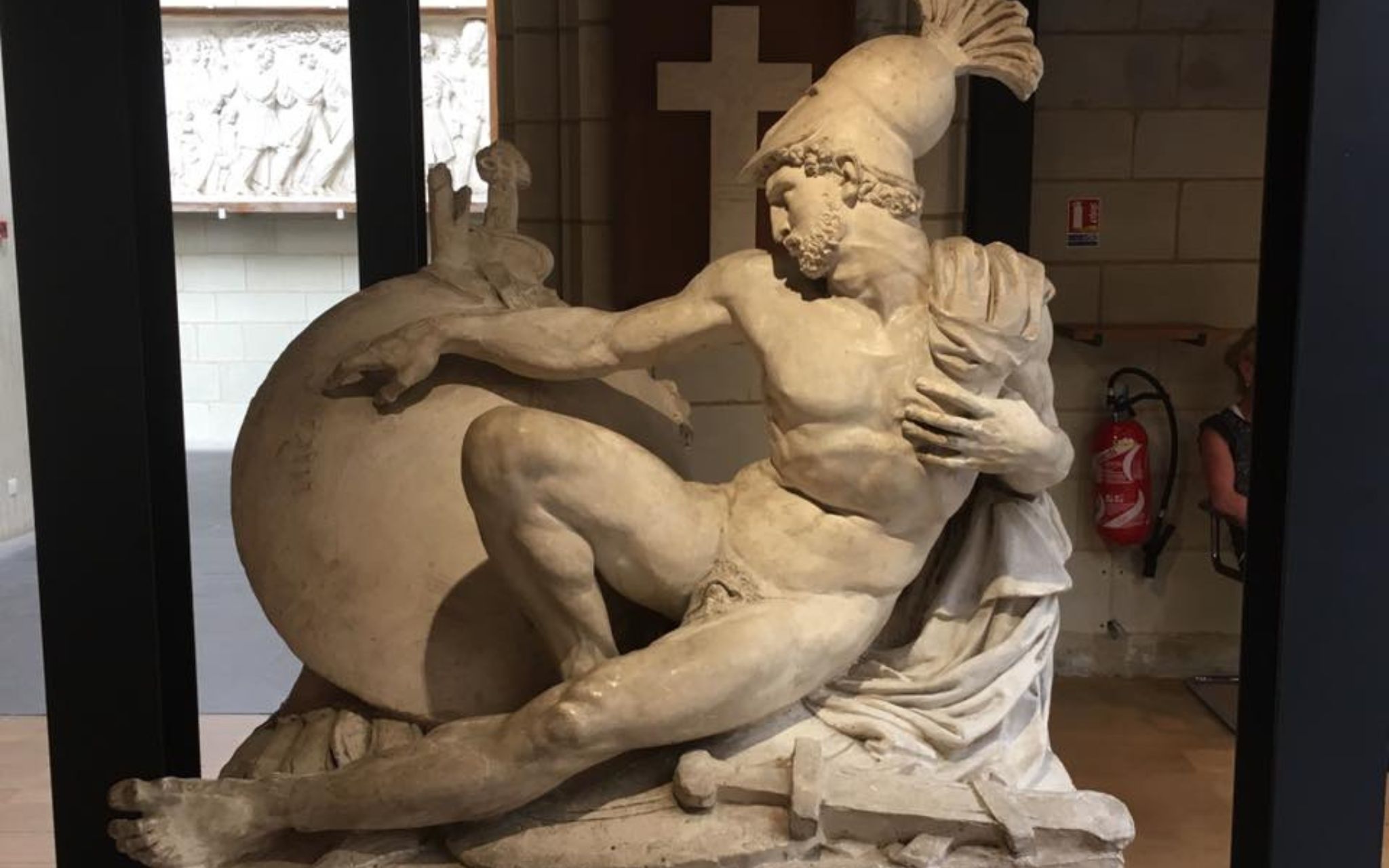
In the fields of the Peloponnese, the image of a lone survivor stood amid hundreds of dead reveals the brutality of ancient warfare and the military values that shaped Spartan life.
As the light faded, his energy ebbing with it, the Spartan soldier Othryadas felt his opponent’s shield drop under the pressure of his own. His gaze, scarcely visible beneath the heavy bronze helmet that covered all but his eyes and mouth, met his adversary’s. Disciplined for warfare by his city’s rigorous upbringing – the world’s first compulsory state-run education system – Othryadas knew exactly what to do.
Grunting with exertion, he plunged his short stabbing sword into the exposed flesh between the base of his opponent’s helmet and the top of his bronze breastplate. As the fighter from the neighbouring city of Argos slumped to the ground, his soul bound for the underworld, Othryadas realised, to his horror, that he was the only Spartan still standing. After hours of fighting, 299 of Othryadas’ fellow citizens had fallen, leaving him to face alone the two surviving Argive champions, Alcenor and Chromius. Spartans may have called themselves the homoioi (‘peers’), but Othryadas was on his own.
Steeling himself for one last effort, Othryadas planted his feet firmly on the ground, readying himself either to win a glorious victory against the odds, or to join his opponents in what the Spartans called a ‘beautiful death’ in combat. War poems written centuries before by the 7th-century-BCE Spartan elegist Tyrtaeus had taught generation after generation of Spartans that ‘it is a beautiful thing for a good man to die, falling in the front ranks fighting for his fatherland’. But the Argives differed. Rather than face Othryadas head-on, Alcenor and Chromius simply declared themselves the winners and ran home to Argos to celebrate their ‘victory’.
Othryadas remained on the battlefield, carefully stripping the armour from the bodies of the Argive dead. He then carried these spoils back to his own army’s nearby camp, where he remained at his station, as was required of a Spartan soldier. According to the later Spartan king Demaratus, Spartan law called for citizens to remain at their place in the line of battle, and to either conquer or die.
The next day, both sides disputed the result of what would later be dubbed the ‘Battle of the Champions’. Around 545 BCE, Sparta and Argos were squabbling over a hinterland between their two city-states known as the Thyrea, which the Spartans had recently occupied. To resolve the conflict, the Spartans and Argives had agreed that both armies would withdraw while two sets of 300 elite champions battled, fearing that if the full armies were nearby, the temptation to intervene would prove too great.
The object of the Battle of the Champions was to avoid a great loss of life on both sides; nonetheless 597 men died – perhaps as much as 5 per cent of the male citizen population of both Sparta and Argos. The Argives, understandably enough, claimed that they had won the duel because more of their men had survived. But the Spartans argued that they were the victors, because Alcenor and Chromius had run away. They stressed that Othryadas had remained on the field of battle and despoiled the dead – a clear indicator of triumph in ancient Greek combat.
With neither side willing to relent, the full-scale pitched battle the Spartans and Argives were hoping to stave off became inevitable. This was likely one of the first significant battles in ancient Greece between heavily armed infantrymen called ‘hoplites’, a name derived from the 30 kilograms or so of bronze armour (ta hopla) each foot-soldier wore for protection. The hoplites fought in a ranked formation known as a ‘phalanx’ – as the poet Tyrtaeus described it, ‘pressing shield against shield, / crest on crest and helmet to helmet / and chest to chest’.
The thousands of hoplites in both armies would have worn a bronze helmet with full face protection known as the ‘Corinthian’, which was usually topped with a horsehair crest. Allowing in little sensory information, such helmets would have created a state of heightened psychological alertness. Both phalanxes of hoplites would have worn breastplates, made from either bronze or a composite made from layers of linen or hide; bronze greaves would have protected their lower legs. But their primary defence was a large, bowl-like wooden, bronze-faced shield called an aspis.
A hoplite’s main offensive weapon was a long, iron-headed ash spear. In case their spear broke, they also carried stabbing swords. Spartan swords were notoriously short. When a foreigner once asked why this was so, he received the blunt reply, ‘So that we might reach our enemies with our hands.’ Spartan soldiers all wore red cloaks and tunics – partly because red was considered the manliest colour, and partly because it would conceal bloodstains. The Spartans’ use of uniforms for their soldiers was hitherto unparalleled, and focused the enemy’s attention on their intimidating conformity.
In the era of the Battle of the Champions, the Spartans fought in five regiments known as lochoi. Each lochos was commanded by an officer known as a lochagos (literally ‘leader of a lochos’), and was divided into smaller units known as ‘sworn bands’ (enōmotiai), led by an officer called an enōmotarchos (‘ruler of the sworn band’). Orders were passed down from the Spartan king to senior officers called ‘polemarchs’ (polemarchoi), then to the lochagoi and finally to the enōmotarchoi, who told the rank and file what to do. The formality of this command structure was unmatched at the time, and helped the Spartans to carry out manoeuvres that contemporary professional drill instructors considered difficult.
The Spartans’ comparative professionalism may have been decisive in the pitched battle that decided the fate of the Thyrea. The fighting was brutal, with heavy casualties on both sides, but this time the Spartans emerged unambiguously victorious.
The Argives were so humiliated by their defeat that they shaved their heads in mourning; they also instituted a new law requiring male Argives to keep their hair short, and denying women the right to wear gold jewellery, until Argos recovered the Thyrea. It would take two long centuries of keeping their hair cropped and doing without gold adornments before the Argives got the Thyrea back. Meanwhile, to celebrate their victory, the Spartans began wearing their hair long as a kind of uniform. Later sources explained their characteristic long hair as designed to make them look ‘freer’ and ‘scarier’, or to make handsome men more handsome and ugly men more frightening.
Although the Spartans won the day, Othryadas did not join his fellow citizens in celebrating. Ashamed that he alone of the 300 champions had survived, he committed suicide. Othryadas may have been trying to avoid joining the ranks of men in Sparta dismissed contemptuously as tresantes – literally ‘those who flee’, but often translated as ‘tremblers’. These men were compelled to shave off half their beard and to wear patchwork cloaks, presumably to make them look ridiculous and to mark them out; they also tended to be the last picked for ball games, banished to ‘insulting’ positions in religious choruses, and forced to yield to younger men – a striking inversion of Spartan norms, whereby younger men always gave way to their elders. The treatment Spartans meted out to cowards may well have been intended to shame them into committing suicide, as Othryadas did. It sounds harsh, but Sparta was a harsh place.

Andrew Bayliss is Associate Professor in Greek History at the University of Birmingham and the author of Sparta: The Rise and Fall of an Ancient Superpower.


