The world might have found it hard to believe. After 22 years of marriage and having made her pregnant at least 12 times, Dickens, aged 46, built a wall in their bedroom to keep his wife, Catherine, out, forced her to visit his 18-year-old mistress to quell rumours, and tried to have her committed to an insane asylum.
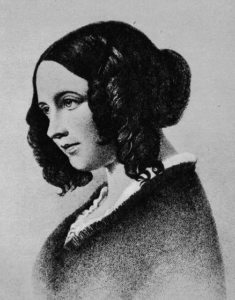
Stipple engraving by Edwin Roffe, after Daniel Maclise, and after John Jabez Edwin Mayall (1890)
He eventually banned her from their home and children and set about destroying her reputation to protect his own from scandal. He feared he could lose everything if the truth about his immoral relationship became public.
Charles had never recovered from the childhood trauma of being taken out of school when he was twelve years old and set to work twelve hours a day in a stinking factory because his father had been locked up in debtors’ prison. So he told the newspapers that no two people were ever less suited to each other, had less in common or understood each other less, that they had lived unhappily for years, that Mrs Dickens suffered from a peculiarity of character and a mental disorder which made her unfit to be his wife and mother of his children and that she had often said she wanted to leave!
Dickens was a literary genius but an ineffective spin doctor. Instead of quelling rumours his statements fanned the flames, not only about his relationship with Ellen Ternan, his teenage mistress but also with Georgina Hogarth, his wife’s younger sister. She had chosen to stay with Charles when he forced Kate to leave and sex with a sister-in-law counted as incest in those days. Mr & Mrs Hogarth disowned her, and the two sisters did not speak again until after Charles’s death twelve years later.
Desperate to control the narrative, Dickens cut off contact with anyone who disputed his point of view, including family and old friends. The children were not allowed to visit their grandparents or any of the Hogarths and he made their life hell if they asked to see their mother.
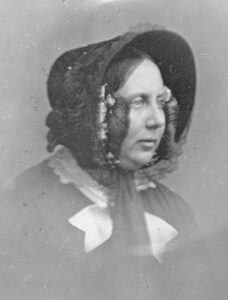
Daguerreotype of Catherine Dickens (1852)
He broke with Mark Lemon, the editor of Punch and Bradbury and Evans, his and the magazine’s publishers, when they refused to publish his statements.
He did the same to Hans Christian Andersen because he said Georgina was not a nice person. She had not made him welcome and had made kind Kate cry during his five-week stay with the family just before Charles met Ellen Ternan. Hans Christian compounded his error by stating publicly that he had witnessed a happy family that summer.
William Makepeace Thackeray had tried to set the record straight when he overheard a fellow member of the Garrick Club saying Dickens was behaving like a scoundrel swapping his wife for her sister. Thackeray incensed Dickens when he explained that the affair was not with Georgina Hogarth but some little actress!
Despite all those who dared to gainsay Charles, his version of events has survived for 170 years. Yet his own letters tell another story: that Catherine had once been his ‘ever dearest Kate,’ the object of a love ‘which no alteration of time or circumstance can ever abate.’
This novel uses his own words against him and asks what other evidence forces us to challenge Dickens’s control of the narrative. We see Kate pondering the same question in the 24 hours following her husband’s sudden death. She revisits the life they spent together, sifting through his correspondence, reliving their pains and joys, and laying ghosts to rest as she struggles to make sense of what became a one-sided love that constrained and nearly destroyed her. Silenced by Dickens’s exploitation of the law – but also by her loyalty to him – about what really passed between them, Kate now speaks up for herself.
Drawing on extensive research and documentation, Mr & Mrs Charles Dickens – Her Story – “So The World May Know He Loved Me Once” fulfils Kate’s dying wish. It also restores her to history as more than a famous author’s discarded wife, giving her an identity of her own, and granting her the dignity, agency, and voice that she was denied in life.
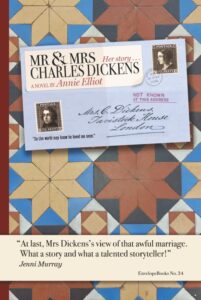
Annie Elliot is a writer and performer, and the author of Mr & Mrs Charles Dickens – Her Story – “So The World May Know He Loved Me Once”, her debut novel.