Yale University Press

The British Way of War, by Andrew Lambert

The British Way of War, by Andrew Lambert

A new biography of a great naval mind by the acclaimed historian.
Benjamin Peel

Julian Corbett was born in 1854 and after becoming a barrister in 1877 he practised law until 1882. At that point he turned to writing as a career beginning with historical fiction often with a maritime theme. That led on to commissions to write a couple of...

The British Way of War: Andrew Lambert Interview

The British Way of War: Andrew Lambert Interview

We discussed Sir Julian Corbett and the British Way of War with the master naval historian
Andrew Lambert

Andrew Lambert, your new book is based on Sir Julian Corbett. He was a fascinating man, with many interests outside of military strategy, but he’s not as well-known as he should be. Why is that? Despite his critical role in capturing and distilling the essence of...

Julian Corbett: Military Genius

Julian Corbett: Military Genius

Julian Corbett, the great naval strategist, was a British Clausewitz. Are we following his doctrine today?

Andrew Lambert

The British Way of War is about the interconnected lives of a man and an idea, lives that reached a climax in the catastrophe of the First World War Western Front. Great ideas do not emerge in a vacuum, they are shaped by individuals, and reflect the time in which...

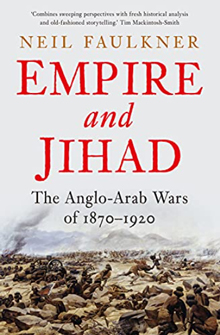
Empire and Jihad, by Neil Faulkner

Empire and Jihad, by Neil Faulkner

The history of eastern Africa is closely associated to the slave trade as a new book has shown.
Lucy Herbert

It seems fitting given recent events, to examine the history of jihad in Northeast Africa through the lens of western interventionism. As Warren Dockter, author of Churchill and the Islamic World, puts it: Empire and Jihad is a ‘sobering bridge’ between British...

Empire & Jihad: Neil Faulkner Interview

Empire & Jihad: Neil Faulkner Interview

Neil Faulkner has written a new book on the Anglo-Arab Wars and we sat down to discuss it.
Neil Faulkner

Neil Faulkner, your book opens in 1851 with the explorer and missionary, David Livingstone, who encounters what turns out to be a huge slave trade that stretches from Africa to India. Whilst Britain had abolished slavery in 1833, what were the numbers that were...

Spymaster: The Man Who Saved MI6, by Helen Fry

Spymaster: The Man Who Saved MI6, by Helen Fry

The espionage historian has written a biography of Thomas Kendrick, long serving officer of MI6.
Ella Beales

British Intelligence operations of the Second World War have been the frequent subject of both scholarly and creative attention, often appearing in popular culture in films such as The Imitation Game and A Call To Spy. Some might argue that there is little left to...

The Other Slave Trade

The Other Slave Trade

Slavery continued well after the practice was abolished in the British Empire, as ivory was transported to satisfy Victorian demand.
Neil Faulkner

The West African slave trade has become a staple of history teaching and popularisation. Rightly so. The triangular trade – trinkets from Europe to Africa, slaves from Africa to the Americas, plantation commodities from the Americas to Europe – was the most visceral...

Merchants, by Edmond Smith

Merchants, by Edmond Smith

A new history on the men that laid the groundwork for Britain's empire.
Steven Veerapen

Merchants, in the literature of the sixteenth and seventeenth centuries, are ubiquitous. One finds them represented on the stage, for example, in the works of Shakespeare and Jonson (‘let’s see him creep!’). The word itself conjures up a host of senses: the jingling...

Tudor Merchants: Steven Veerapen Interviews Edmond Smith

Tudor Merchants: Steven Veerapen Interviews Edmond Smith

The novelist and historian Steven Veerapen sat down with Tudor historian Edmond Smith to talk about his new book, Merchants
Edmond Smith

Edmond Smith, what inspired you to write about these early entrepreneurs, the subject of your new book, Merchants? My PhD set out to explore how individual investors shaped the infamous East India Company, but the more I dug into this, the more links I discovered with...

The Making of Global Britain

The Making of Global Britain

An early venture to Benin ended in failure, but the making of Global Britain was during the 16th century.
Edmond Smith

Abandoned on the banks of the Benin River in 1553, the first English merchants to travel to West Africa could only look back and reflect that, perhaps, their organisational strategy had not been very effective. Things had started well enough, with a painless departure...