Changes in social attitudes happen unevenly across society. New ideas are adopted at different rates by different classes, age groups, and professions. So it is that an institution may persist in behaving in ways long considered antiquated by the society of which it is a part.
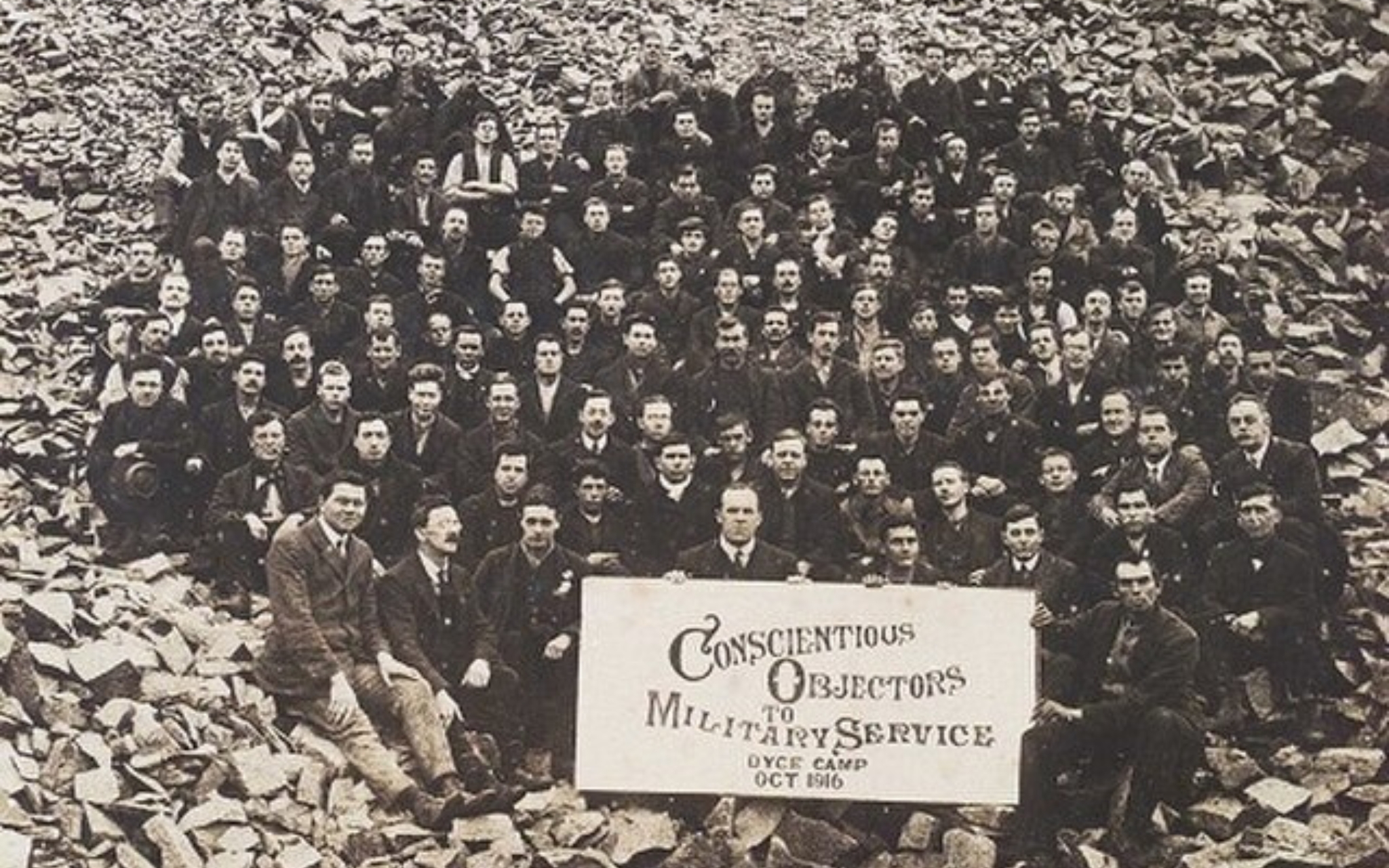
This principle is vividly illustrated by the experience of British conscientious objectors during World War One.
In Britain today, the notion that the government could legally compel a citizen to kill seems abhorrent. Even proponents of compulsory national service tend to couch it in terms of personal development for young people, rather than as a duty owed to the state by the individual.
But this is a modern mindset. It was only a century before the start of World War One that government press gangs were abducting men from the streets to serve aboard His Majesty’s warships (no exception, of course, was made for pacifists). The practice was unpopular, but it did not provoke the violent resistance one would surely expect today.
Britain in 1916 stood between these two extremes. When conscription became inevitable, Britain’s civilian leaders, steeped in Enlightenment ideals, made allowances for individual conscience. A system of tribunals with the power to grant or deny C.O. (Conscientious Objector) status was instituted to weed out “shirkers”.
A critical flaw in this system prevented it from acting as intended. Each tribunal consisted of “prominent local men” and one representative of the military. With decision-making devolved to the borough level with no central control, the individual tribunals were free to apply exemption criteria as they saw fit.
Decisions made by these local tribunals could be shockingly idiosyncratic. Members of some tribunals shared the social views of the parliamentarians in London and were inclined to grant exemptions.
In other regions, tribunals might be run by men who were hostile to the notion of conscientious objection, not having absorbed the newer, more liberal attitudes.
Members of explicitly anti-war religious denominations such as the Quakers were luckier than men of other denominations, who faced greater scrutiny. Applicants were asked to point to specific passages in the Bible to justify their pacifism. Tribunals sought to catch a man in moral inconsistencies by asking him if he had ever been involved in a playground fistfight as a child, or how he would respond if a German soldier were about to inflict some outrage upon his wife or sister.
Reasons for denying C.O. status could be capricious in the extreme. In one case, the tribunal chairman rejected an applicant on hearing that he was eighteen years old. “Oh in that case you’re not old enough to have a conscience.”
The consequences of rejection could be severe. Once denied C.O. status, a man was officially a soldier, and therefore subject to military punishment for being absent without leave. On British soil, this was limited to imprisonment. In some instances, though, the Army transported the failed applicants to France. There, they were eligible for battlefield punishments, including the infamous “Field Punishment Number One”, which involved tying a standing man to a gun carriage for hours. Dislocated shoulders were a frequent outcome. Objectors could even be shot for disobedience.
In my novel, Timebomb, one character’s story is based on the experiences of the “Richmond Sixteen”, a group of objectors who were taken to France and faced execution by firing squad. Only a smuggled note and the subsequent intervention of the government prevented the sentences being carried out.
The modern, more-liberal attitudes of the political elite had not yet fully been absorbed by the Army, and a clash resulted. In this instance, the modern attitudes prevailed.
A generation later these modern attitudes had permeated society to a much greater extent, and men who refused to fight in World War Two faced far fewer obstacles than their World War One predecessors.
Science, we are told, progresses one funeral at a time; the same might be said of social attitudes.