
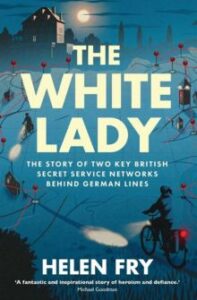
It is an enduring trope of spy fiction that finds retired spies, their glories long behind them, approached and re-activated for one final mission. But sometimes, reality outdoes fiction and Helen Fry’s masterly new study of wartime resistance in Belgium relates how the agents of a key First World War espionage circle came together just twenty years later to reprise their heroic work in the Second World War.
Fry is a formidable historian of British intelligence, whose excellent The Walls Have Ears and Spymaster detail the activities of MI19 in surveilling prisoners of war in Britain during the Second World War. In The White Lady she applies the same diligence to recently declassified files in UK and Belgian archives to detail how agents were recruited, often betrayed and how vital their intelligence was to the war effort.
The First World War White Lady network and the Second World War Clarence Service were the among the most important British secret service networks operating behind enemy lines. The Belgians chose the name La Dame Blanche for their network because of the legend that the ghost of a white lady would herald the demise and downfall of the Hohenzollern royal dynasty. Therefore this White Lady, it was hoped, might precipitate the end of German occupation in Belgium.
The founding members of the network, Walthèr Dewé and Thérèse de Radiguès, operated a circle of couriers and spies who risked their lives to smuggle intelligence out of occupied Belgium. When they regrouped two decades later, much of their success was down to the experience and knowledge derived from their first work. Throughout the war, their agents were able to supply London with details of enemy army movements, fuel transport and U boats as well as reports from the coastline and details of Hitler’s secret weapons programme.
Claude Dansey, deputy head of MI6, to whom the Clarence Service was answerable, said it was the most crucial network for military information in the whole of Europe. In all, operators in the field sent over eight hundred radio messages to London and delivered more than a thousand reports, including groundbreaking information on the V-1 rocket. Not all their information was heeded. Before the Blitzkrieg, agents observed early signs that the Germans were preparing to invade, because they were felling trees and dense hedgerows. Their warnings, however, went unheeded.
A key figure back in London was the agent handler Ruth Stowell. Having travelled the world with Freya Stark as a young woman, she returned to Britain to be posted to Bletchley Park. From there, on account of her fluent French, she was moved to MI6’s Belgian desk. Her responsibilities included preparing parachutists being sent into Luxembourg, overseeing every detail of their appearance right down to ensuring that they had the correct ‘Belgian’ haircuts. Yet despite her vital work, Stowell (who eventually married Lord Scarman) is not mentioned in official MI6 history and as Fry points out, her role has been invisible until now: ‘Telling her story has been part of restoring the contribution of women to our narratives.’
That ambition is amply achieved in this book, not only in the accounts of those women who sheltered airmen and couriered messages, but those who helped in ingenious ways, such as the Belgian housewives who would knit coded patterns into their jumpers as they watched German troops pass by. The knitters used the number of stitches to indicate the number of troop movements and regiments, and the style of stitch to signify the type; plain for soldiers, purl for wagons. When the jumpers were completed, they were tossed over the border and their coded messages eventually decrypted at GHQ France. Like so many women, Fry says, ‘their contribution has been hidden for too long by official secrecy.’
Comparing two networks twenty years apart is an illuminating device, but a depressing one because war only gets worse. As Fry soberly observes, it was more dangerous to work as an agent in WW2 because of the brutality of the Gestapo, who would not hesitate to arrest and torture friends and family. Yet her work in examining the detail of both wars only emphasises the ongoing importance of heroism and resourcefulness needed, in both past and future, for effective wartime resistance.
Jane Thynne is a bestselling writer and the author of Appointment in Paris.