
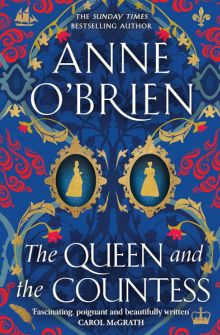
The Queen and the Countess is Anne O’Brien’s latest medieval historical fiction, following two women on opposing sides of the Wars of the Roses. Set between the 1450s and 1480s, this novel centres on Margaret of Anjou (Queen of England and wife of Lancaster King Henry VI) and the Countess Anne of Warwick (wife of the Yorkist ‘Kingmaker’ Richard, Earl of Warwick).
Renowned for writing about the overlooked women of medieval history, O’Brien creates an unusual, yet compelling, pairing in her choice of protagonists. Though on opposite sides of the war, Margaret and Anne share many strikingly similar experiences – particularly the uncertainty of motherhood and the loneliness, pain, fear and despondency they must have felt as they awaited the return of their absent husbands. For most of their lives, Margaret and Anne were defined by their titles: Queen, Countess, Wife, Mother. O’Brien doesn’t shy away from this, but she ensures that they are remembered not only for these roles but also for their fortitude, resilience, courage, determination, love and sacrifice.
With rich descriptions of characters, settings, crowds and clothing, this novel immerses readers in both the era and the lives of its complex protagonists. Spanning three decades, it follows Margaret and Anne from Loveday in 1458 – a symbolic reconciliation attempt between the warring Houses, orchestrated by Henry VI – to the far-reaching consequences of the Act of Accord, a pivotal legislation that ultimately leads both families to face exile, violence, and the sorrows of war.
Written in the first person, with each chapter containing the perspectives of both Margaret and Anne, readers gain a unique insight into how these women view themselves and how they are perceived by others. This clever narrative device allows for a deeper understanding of their private and public personas. It is particularly fascinating to see how both women interpret the same events, especially in terms of their perception of power (or lack thereof) and their ability (or inability) to influence outcomes. Bound by societal gender expectations, and often used as pawns in marriage alliances or to secure wealth and titles, O’Brien presents Margaret and Anne as examples of how many women were treated during this period. Yes, despite these constraints, both women continue to fight for their voices and what they are owed.
This novel considers several interesting questions: What is love? Or perhaps, more accurately for women of their status, what is owed to them in marriage? What does it feel like to no longer feel at home in a place you once cherished? And what is it to be a woman reduced to a pawn in a man’s relentless and indiscriminate quest for power and glory?
The Queen and the Countess shows the human cost of the ‘cruel game of crowns and kingdoms’. Whilst this could be seen as a tale of two women who ultimately fall victim of to the ambition of others it is, arguably, the opposite. It is a story of two women who sacrifice everything in their fight to protect their families – and themselves.
Anne O’Brian is a Sunday Times bestselling author of historical fiction. Her novels can be found here.
Ella Beales is a historical researcher and book reviewer.


