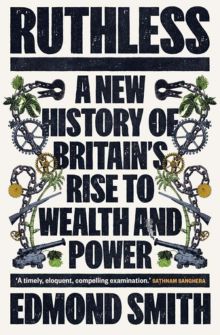
How did the Industrial Revolution come about? And why did it start in Britain? Professor Edmond Smith examines these fundamental questions in compelling fashion, from the founding of the Royal Society in 1660 to the onset of imperial glory at the turn of the 19th century. Undertaking deep research in original archives, they unearth all manner of facts and anecdotal gems glinting with insight. Convincingly, they demonstrates how ‘a web of interactions and exchanges that stretched across the globe’ resulted in the manufacture of yarn and the British textile industry which led this revolution. Much like the United States, which would also come into being during the same period, this was a process of ‘E pluribus unum’ (out of the many, one).
Such history is notoriously diffucult to render. How to remain true to its complexity, whilst at the same time conveying the central phenomenon itself? The ‘why’ is immensely complex, whilst the ‘what’ frequently appears in the form of a vast generalisation. Professor Smith’s focus is often on figures once removed from the centre stage. Take, for instance Samuel Oldknow, who launched himself onto Manchester manufacturing scene with a £3,000 loan from the better-known Richard Arkwright, developer of the spinning jenny. As Smith points out: ‘Oldknow was unskilled as a mechanic, spinner or weaver. His business depended upon using his access to capital to insert himself into every stage of cotton manufacturing’. He sub-contracted, purchasing raw cotton, which he distributed to essentially self-empolyed spinners working in cottages, then collected their yarn, distributing this to self-employed weavers, from whom he collected the cloth, which he checked for quality, before passing this on to merchants. Travelling from Manchester to London, he would research which types and qualties of product were most in demand. Borrowing further from Arkwright, he was able to expand. By 1786 he was the foremost cotton-cloth manufacturer in Britain, with over 500 weaving looms at his disposal.
All of this is meticulously recorded in the archive of Oldknow’s letters. As indeed is his downfall. With so many sub-contractors working independently, he was exposed to competitors, who frequently poached his best workers. But worse was to come, with the establishment of cotton mills in Manchester, where all the workers could be housed under one roof, together with machinery and jennies driven by steam. Within decades, Oldknow and his ilk had vanished. Today, his name is remembered by a sole pub, the Samuel Oldknow in Marple, the suburb of Manchester where he started out.
Professor Smith covers the entire sweep of the phenomenon we know as the Industrial Revolution, richly illustrating both its innovations and its horrors. There is no easy answer. They show how scientific ideas and commercial innovation are inextricably involved with slavery and colonial exploitation. At the same time, Smith also introduces the occasional countervailing idea – as, for instance, when the East India Company sought to replace Caribbean sugar, with its advertising slogan: ‘East Indian Sugar Not Made By Slaves’. Or when miners unearthed a dinosaur fossil, judging it to be ‘a giant deceased human’. The face of Britain would be transformed forever by the spread of canals, the growth of the mining industry, Blake’s ‘dark satanic mills’ and the like; and these would in turn transform the world. The method by which this process took place is tellingly characterised in Edmond Smith’s Ruthless.
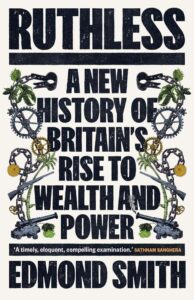
Dr Edmond Smith is an author and academic. You can find Ruthless here.
Paul Strathern is an acclaimed historian and the author of Dr Strangelove’s Game: A Brief History of Economic Genius.