
I remember being taken on the Northern line as a child who loved talking kings and queens and reciting their dates and associated trivia ad nauseam (still my peak!). The murals that bring to life the platforms at Charing Cross were pointed out to me, the simple explanation being that Edward I had set up a number of crosses in memory of his wife, Eleanor of Castile – sufficient detail to sate the curiosity of a six- or seven-year-old. The fact that this was near enough the endpoint of a 200-mile journey of her body did not really register with little London-based me.
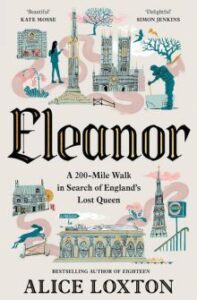
Twenty-odd years later and it is Alice Loxton’s Eleanor that has filled in the remaining blanks of that particular tale, one of love, grief and pilgrimage. The social media phenomenon behind @history_alice’s account of a walk to retrace the funeral route from Harby in Lincolnshire to Westminster Abbey 734 years on, is not merely a historical biography or a travelogue. The book is more than the sum of its parts, chock-full of insight into the legacies of the various crosses, those that survive and those that did not, the towns and villages where the cortège stopped off, and the realities of life in the 13th century, for monarch or for peasant.
Eleanor and its ever-approachable, well-paced reimagining of those two weeks in December 1290 unfussily throws you into the mindset of someone travelling in the retinue alongside the procession, in much the same way as the author threw caution to the wind and set off herself, whether sufficiently prepared for the challenge and distance involved or not! The seeds of the book are said to have been sown in Loxton’s day in ‘The Queue’ to see Elizabeth II’s lying-in-state in Westminster Hall. This modern-day grounding signals exactly what is at issue when a sitting monarch or their consort lives, dies and is later memorialised. The journey in search of Eleanor and what ensues feel all the more relevant then, the majority of the population’s grasp and understanding of nationwide mourning having been the less because of the late Queen’s unprecedented reign.
Not only does the walk take Loxton through the streets and lanes of middle England – that history is all around us appears to be the prevailing precept of the book – but she endeavours to expose herself to and get to grips with the craftsmanship behind the crosses, three of which still remain. Her visits, first to a workshop of a Yorkshire stonemason who had worked on the conservation efforts for the Northampton cross, to take a stone-carving course, and, later, to the home of David Gentleman, the designer of those Charing Cross prints, serve to pinpoint just how rich the creative legacy of Eleanor and Edward I’s 36-year marriage remains today, to demonstrate both the appeal and endurance of their story.
Zeb Baker-Smith is a Classics teacher based in Malawi, a freelance journalist and Editor at Aspects of History.