
Welcome, Natalie, and thank you for talking to us today. My first question is – why do you think there is such an appetite nowadays for fiction set in the ancient world?
I think it’s just having a moment, isn’t it? And some of that will probably just be a trend, I suppose, as these things are. Maybe it’s an alternative escape from a dispiriting reality, from cozy crime, or whatever. But I think there’s also a really solid base of people who just love myth. Kids don’t get to do it for as long, I think, at school. You know, most kids get to do a bit of Egypt, and a bit of Rome, and a bit of Greek myth at school, but they don’t get huge amounts of Latin and Greek pushed at them anymore. That’s not a fight I’d particularly take on, but I think Classics is something which interests huge numbers of students, and that they don’t always have access to. It interests huge numbers of adults, and often they’re people who were told at school that they could study, like, a little bit of classics, but that there wasn’t room on the curriculum, or that they weren’t clever enough to be in a Latin class or whatever. Latin is not a difficult language, so if you’re finding a student unable to learn it, then you should look at your teaching methods, I would say. But I think because it’s been sort of stripped back from the education system, it doesn’t mean that people’s appetite for it has gone away, so fiction is a really good way for a lot of people to access this stuff. And I’m lucky that I get the radio shows as well, so I can force classics on people from multiple angles at any given time, and I do…
I don’t think you force it.
Hmm…
I was wondering which was the first myth you remember reading when you were little?
I don’t know. We did definitely have the Puffin Book of Greek Myths or the Ladybird Book of Greek Myths, but I don’t remember at all. My memory of my childhood is hopeless. If you ask my brother, he might know, but I never do. I’ve fully replaced my own memories with memories of, you know, dates from ancient Greece or whatever. So I’m excellent if you need to know when the Spartans lose a land battle at Leuctra (in 371, to the Thebans), but I’m hopeless if you want to know what I did last week.
Okay, I’m trying to think of a Greek date I really want to know, but… no, we’ll move on. Now, you recently said that this book is special to you. Would you tell us that story, please?
Of course. Euripides’ Medea is the first Greek play, maybe the second, that I read in Greek, in the sixth form. It’s the first Greek play I saw performed. I saw Diana Rigg play her at the Almeida. My dad drove me down from Birmingham to see her in London, and I had the most extraordinary experience watching this. Diana Rigg was obviously mesmerising. And in the moment where Jason comes on and doesn’t believe that his children are dead and then demands to see them, the back wall of the Almeida, which is not a large theatre, was covered in, like aluminium, I guess? Like a brushed metal plate. And then within this sort of huge, dulled metal wall, were two panels that it wasn’t easy to see without knowing they were there. At the moment where he demands to see their bodies, she thumped the back wall, and these two huge panels, which were on wires suddenly dropped down, everyone jumped a foot and a half in their seats, and the dead children were behind these two panels. And I remember thinking, even at 16, maybe 17, years old, that I would never be the same again, and I was never the same again, so it worked.
I carried on being obsessed with her as a character in a play through my undergraduate years. I wrote a paper that my second year, there was a paper on the presentation of Medea in Pindar’s Pythian IV, Euripides and Apollonius of Rhodes’ Argonautica III. So I took that paper and I wrote my undergraduate dissertation on the heroics of gendered infanticide in the work of Euripides.
So, yeah, I’d been squaring up to this one for a long time. I’ve probably seen 20 or 30 productions of Medea, through my life now. The most recent in Japanese, a kabuki production, touring Europe earlier this year, which was the first one I’d seen since I’d written the book, and I thought, “What if I’ve broken it in my head?” You know, I’ve spent so long in her head. I’m thinking about and analysing the play more than I ever had, you know, for an undergraduate dissertation. What if it doesn’t work anymore? And then, you know, like, 85 minutes later, we were all on our feet, and tears streaming down our faces, and I was like, oh, it works just fine. It’s all fine.
I translated it before I came to start writing the novel. In December 2023, I thought, “I’m not quite sure how I want to start it. But I haven’t got very long before I have to start working on the radio.” This is always the way with me, so I can’t waste this time. And so I thought, “I’ll just sit down and translate the play longhand, you know, into a notebook, and then when I’ve finished, I’ll know how to start the book.”
And I did. And that’s where the title comes from. I think it’s line 77 of the play. The children’s tutor has arrived and says to the nurse that the kids are going to be exiled along with their mother, and she says, “Surely Jason won’t see his children thrown into exile, even if he’s fallen out with Medea?” And the tutor says, “Old loves have replaced new loves, and that man is no friend to this house.”
So, I was like, bingo! I’m having that!
And you use the nurse’s speech as your chapter headings.
That’s right, I’m glad you noticed this.
It took me several chapters.
That was my plan. I didn’t want it to be too obvious. Somebody was reading the book in the queue for signing last week, and they’d already got it by the time they got to the front of the queue. I was like, maybe I should have been more sneaky.
At the end of the book, I went through and flipped from chapter to chapter, to check you’d got it all.
Yeah, check, I got my tenses right, yep. It’s always worth checking
So, going on to Natalie Haynes Stands Up for the Classics, which, of course, I’m a big fan of…
Oh, thanks!
It’s been going for…?
11 series… 11 years. How mad is that?
When you’d just written, An Ancient Guide to Modern Life.
That’s right. An Ancient Guide to Modern Life came out in 2010, and then I’d started doing a live show to go with it, because it became clear very quickly that if I wanted to sell books, I should be at book festivals, and if I wanted to be at book festivals, I could be one of three people, or two people on a panel. And then I would have basically half of a 50-minute session to talk, or I could offer the book festival, like, a solo thing.
I came from stand-up, so I wasn’t afraid of solo performance, and I knew I could, or I was pretty sure I could get audiences to listen and to enjoy it, even though I wasn’t going for gags, like in the old days.
That was really fun, and then I pitched it to the BBC and said, how about if we did this for a radio show. And they weren’t sure, but eventually said yes. That was in 2013. So it took a couple of years to persuade them, and then the first series went out in 2014, and here we still are. Next year, I’ll make Series 12.
This year we did a couple of episodes on Alexandria, and people loved them, and a couple of series ago, we did Pompeii, so I really enjoy doing biography of place.
When lockdown happened and we were making them from home, the series that I intended to make, I hadn’t yet written. And I couldn’t get the books, because, you know, people forget now that, but, for a while, you know, we couldn’t get books out at all. Even Amazon wasn’t delivering.
So we had to do a few episodes. That series, which is only four episodes, and the following series, were based on chapters in my upcoming, at that point, non-fiction book Pandora’s Jar, just because I’d got the books in the house. That’s how it had to be.
And then I thought, well, I’ll make up for it. When we came back, I did the whole Odyssey in 28 minutes, and I’m like, there we go!
And then last week, you did the Aeneid in 27 minutes.
Yeah, it was fun, wasn’t it? God, it took a lot of work.
It was fun. I personally can’t stand Aeneas, so I did want you to be more horrible about him – losing every woman he’s ever loved.
Oh, he’s just a drip, isn’t he? I think that’s the problem. He’s sort of, you know, he’s a perfectly nice, carved-out-of-wood man who stands there going, “Oh, I love you,” and then not doing anything very much, while the world changes around him. I mean, he wouldn’t be my guy, for sure. I probably would have fallen for the dubious charms of Odysseus, but Aeneas is just a bit too Captain America for my taste.
How do you think the performing influences your writing? And does your writing influence your performing?
Yes, they both influence each other. When I’m writing, I do think a lot about how it will sound when I do the audiobook. I always tell young writers when I get to speak to them that the best way of editing your work is to read it aloud. Always. That’s not just how you notice typos, but it’s also how you notice unconscious repetition and verbal tics that you wish you didn’t have.
You know when you want repetition for its own sake, and when you’ve framed a sentence so that it kind of trips you up. If it trips you up when you try to say it out loud, it’s going to trip people up inside their head, even if they’re not quite conscious of it. Sometimes you want repetition for resonance, and other times you just forgot you used the same word two pages ago. You pick those things up a lot faster by reading aloud.
I was always going to use Apollonius’ Argonautica as part of the background for No Friend, but when I realised there was a talking crow, I can never resist a talking crow chapter, because I’ll always have such a ball reading them when we do the audiobook.
My talking birds are quite different. There’s one in Stone Blind, which comes from Ovid, and there’s one in No Friend, which comes from Apollonius. They’re quite different in nature, but they’ve obviously got similar characteristics because they’re both crows. I hope they have that slight attention-deficit thing that crows always seem to have when they’re hopping around the place.
I think it definitely works the other way as well. I like performing my own work. I don’t think I would feel particularly attached to performing someone else’s. I like to create the material that will be the basis of the shows.
The radio shows are a mix – partly improvised and partly written, performed from notes. The notes have got longer as we’ve done more series, because I used to have more time to commit them to memory and now I don’t. That side of the performance now is really only in my live stuff.
We started the tour two weeks ago today, a preview in Brighton, and then the launch show was last Tuesday in London. It was fun, but now I’ve done six or seven performances, I’m like, oh, can we start again? Now I know what I’m doing, now I’ve learned it, and I’ve put jokes in it, can we go again?
People are always so nice, and I try to remind myself that I’m not a stand-up comic anymore. It’s fine if I don’t get laughs every minute, because that’s not the job I’m paid to do these days.
But your stand-up soul is hard to turn off. Where’s that laugh? How did you miss that? The beginning of a show is really a feat of memory more than anything else, because it’s 90 minutes. Getting 90 minutes of material into your head is a lot, even if you know it well. Making sure you don’t forget the timeline, or names and dates, still takes time to commit to memory.
The next thing I wanted to ask is about classics in education. You’re a patron of Advocating Classics Education, so give it a plug!
Edith Hall is obviously a force of nature, and her commitment to putting classics into state schools has had an impact on, I can’t even imagine, thousands, tens of thousands of lives already. One of the things that she is so passionate about is making sure that Classics can be taught in state schools where Classics teachers are in fairly short supply. As far as I know, unless the numbers have changed, more Classics teachers retire each year than qualify.
Edith’s project was to put materials into the hands of enthusiastic non-classics teachers so that they could teach Classical Civilization. And of course, there are lots of teachers who’ve seen their own subjects somewhat diminished. Modern languages teachers have often seen a drop in students, unfortunately, since it ceased to be compulsory.
It’s not just the obvious ones you might assume. English teachers, modern language teachers, history teachers — she also has physicists and chemists who are keen on classics, and now they’re teaching it too. So I have absolutely loved being a patron for Advocating Classics Education.
I do fewer events and things for basically everyone than I used to, it feels like, because I just can’t spend the whole year on the road anymore. Writing the novels is obviously a bit more emotionally draining than the non-fiction. In No Friend to This House, you can hear how emotionally connected I am to it on the audiobook — there are bits where you can hear me crying.
It’s very hard to do a day writing that and then go on stage and be me plus plus. So I’m trying to reduce the time I do performing. I don’t get to do as many school visits, except that tomorrow I do, because I’m in Monmouth, and I’m going to Monmouth Comprehensive School before I do the event in the evening.
But it’s always lovely to be back in schools, and Edith Hall never gets tired. You could wake her up in the middle of the night and say, “We need somebody to make sure that more state schoolchildren have access to classics,” and she’d be like, “Yes, I am ready.”
So whenever people tell me I have loads of energy and blah blah blah, I think, “Yeah, because I trained watching people like Edith, who just doesn’t let reality impede her need to do the right thing.”
Having spent your career performing and writing about it, what would you say is the most important thing that people need to know about Classics?
I hope the message that I’ve most consistently been promoting is that Classics belongs to all of us, and not just to an elite who get to study at a fancy school. I’m really conscious of the fact that I belong to an elite who got to study it at a fancy school. I got to do Latin and Greek and Ancient History A-Levels, which I don’t think anyone would let you do now. Wisely, obviously, because I’m qualified to do literally the job I have, which I had to invent in order to have it.
I hate the idea that classics is an elitist subject. I’ve always hated it. I feel like classics is morally neutral. If we withdraw it from the curriculum, and then only let private school students study it, before deriding it for being elitist, Classics did nothing in that equation. That was all on us and our values.
And my other great loathing, as I alluded to earlier, was people being told when they were 10 or 11 that they weren’t good enough to study classics. They have spent their whole, often incredibly successful working lives feeling like there was something they weren’t good enough for, and that Classics was too good for them. And then only as a retired person with more free time have they found that, in fact, Classics is completely available to them, and that they were always smart enough.
And even if they hadn’t been smart, there were still bits of Classics that belonged to them. As a friend of mine used to say, the house of western thought has many rooms, but only one basement. And we all deserve the chance to be able to access those things. These stories, this history, are our history.
I’ve loved being able to write novels and putting women at the centre, you know, and getting told by journalists that it’s an anachronistic thing to do, and pointing out calmly in exchange that of the eight tragedies that Euripides wrote about the Trojan War, fully seven of them have women as title characters. So it wasn’t that anachronistic, actually. Unless you’re saying that he was anachronistic also, in which case, sure.
Those kinds of assumptions were made because for so long Classics was something for posh boys to make their own. My ongoing commitment to making that not true anymore will never end, I don’t think.
And finally, a recommendation. If everyone in the world had to read one history book, what would it be?
I love Edith Hall’s Introducing the Greeks. It’s a slim volume, it’s only a couple of hundred pages, but somehow she manages to get 2,000 years of ancient Greek history into a themed and chronological order, and deal with some of the huge social and cultural issues of Greece. I don’t really know how she did that. I quite often give people copies of Introducing the Greeks as a gift, so if I could, I would give a copy of that book to every school.
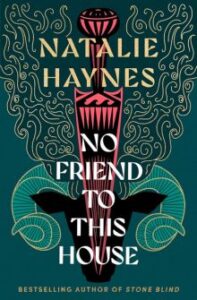
Natalie Haynes is a broadcaster and the bestselling author of No Friend To This House, which was released in September.
Fiona Forsyth is the author of Death and the Poet, the second instalment of The Publius Ovidius Mysteries, published by Sharpe Books.