
It’s astonishing how firmly the tragic story of Puyi and Wanrong, the last emperor and empress of China’s Qing Dynasty, remains in the public imagination.
In the West, much of that fascination comes from Bernardo Bertolucci’s lavish 1987 epic The Last Emperor – now 38 years old. In China, the doomed couple, their gilded-cage existence in the Forbidden City and their eventual downfall at the hands of the Japanese continue to inspire histories, novels, soap operas, websites and graphic novels. On weekends, children in Beijing even cosplay as Puyi and Wanrong and wander around the former imperial city.
Yet many of these portrayals sacrifice historical detail for politics, romance or exoticism.
In the People’s Republic of China, it has often been convenient to portray the Qing and its last emperor as weak, impotent – in every sense – without agency and ultimately as a traitor who became the Japanese-sponsored Emperor of occupied Manchuria, renamed “Manchukuo”. Western accounts, meanwhile, can mistake the absence of Hollywood-style romance and public affection for a failed marriage, exoticising the couple as the final, decadent rulers swept away first by republicanism and then communism.
The Last Emperor and Empress
Puyi became emperor at just three years old in 1908, selected by the Empress Dowager Cixi, who died the following day. At five, he abdicated as the Qing/Manchu Dynasty collapsed and the Republic of China was born under Sun Yat-sen.
For the next fifteen years, he lived almost entirely within the Forbidden City: an extraordinary gilded cage in the centre of Beijing and now the world’s most visited tourist attraction.
In 1922, aged 16, Puyi married Wanrong, the daughter of a Manchu nobleman. Together they became the last emperor and empress of China, and their wedding was the last great display of imperial pomp ever staged in Beijing.
Then they effectively vanished.
For two years Puyi, Wanrong and his primary wife, Wenxiu, lived behind the walls of the Forbidden City until a warlord expelled them in November 1924. Few outsiders entered. Journalists were discouraged. Puyi’s world revolved around his Scottish tutor, Reginald Johnston – Peter O’Toole in the movie – and, crucially, a woman who has almost disappeared from the familiar story: Wanrong’s young American tutor, Isabel Ingram, the daughter of Philadelphia missionaries in northern China.
The Serendipity of Being a Historian
As a historian of modern China, I had long been fascinated by Puyi and Wanrong: teenage newlyweds trapped inside the vast Forbidden City, surrounded by rapacious warlords and a fragile new republic.
Walking through the former imperial apartments, I tried to imagine them there and to see them afresh through The Last Emperor. They came from elite Manchu families steeped in tradition and had entered an arranged marriage at the end of an imperial dynasty. Yet they were also young people embracing modernity: motorcycles, cinema, tennis, cigarettes, jazz records and, above all, photography.
Looking through the photographs they took in the Forbidden City, I sensed a young couple desperately trying to find a role for themselves, build a relationship and make sense of an utterly extraordinary situation.
But historians have to be wary. It is dangerously easy to project our own hopes and assumptions onto century-old photographs.
Then I received an email….
It was from an American descendant of Isabel Ingram. He had read a magazine article I’d written noting that Ingram was absent from the famous film, barely appeared in Johnston’s 500-page memoir and had effectively been erased from the story.
Would I like to see her diary from the two years she spent with Puyi and Wanrong inside the Forbidden City?
Yes…
Very much…
Inside the Forbidden City
Until now, we have had only two substantial accounts of those crucial years between the royal wedding and their expulsion into the chaos beyond the palace walls: Johnston’s detailed but rather impersonal Twilight of the Forbidden City (1934), and Puyi’s much later autobiography, From Emperor to Citizen (1961), itself repeatedly and heavily edited by the Communist authorities.
Now we have Isabel Ingram’s diaries and letters.
And they transform the picture.
Ingram describes a couple working at their marriage and forging a kind of practical, private love. They played tennis, bicycled, took photographs, listened to records, picnicked and planned a future together despite the extraordinary forces ranged against them.
She also reveals something long obscured by gossip and hindsight: Puyi and Wanrong had a private and intimate life together.
Her diaries allow us to look again at the other sources—and at the final years of the Forbidden City itself—with fresh eyes.
Of course their brief halcyon period did not last.
Puyi would become a pawn of the Japanese in Manchuria. Wanrong would descend into opium addiction and die horribly and tragically young. Puyi would survive into Communist China, become a gardener and spend his final years largely in obscurity.
The last emperor and empress have been portrayed countless times. But perhaps, only now, are we beginning to see them as they actually were: not political symbols of a feudal past, nor exotic caricatures for western consumption, not simply victims or villains, but two young people trying to build a life inside the ruins of an empire.
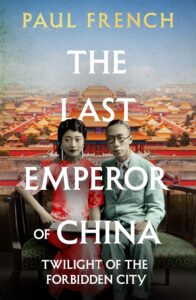
Paul French is the author of The Last Emperor of China: Twilight of the Forbidden City, published by Elliott and Thompson.