
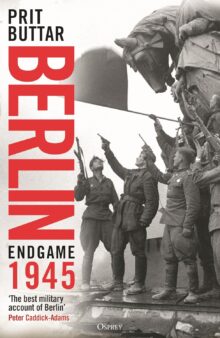
For some of us it might seem that there was little more to add to what we already knew about the last days of the Nazi regime in and around Berlin. Yet this meticulous description and analysis by Prit Buttar proves that this is not the case. His thorough research into personal testimonies and memoirs of those involved on both sides of the conflict unveils a much more nuanced picture of what happened.
Buttar reveals that internal rivalries and uncertainties within the German and Russian leadership affected the nature of the outcome in 1945. The Russians were operating under the personal leadership of Joseph Stalin which meant that tactical decision-making was sometimes delayed by indecision and also deeply influenced by Stalin’s paranoia, this latter leading to Marshal Zhukov’s displacement and demotion directly after Berlin was secured. Equally the personal leadership of Hitler, supported by loyal adherents like Himmler and Goering meant that talented strategists were overridden, with huge dependence on a belief that, despite the onslaught from west and east, somehow victory would still be secured. Buttar cogently conveys that sense of unreality which almost seems to have persisted to the day that Hitler finally committed suicide.
The research into people’s testimonies and diaries is very rewarding for those of us who are interested in how people felt. The German people, once they realised that defeat was inevitable, were focused on hoping that they would be largely under the control of the Allied forces coming from the west because they knew how unpleasant the experience of being occupied by Russian troops would be, in terms of a lack of respect and humanity, especially in how women would be treated. There is more than a hint because of this that the German defence was concentrated on the Russian advance. The Russian attitude was not unexpected because the German attitude to people to the east had long been negative and exploitative, so to a degree the Russian behaviour was retributative.
There is also a modern-day parallel in how Hitler chose his inner circle. Politicians, inevitably, align themselves with people of a similar perspective but usually there is a recognition of degrees of capability. Buttar’s analysis of Himmler, in particular, reveals that his self-evident psychological and health weaknesses did not suit high office, and yet he remained in post until the very end because of his loyalty.
The other perspective which Buttar unveils, using personal testimonies, is how ordinary Berliners reacted to what was happening. His contextual introduction reveals that Berlin had not been a centre of Nazi enthusiasm but that its status as capital meant that it was identified with its practice. People were waiting for their chance to be released from this authoritarian regime in what had been previously a very cosmopolitan and open society.
As always with Prit Buttar, this is a very detailed exploration but the outcome is that we can understand, from the German people, what they were enduring in what he has labelled the ’end game’ of the Second World War.
Trevor James was the editor of The Historian from 2006 to 2019.