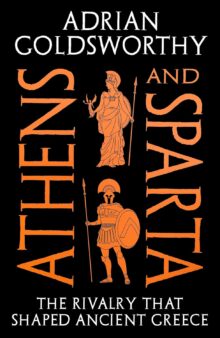
The Romans too often get the good gigs, both on our screens and on the shelves, these days; the Greeks, not so much… That is the starting point of Adrian Goldsworthy’s journey east across the Mediterranean and his sweeping account of the two headline acts at the tip of the Balkan peninsula. That word ‘sweeping’ gets used an awful lot in historical book reviews (my own included!) but it would be unfair not to pay deference to the author’s ambition – and success – in tying a multitude of strands together and covering the heavy hitters, Athens and Sparta, their alliance and conflict, the polarity of their identities and ideologies in one fell swoop.
Athens and Sparta: The Rivalry that Shaped Ancient Greece begins with a ‘Greek’ world fragmented into thousands of poleis with little concept of pan-Hellenism in political or military terms, its story traced from Homer and their mythic origins to the end of the Peloponnesian War. By the end of that fabled conflict and the 5th century BC, Athens and Sparta emerge as dominant, yet not inevitable, rivals, their supremacy, naval and terrestrial respectively, the basis for a cooperative victory against the Persians and devastating campaigns against each other that would ravage Greece in its entirety. To capture the push and pull of this complex entanglement from start to finish is Goldsworthy’s aim, one which he achieves in compelling fashion.
Has the polarity been overstated in the historiography of modern times? No doubt the Spartans conceive of their authoritarian state in an markedly different terms to the democratically inclined Athenians, their performative image of themselves as Iliadic conquerors in stark contrast to the notion that their rivals were sprung from the land itself. However, despite the successful alliance struck in opposition to the invasions of Darius and Xerxes, the author argues that both were in the business of seeking prestige, that, just as in recent weeks, friction can lead to conflict on the basis of a state’s sense of honour and perception.
When writing 5th-century Greek history, the presence of Herodotus and then Thucydides always looms and, though mentioned and assessed frequently, Goldsworthy still maintains the reader’s attention and never gets bogged down in his analysis and consideration of the gaps, biases and uncertainties that plagues ancient historiography. It is the synthesis of his close adherence to sources and research, paired with his ability to keep the narrative accessible for those approaching this rivalry for the first time, that underlines the lasting notion that it is identity which underpins the Peloponnesian War, and why understanding that is as relevant now as it ever was.
Zeb Baker-Smith is a Classics teacher based in Malawi, a freelance journalist and Editor at Aspects of History.