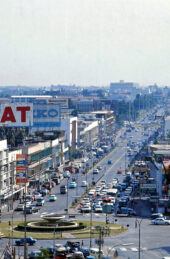

The historical context of Delhi – City of Spies is crucial to my novel because it is the true story of an unsolved murder that took place in New Delhi in 1954 at the height of the Cold War.
Although my book is based on a family archive and is, therefore, subjective and anecdotal, research into the background and historical context has been fascinating and has revealed the following findings.
Despite the joy independence aroused in a country, whose wealth and natural resources had been plundered and exploited for over two hundred years, India at that time was still reeling from the bloodshed of Partition and the refugee crises that ensued. India had been carved up to create Pakistan with scant regard for religious, natural and social boundaries. Researchers now agree that between 2.3 and 3.4 million people were killed in the violence and approximately 15-18 million became refugees, forming the greatest mass migration in the history of the world.
By the early 1950s, India had begun to forge a new order and identity in the shadow of the Cold War. The emergent post-war super powers – the USA and USSR – flooded in to New Delhi, eager to achieve economic and strategic domination in the region.
The Prime Minister of India, Jawaharlal Nehru, pursing a policy of non-alignment, determined that India, after the long years of struggle for independence in which he had played such a central part, would not merely become the puppet of these two giants of the Cold War with their opposing ideologies. He embarked on an ambitious programme of economic, social and political reform.
However, Nehru knew that he would need financial and technical support from these two power blocs to build India’s industrial base. Therefore, non-alignment became a tricky game of give and take with one played off against the other. Delhi, in those years, became a city of spies as the two giants of the 20th century sought to supply the nascent country, not merely with economic and industrial aid, but with military equipment. This battle for dominance took place in Delhi, hidden under the mask of trade, as the race for the sale of armaments escalated.
In Delhi – City of Spies, we see how the USA sought to sell the American dream of a consumer-based society, while urging the purchase and proliferation of arms, and the USSR (whose goals were remarkably similar if not their method) tried to assert their ideology through arms, industry and agriculture.
Nehru plotted an adroit path through this particular minefield, playing the old allies (now bitter enemies) off against each other and wooing new friends in Europe and Asia, as he continued to defend his beloved country’s independence with devotion and skill.
My book links this toxic atmosphere, full of hidden danger, with an unsolved murder. It is a case, whose official explanation was clearly a cover-up, and one in which none of the usual procedures were followed.
The book shows how the greed and ruthlessness of international power politics impacts individual lives and can destroy them with callous disregard. How things have changed. Or have they at all?
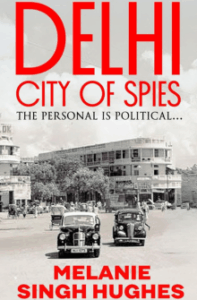
Melanie Singh Hughes is the author of Delhi – City of Spies, the true story of an unsolved murder set in Delhi in the 1950s, which was published in October 2025.