Matthew, we are a couple of years on from the release of your book, One Fine Day: Britain’s Empire on the Brink. It is, perhaps, a rare thing for a history book to focus on a single day – in this case 29 September 1923 – but could you, first, give us a bit of context behind the title and remind us of the significance of that particular date?
It was on this day that the Palestine Mandate became law, and the British Empire reached what turned out to be its maximum territorial extent.
With hindsight we now know that it’s a pivot – thereafter the empire will only shrink. In fact, less than a month later the Sultan of Rwanda’s land was handed over to the Belgians, reducing the empire by some 2,100 square miles. Choosing just one day – well that’s a very sharp pivot.
Perhaps this is the benefit of hindsight, but the feeling one gets from reading the book is that, despite Britain still amassing land and population, including mandates such as Palestine, the writing was already on the wall – and that those involved at the 1923 Imperial Conference were aware of this ‘brink’. Is it fair to assume that was the case for the attendees and, if so, when do you reckon was the apex of the British Empire?
Of course, at the time no one knew that this was the zenith, that thereafter it would be downhill all the way. In fact, in some ways there was renewed optimism. Across the empire, businesses were recovering from the sharp recession of 1921, and recent serious troubles in Ireland, Iraq, India and Egypt had abated. With the United States retreated into isolation and the Soviet Union in chaos, the British Empire was the undisputed sole global superpower. South African Prime Minister Jan Smuts declared that the empire was now ‘the widest system of organised human freedom which has ever existed in human history.’
But, as one reviewer of my book noted, it was at this exact time of imperial zenith that the ‘factors coalesced which were to destroy it’. This is what I explore in the book.
I guess you could find many other ‘apexes’ with other criteria – wealth, health, literacy, military or commercial or even artistic predominance. I think most would agree that some sort of peak occurred in the early 1870s, just before industrial supremacy passed to Germany and the United States, and before the confidence-sapping South African Wars.
In your interview on the Aspects of History podcast, you gave listeners an insight into how the sausage gets made, bemoaning the scope of research that goes into a book with such a worldwide outlook. Looking back, how important was it to labour over such a lot of material and understand the various issues and nuanced circumstances that faced of each dominion, colony, protectorate, mandate and territory – and the voices of the inhabitants of these?
Sorry if I sounded like I was moaning! I absolutely loved doing the research. Some areas, such as the Caribbean, were familiar to me, others less so, so there was a lot of ground to cover, and, as you imply in your question, the separate parts of the empire were radically different.
To find the ‘voices of the inhabitants’, the colonised, often took that extra yard, and sometimes a stroke of luck. I personally found those stories endlessly surprising and fascinating. Perhaps a highlight for me was tracking down an audio recording from the early 1950s of an interview with Harry Thuku, the Kenyan nationalist whose story of taking on the literally murderous white community there I tell in the book. This was an actual ‘voice’!
Your use of the work of novelists has been praised. Alongside official papers, letters and newspapers, life around various corners of the empire is depicted through authors like D.H. Lawrence, E.M. Forster, Orwell and Somerset Maugham. To what extent do you think the novels and literature of the day would have influenced those attending the conference?
We talked a bit about this on the podcast, how novelists – often articulate, observant and thoughtful – can be useful eye-witnesses to parts of the Empire. Orwell, for instance, wrote from experience at the sharpest end as a British policeman in crime-wracked Burma. But it’s not just about the novels; most of them were prodigious writers of diaries, letters, newspaper articles and more. I quote more from these than from the fiction.
I’d be surprised if many at the conference had not read Somerset Maugham. He was a literary megastar. Perhaps, though, they might have found his stories of grubby white behaviour in Malaya somewhat off-putting. The colony, though, was at the front of officials’ minds, not just for its extraordinary wealth, but for the danger it faced from the increasing threat from Japan.
In the last twelve months or so, the debate has appeared to rage on over the transfer of sovereignty of the Chagos Islands. Without necessarily focusing on those particulars, are the kinds of national conversations in the public domain and coverage in the newspapers from the 1920s onwards comparable to the modern day, as those processes of liberation and independence began to be enacted?
It’s interesting to compare the media of a hundred years ago to that of today. The greatest difference is, of course, in platforms. In the early twenties, newspapers and magazines were king; obviously no TV or internet, and radio was only in its infancy (the very first issue of Radio Times came out on 29 September 1923). But there was a staggering number of papers, selling huge quantities, and across a range of approach and opinion as varied as today’s. For the book, I looked at everything from the ultra-right English Race magazine to Sylvia Pankhurst’s Communist newspaper The Workers’ Dreadnought in the UK, and a similarly varied range across the empire. I found it fascinating, for instance, that there were black-run newspapers in Nigeria that were fiercely opposed to the emerging nationalist movement. Interestingly, even the most radical and progressive publications of this time called for the reform, rather than the abolition, of the empire.
Following on from that, it is fair to say that the current political climate means that a book like this has the potential to raise eyebrows on both sides – and might be susceptible to flak. Is empire, and especially the British Empire, a perilous topic to be writing about today, or does that make the need for responsible, insightful and well-considered accounts all the greater?
I think a history book deserves flak if it is clearly the work of someone who has made up their mind on a subject prior to working through the source material, but instead selecting evidence to support their point of view. I’ve come across quite a few polemicists, particularly at the extremes of the debate who, when you check it, have selectively quoted a source or deliberately mangled the context. This is unforgivable.
I think if you can be ‘responsible, insightful and well-considered’, then you should not find writing on empire ‘perilous’. Of course, it is a very live subject – the enormous empire of a hundred years ago has shaped not only today’s Britain, but much of the rest of the world. Add to that the growing calls for reparations, and we have a highly current and important debate on our hands.
No doubt you have enjoyed the very warm reviews for One Fine Day, from both sides of the political spectrum – can you think of anything you would have wanted to change or add, angles to be followed up on, or corners of the globe to be examined?
I’m really grateful for the generous newspaper reviews and the positive feedback I have had from online reviewers and from happy readers who have taken the time to get in touch directly with me.
Even with a particular focus on only parts of the empire, I actually had to cut reams of the first draft, a lot of which I’m quite sad about. There was originally much more on Shanghai and China, which I would have fought harder for if I knew there would be a Chinese edition – a first for me! Three chapters on Sri Lanka were chopped, which meant we lost, amongst much else, further exploration of the key theme of religious nationalism and its dangers. But there just weren’t quite the killer central ‘characters’ that the other chapters are built around. Nonetheless, it was particularly galling, as I’d actually managed to visit there for research.
Generally speaking, I would have liked to have been able to travel more. This has always been, for me, one of the most rewarding and revealing parts of research, and I’ve had amazing trips – to the snow-bound American mid-west interviewing veterans for Monte Cassino, to Panama and the Caribbean on numerous occasions, to (probably best of all!) extraordinary Suriname for Willoughbyland. Obviously with this book I couldn’t go everywhere, but I had exciting trips round Kenya and Myanmar all planned, and then Covid happened. When it was over, I’d run out of time.
Fortunately, I was able to employ local researchers in Myanmar, Kenya, Nigeria, Australia, New Zealand and the Caribbean, who were incredibly helpful, and also gave me a very enlightening perspective on local attitudes. But I would have loved to have spent years travelling everywhere!
And what will 2026 look like for you? Are you getting to grips with another sweeping global history?
I’m working on something quite different, though set in roughly the same period as One Fine Day. Amongst other things, it shows the British in a very surprising and revealing aspect. That’s all I can say for now!
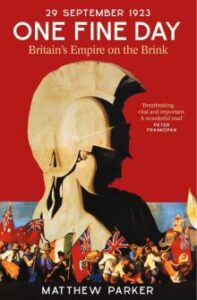
Matthew Parker is an historian, writer and the author of One Fine Day: Britain’s Empire on the Brink. You can listen to a full conversation with Matthew on the Aspects of History podcast feed.
Zeb Baker-Smith is a Classics teacher based in Malawi, a freelance journalist and Editor at Aspects of History.