

Nathen Amin, what first attracted you to the period or periods you work in?
I was raised in West Wales, where history and the past is very vivid in the form of mythology, legends and, of course, castles. So an appreciation of the magic of the world that once was has always been present in me. I can’t claim to have been particularly enamoured with the Wars of the Roses or the Early Tudors, however, until my mid-twenties when I began reading about Henry VIII, getting bored rather quickly with his Reformation and wife troubles, and learned that he had a war-winning Welsh father from my neck of the woods. Once I began investigating the life and reign of Henry VII, rather than VIII, I quickly became hooked. So a fascinating story that has heavy local interest.
Can you tell us a little about how you research? Has the process changed over the years?
No book can be written without sketching out the basic premise, to understand what your argument is, what you want to convey, and the central narrative of the story you are telling. Any popular history, though non-fiction, is telling a particular story. It is imperative to grasp that before you even begin to put words to screen.
This allows me to visualise how my work is going to unfold, and then it can be broken down into smaller sections or sub-stories for each chapter. I know roughly where I want to take each snippet – like a television episode, work on one show at a time to begin building up the fuller series that is the book.
Once I have my outline, I read around the subject of that episode, consulting the generally accepted authorities on the matter at hand and some newer research if applicable. I understand more about the subject and the historiography before I then delve into the primary sources used to reach such conclusions. Notes upon notes are made forming the spine of my book, as primary and secondary sources are worked together to develop my narrative.
Usually, at this stage, I begin to find myself spotting plot-holes or errors in the works of others, or understand why they have reached certain conclusions. Onwards we press, amending as we go. The editing is the process of turning this collection of thoughts and notes into something that can eventually be readable.
As for change, nothing has changed that much in the period I have been writing. I began researching in around 2011, so this was already the internet age. Much of our research can now be conducted remotely, using the internet to access manuscripts, documents, sources and articles from the comfort of our own homes (or in my preferred location, the pub).
I suppose one thing that does change is our own experience and knowledge – that old adage that the more you learn the less you know becomes painfully accurate, and our awareness of our ignorance can at times be overwhelming when beginning a new project.
The common phrase is that history is written by the victors. Do you think this is true?
To some extent history is written by the victors, but it isn’t as clear cut as that of course. The Tudors famously were the victors of the Wars of the Roses, yet Richard III has a worldwide fanbase that has turned much of the narrative on its head. And if history is truly written by the victors, then we may as well pack up and go home, as our work is done for us.
Are there any historians who helped shaped your career? Similarly, can you recommend three history books which budding historians should read?
Every historian I have read has had some effect in shaping my career as they have, naturally, added to the weight of knowledge I have developed to produce my own work. We all stand on the shoulders of giants, after all.
Four historians that are worthy of mention, however, are Helen Castor, Ralph A Griffiths, Sean Cunningham and Matthew Lewis. Helen requires no introduction and is rightfully revered as one of the greatest historians of her and any generation. She has perfected the art of taking an abundance of academic knowledge, decades of archival and research experience, and can present it in an enjoyable and evocative manner that makes her work accessible to all, expert or beginner. That is the golden ticket, and really difficult to accomplish.
I recall with great honour and humility how she reached out to me during the writing of my first full-length work ‘The House of Beaufort’ to offer her advice, thoughts and feedback. This is highly accomplished Cambridge professor with extraordinary professional experience extending her help to some random person without any formal historical training. It was hugely rewarding and inspiring to sit, however briefly, under the learning tree of a great scholar. And she remains, as ever, generous.
In regards to my own area of study, Ralph A Griffiths is one of the all-time legends who shaped medievalism during the 20th century. His influence is keenly felt across the subject, and in particular his popular book ‘The Making of the Tudor Dynasty’ was the work which has inspired my entire Welsh Tudors-focused career. Similarly, Sean Cunningham of The National Archives has an understanding of the reign and character of Henry VII unlike anyone else in the genre.
Finally, Matthew Lewis is the foremost historian of Richard III and someone I have known in a personal capacity from before there was a dream of producing public history as a career. He has challenged me throughout this period and helped me shape my own views on how we read and analyse the later 15th century. Noone should operate in a knowledge vacuum or an echo chamber if we are to press on.
If you could meet any figure from history, who would it be and why? Also, if you could witness any event throughout history, what would it be?
People may expect a Tudor-related answer from me, but the truth my true passion lies in the life and times of Muhammad Ali. If there is one moment from history I could be present for, it would be ringside in Kinshasha, Zaire in October 1974 to witness Muhammad Ali accomplish the unthinkable and defeat George Foreman for the heavyweight title. It was a pivotal clash, not just sporting, but political, societal, cultural, it transcended mere sport. Then I’d take Ali for a coffee the next morning for a chat.
If you could give a piece of advice to your younger self, either as a student or when you first started out as a writer, what would it be?
My issue all through school, university and even now is focus. I have a wandering mind and find it difficult to sit still and concentrate on the task at hand. I think there is more help out there now for those with such brains so I’d encourage me to look into a helping hand from an early age.
Regarding history, mine would be to use the opportunity of youth to pick up some practical hands on experience with archive sources, to consider work placements and volunteering to develop some of the key skills and connections one needs. Then again, our path leads is to where we are and I have no complaints.
Can you tell us a little bit about the project you are currently working on?
I am not currently writing books – after five in a decade it has been nice to recharge and explore other aspects of presenting public history, like producing work for my Substack page, hosting the Aspects of History podcast, and hitting the road putting on lectures. Perhaps one day I will put pen to paper. Watch this space!
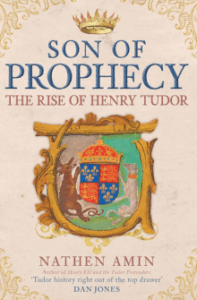
Nathen Amin is an historian from Carmarthenshire in West Wales who focuses on the 15th century and the reign of Henry VII, and the author of Son of Prophecy: The Rise of Henry Tudor (2024).