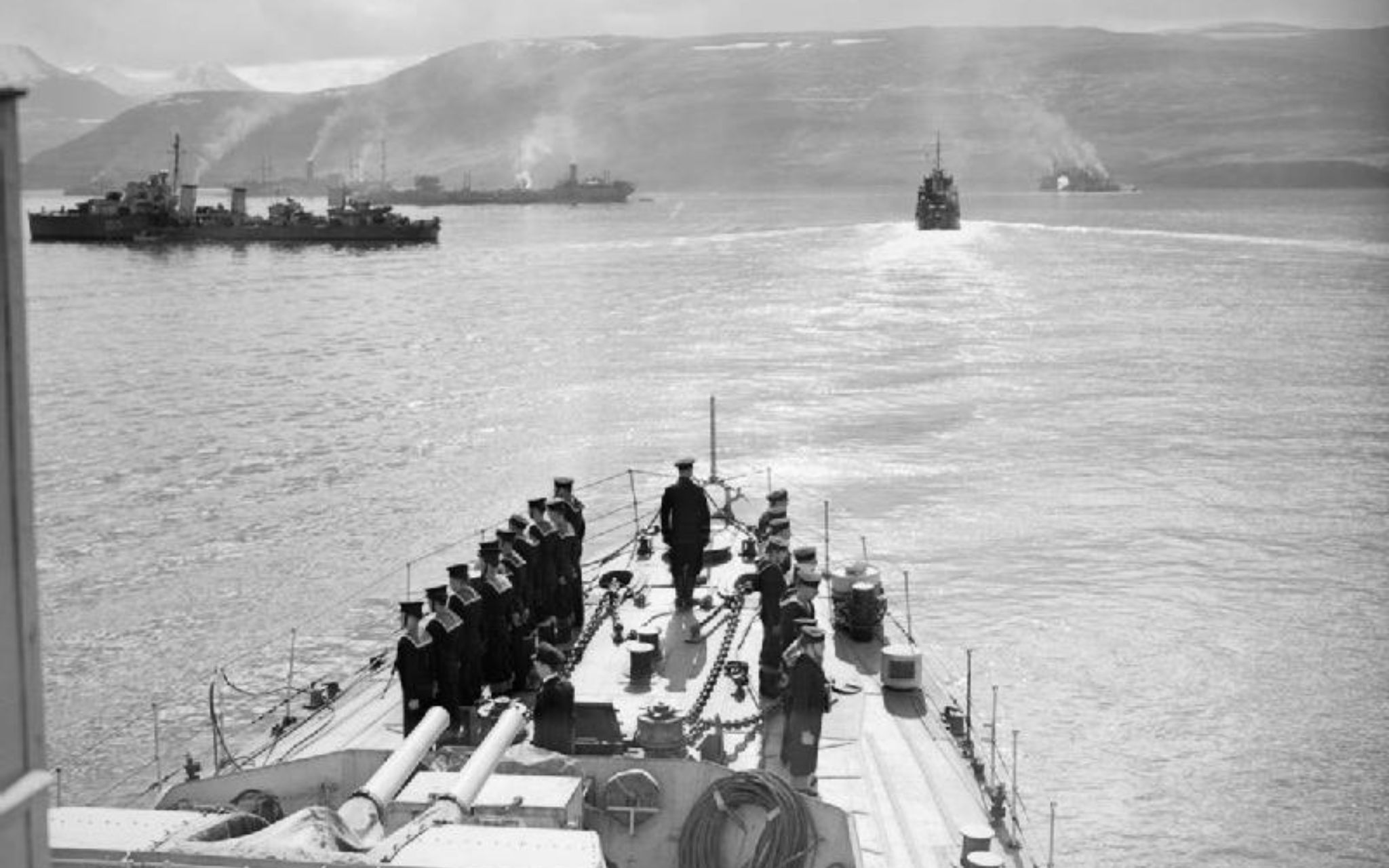
Many if not all readers will at least know the basic facts about the so-called PQ17 disaster. PQ17 was the World War Two Arctic convoy whose merchant ships on 4 July 1942 were ordered to scatter while carrying arms and other aid to Russia because it was thought Tirpitz was approaching. It left them without protection, and vulnerable to attacks from German aircraft and U-boats.
No less than 19 of the 30 merchant ships scattered were abandoned or sunk after being targeted.
Four more ships might well have been sunk had it not been for the action taken by Leo Gradwell, the captain of the armed trawler Ayrshire who effectively disobeyed the scatter order. That was par for the course for a barrister like Gradwell, whose legal training had encouraged him to do the exact opposite of what was drummed into the heads of Royal Naval recruits. The Royal Navy required its juniors to obey every order. Gradwell had been taught to question every statement even if it emanated from the mouth of a superior.
The implication within the command in the wake of the scatter order that all merchant ships should head towards Russia did not make sense given that was exactly what the Germans would be expecting once they knew the convoy had split up. And the insistence that the merchant ships and remaining smaller escorts should not club together, giving the groups that would have been thus created extra firepower, seemed like madness.
So it was that rather than heading eastward alone following the scattering, Gradwell decided he would steer northwards towards the Arctic ice fields along with the three merchant ships which he encountered on the way.
However he and the crews in the ships accompanying him northward, which were the merchant ships Troubadour, Silver Sword and Ironclad, were horrified by radio signals emitted from the decks of the Allied ships attacked by the Germans. One particularly haunting plea for assistance prompted Howard Carraway, the American head of the armed guard in the merchant ship Troubadour to write in his diary:
‘All over the Arctic, German planes and subs were raising hell.
Wary now, the trawler skipper [Gradwell]…told us to follow him into the ice to avoid the bombers….We were scared stiff. Planes were within… five minutes of us, and the trawler and our few guns were all the protection we had…. We manned our guns and waited…. Poor Sparks got very sick, and threw up over the rail from fear and excitement.
After what seemed an eternity, an hour passed and there were no more distress signals. We breathed deeper, [and] felt more secure as we packed further into the ice fields [where] the cakes were getting bigger [and] the ice harder.’
On the other hand those below decks wondered if, by saving themselves from the Luftwaffe, it would result in their falling victim to other terrors. ‘Every moment it sounded as though the bulkhead would burst in under the pressure, or be cut clean…through, as by a giant tin opener,’ wrote Walter Baker, one of two coders in Ayrshire.
But fear of the German planes evidently trumped concern about the cutting properties of the ice. Notwithstanding Baker’s concern, they somehow pressed on. Baker’s report continues: ‘When the ice became really thick, our bows would rise up over it, and then the weight of the ship would force them down, crack it and on we would go.’
Emboldened by the dying down of the distress signals coming from the south, or perhaps deterred by the thickening of the ice to the north, they eventually steered to the south-east and then stopped. It appears to have been one of several halts to take stock.
After one stop, Leo Gradwell asked Richard Elsden, his first lieutenant, to walk across the nearby ice to talk to the other ships’ crews in an attempt to boost their morale. It was while fulfilling this mission, that Elsden had the idea which was to produce one of PQ17’s iconic images. The ships’ relatively dark silhouettes stood out against the white ice. Why not camouflage with white paint the starboard sides of the ships which would be facing towards the south when the ships’ bows were pointing eastwards, thereby making them harder to spot from the direction where aircraft were likely to appear, and why not complete the job by also painting their decks? The idea was swiftly adopted by the commanders of all the ships.
‘All hands turned to,’ Troubadour’s Carraway wrote. ‘There were thirty and more brushes slapping white paint over our decks, housing, rails, boats, funnel, masts, forecastle, everywhere.’
Carraway has recorded how before the job was completed, ‘the trawler came alongside. Her skipper (Gradwell)…and his first lieutenant, a kid in his twenties, both English to the core, came aboard for a war council. [Gradwell]…asked [Troubadour’s] Captain Salvesen if he wanted to head south to Russia, or what. The Captain [Salvesen] said he thought we’d better go back into the ice as far as we could, finish the painting and let the excitement die down a little before we made a run for it…That was agreeable, and we headed once more into the ice.
The other ships soon followed. About ten miles into the heavy stuff, we found an opening and stopped. The others stopped too, south of us, but within easy signaling distance.’
While they lay in this position, Carraway was given the chance to have a rest. When he woke up, he was so astounded by the spectacle, he was prompted to write in his diary : ‘The ship was a mass of white. I never saw such a transformation.’
The crews in the four ships vied with each other to produce the best result. According to Ironclad’s armed guard commander Lieutenant William Carter, the steward in his ship ‘went into the dirty laundry hampers, and got out sheets and table cloths. We spread these on the deck, and weighted them down with spare fire bricks used to repair the fire box of the boiler. They were also wrapped around the masts and secured in place by tying them with string.’
Paradoxically the sun, which usually tends to assist observation, only served to improve the blinding effect. ‘The glare from the bright sunlight was blinding,’ Carter reported, ‘with us surrounded by solid white ice for miles around. All of us were bothered somewhat by snow blindness. We all had dark goggles but they would not stay clear of vapor, so we stopped using them…The ships were about a hundred yards apart. In the sun’s glare from the ice, we could barely see each other. The trawler signaled us that we were very nearly invisible.’
For a while the crews in the painted ships gasped with relief at having escaped from their pursuers. However, during the evening of 6 July 1942, Leo Gradwell decided they must move lest their ships ended up being gripped and imprisoned by the ice thanks to the wind that had started blowing from the south.
His decision to move so soon appears to have been influenced by the observation that although their steering into the ice had certainly not been unimpeded, now that they were several miles into it, they could see that there were places where it could be penetrated. According to Troubadour’s Howard Carraway: ‘The surface of the ocean here is four fifths covered with ice. [There is] almost a solid mass of it. But it’s melting and rotten, offering little resistance when our 10,000 tons rams into it at 8 knots.’
There was nevertheless concern that their path through the ice fields to the east would be blocked. The following extract in Howard Carraway’s diary recorded their stop-start progress:
‘We have been grinding steadily on, sometimes north, sometimes east, then again south when the ice gets too heavy. Frequently the old ship shakes and rattles from stem to stern as every timber in her creaks [when] we have failed to dodge a really big hard cake and have to smack her head on. But it’s gradually getting thinner, the big ones more infrequent, as we work further south and east. Every hour takes us a few miles nearer our destination and further from the damned Jerry.’
That may have been the case. But they only remained beneath the German radar thanks to good fortune. ‘At about 5 p.m. yesterday (7 July) a plane flew directly over us,’ Carraway reported in his 8 July diary entry, ‘invisible as we were to him for the fog. We went to battle stations for a few minutes, but soon forgot it since there was no chance of his having seen us.’
This incident, combined with the ongoing fear that they might be discovered at any minute, so spooked the captains of two of the merchant ships, that when they finally reached the western coast of Novaya Zemlya, the Russian archipelago to the east of the scatter point, on 9 July, and paused in a deep bay to the north of Admiralty Peninsula for a conference, there were nascent signs of a rebellion.
‘One captain, of the Silver Sword, wanted to scuttle the ship and save the crew,’ Carraway reported, adding: ‘The captain of the Ironclad didn’t disagree. But the Old Man (George Salveson, the 34-year-old Norwegian master of Troubadour, already praised by Carraway for being ‘admirable in the ice, standing in the bitter cold atop the bridge for a better view hour after hour’ so that ‘we were the only ship of the four to get through the stuff without a bent bow or dented side’) got heated up about this…. He said he was not scuttling his ship. He was going to Archangel with the cargo (which included 18 tanks and 186 other vehicles), or be sunk on the way there. Lives, he said, could be lost in the attempt…[However] if they wanted to go back, or scuttle, or do anything except head for Archangel, they could do it without his company. He would go alone. I was 100 per cent behind him. This rallied weakening spirits and we ended by planning to be off.’
Thus one man’s courage effectively rescued Ironclad’s cargo, which included 10 tanks, 15 aircraft and 80 other vehicles, and also Silver Sword’s, which contained amongst other aid 10 tanks, 4 aircraft and 92 other vehicles.
The trawler with all three merchant ships eventually made it to the Matochkin Strait, which lay between the two main islands of the Novaya Zemlya archipelago, where other fugitive ships had sought a safe haven. They were all rounded up a few days later and escorted to Archangel.
Their arrival helped boost the number of PQ17’s merchant ships that delivered their aid to northern Russia to 11, a modest number, but not half as bad as Churchill had at one time been fearing.
Hugh Sebag-Montefiore is the author of several history books, including Battle of the Arctic: The Maritime Epic of World War Two.