
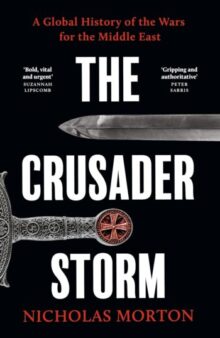
As with his previous, The Mongol Storm, with his research into The Crusader Storm, Nicholas Morton confirms his status as a skilful researcher and analyst of the continually contested region which we loosely define as the Middle or Near East. His sub-title – ‘A Global History of the Wars for the Middle East’ – guides us to expect that there will be a strong emphasis on military conflict.
In our modern times its political instability and religious rivalries are plain to observe. What Nicholas does is to address the roots of these two areas of human conflict and competition as they demonstrated themselves in the twelfth century. Supported by excellent sketch maps, as a result of his detailed analysis and interpretation, we can understand the complexity of the competitive atmosphere that prevailed in the twelfth century, elements of which still affect the modern political and religious situation.
The twelfth century closes with Saladin as the dominant military and political figure but the background that Nicholas unravels for us is very revealing, much as modern studies of the region do for us.
Alongside the traditional religious, military and political rivalries, we can see how some of the complexity arises from economic factors: not so much because of any particular economic attraction in the region but because of its location. The movement of Crusader troops and their war machine was facilitated by Venetian, Genoese and Pisan business communities who readily provided their vessels to support the Crusader war effort. The European commercial interest in exotic items, such as silk from China and precious stones from India and Sri Lanka, in the Far East was already well-developed. These business interests wanted to ensure that their trade would grow, with a European presence on the Mediterranean littoral. Without the Italian fleets, the Crusades might never have succeeded.
Equally Nicholas also reveals that the relations between the various Crusader states was not as cohesive as we might have expected because the particular religious affiliations of the settlers created rivalry and suspicion between the various elements, affected by whether they were of eastern Orthodox or western Catholic origin. This meant that sometimes the relationship between some Islamic and some Christian inhabitants was stronger than might have been anticipated. The situation was also complicated by the status of Jerusalem because the Islamic and Christian residents, in their hearts, also respected that they all shared an Abrahamic tradition, a sense that they also shared with a flow of Jewish settlers.
The difference of emphasis within Islam, as evidenced today, was also apparent. What would become Sunni, in the west in Turkey and Egypt, and Shia in Persia, was already evident, with the extra complication that some of the Islamic faithful also brought elements of their previous faiths in the East, with shamanist features. The situation meant that this was not as coherent a religious grouping as might have been perceived in the West.
The outcome of this era was a patchwork of religious and political alliances and allegiances, which led to future uncertainty after Saladin’s time, very much the era when the forces of Genghis Khan began to appear. What we appreciate from Nicholas Morton is a sense of the turbulence that existed then, intensified by the importance of Jerusalem. This should be recommended reading for any politician planning to intervene in this region in our times!
Trevor James was the editor of The Historian from 2006 to 2019.